Exchange Ranking
 Top Exchanges
 24h Volume Ranking
 Popularity Ranking
 Exchange BTC Balance
 Proof of Reserves
 Decentralized Exchanges
 Funding Rate
 Funding Heatmap
 Liquidation Data
 Max Pain
 Long/Short Ratio
 Whale L/S Ratio
 Binance/Okex/Huobi L/S
 Bitfinex Margin L/S
 ETF Tracker
 Solana ETF
 XRP ETF
 Hong Kong ETF
 Bitcoin Treasuries
 Crypto Reversal
 Ethereum Reserves
 HyperLiquid Wallet Analysis
 Hyperliquid Whale Watch
 Large Transactions
 On-chain Movement
 Bitcoin ROI
 Stablecoin Market Cap
 Options Analysis
 News
News Articles
 Economic Calendar
 Features
 Wallet
 Contract Calculator


 Security
 Collections
 Watchlist
 Following
 BTC
BTC Bitcoin is difficult to stand firm above US$80,000. Analysts say it requires new demand to enter the market.
Bitcoin is difficult to stand firm above US$80,000. Analysts pointed out that if the rally is to continue, new demand is needed to enter the market. The target of $88,000 to $90,000 is still under discussion, but the $75,000 to $76,000 area is now more critical. Although Bitcoin retested $80,000, it failed to remain above this level. With the intraday correction of BTC, the focus of the market is no longer just on trying to break through new highs, but on the intensity of demand that supports the current rising market.
According to XWIN Japan analysis, when Bitcoin fluctuates around US$80,000, one of the biggest obstacles it faces comes from profit-taking. As prices rise, more and more investors enter profit bands, increasing their willingness to sell.
Why is it difficult for Bitcoin to exceed US$80,000?
XWIN Japan data shows that almost all people investing in Bitcoin have returned to profitable status. The unrealized profit indicator for long-term investors was 21.1 and for short-term investors it was 13.4. For investors who have held Bitcoin for 1 day to 1 month, the indicator is 13.9; for investors who have recently bought, it is 5.3. This chart shows that as prices rise, more investors have reasons to sell.
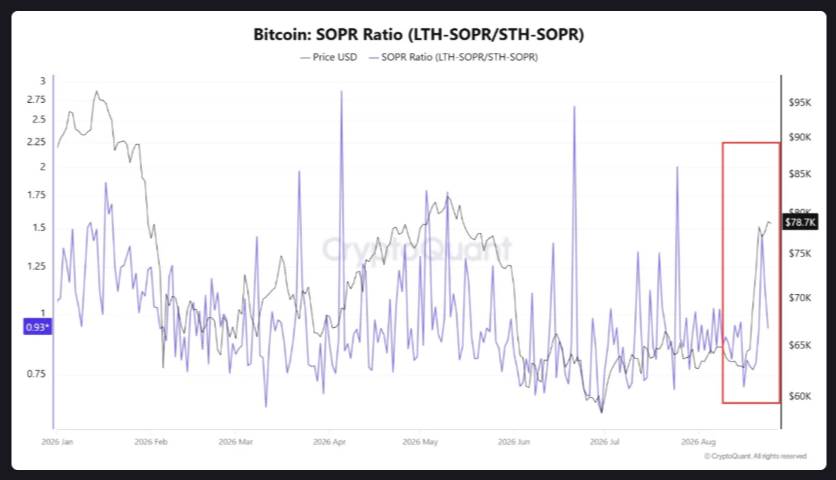
XWIN also points to a metric called SOPR Ratio, which compares profit-taking by long-term and short-term investors. When Bitcoin approached $80,000, the ratio briefly rose to 1.4, indicating that long-term investors were more active in profit-taking. The ratio then fell back to 0.93, and short-term investors once again outperformed long-term investors.
How can Bitcoin reach US$90,000?
According to XWIN Japan, it is not enough for Bitcoin to continue to exceed US$80,000. In addition, increased demand in ETFs and spot markets is needed. If new buyers can absorb the selling from existing investors, BTC is expected to move into the US$88,000 to US$90,000 area. The key point is not that the price briefly exceeded $80,000, but whether new demand can absorb the bitcoin released into the market by profitable investors. As a result, the move of $90,000 depends more on changes in the balance between demand and selling pressure than on purely price targets.
Why is $75,000 to $76,000 so important to Bitcoin?
If the trend goes in the opposite direction, XWIN's focus is US$75,000 to US$76,000. If Bitcoin continues to fall below this range, short-term investors 'profit margins may narrow, triggering a new round of selling and accelerating the correction. Therefore, in the current price structure, two areas are particularly prominent: US$88,000 to US$90,000 is the upside target, and US$75,000 to 76,000 is the risk area.
Why did Bitcoin's rally weaken?
CryptoQuant analyst BorisD agrees that the rising market has lost momentum at high levels. Binance's volume Delta indicator showed that when Bitcoin rose from $63,000 to $70,000, it reached $1.17 billion; when the price approached $80,000, it fell back to about $350 million. Similar, more subdued data emerged on other major exchanges. BorisD pointed out that the market may go through a period of consolidation before attempting a new round of breakthroughs. In other words, Bitcoin's hovering around $80,000 may not mean the end of the rally, but rather that the market is gathering strength for the next direction. This judgment is also consistent with the flattening of prices after last week's strong rise.
What factors triggered Bitcoin's rise?
Bitcoin traded below US$65,000 on August 19, but rose to more than US$81,000 within a few days. The main factors driving this trend include: the U.S. Treasury Department's plan to increase the size of long-term treasury bonds, a rebound in demand for spot bitcoin ETFs, and the liquidation of short positions of more than $4 billion. The U.S. Treasury has increased the size of long-term Treasury bond repurchases in each operation from $2 billion to at least $4 billion. During the same period, the U.S. spot Bitcoin ETF recorded a net inflow of approximately US$2 billion in five trading days. The rapid liquidation of leveraged short positions also further amplifies price fluctuations.
The current price of Bitcoin is about US$79,000. Despite a 2% decline in the past 24 hours, the increase has still reached 23% in the past seven days and a 21% increase in the past month. Despite the strong weekly performance, BTC is still about 37% below its all-time high of more than $126,000 set in October last year.
The core question that determines Bitcoin's next move remains unchanged: Should we break through $80,000 again, or test the support level of $75,000 to $76,000? If new demand can absorb profit-selling pressure, the US$88,000 to US$90,000 market is expected to strengthen; otherwise, the market may first find a balance at a lower level.
The content of this article is based on general market data and does not constitute investment advice. It is recommended that you study on your own.