Exchange Ranking
 Top Exchanges
 24h Volume Ranking
 Popularity Ranking
 Exchange BTC Balance
 Proof of Reserves
 Decentralized Exchanges
 Funding Rate
 Funding Heatmap
 Liquidation Data
 Max Pain
 Long/Short Ratio
 Whale L/S Ratio
 Binance/Okex/Huobi L/S
 Bitfinex Margin L/S
 ETF Tracker
 Solana ETF
 XRP ETF
 Hong Kong ETF
 Bitcoin Treasuries
 Crypto Reversal
 Ethereum Reserves
 HyperLiquid Wallet Analysis
 Hyperliquid Whale Watch
 Large Transactions
 On-chain Movement
 Bitcoin ROI
 Stablecoin Market Cap
 Options Analysis
 News
News Articles
 Economic Calendar
 Features
 Wallet
 Contract Calculator


 Security
 Collections
 Watchlist
 Following
 ETH
ETH Ethereum reaches US$20,000 in 2030: Predictive analysis of three AI models
When Ethereum is currently trading at close to US$2470, claiming that it can reach US$20,000 by 2030 seems ambitious. This target means prices need to rise more than eight-fold from current levels, pushing the market value of Ethereum to nearly approximately $2.4 trillion.
Ethereum has achieved huge gains before, so it is not easy to completely deny this goal. The problem is that ETH has now grown significantly in size and has not been smooth since its all-time high in 2025.
This raises an interesting question: What will it take to happen in the next 4 years to get the Ethereum price to reach $20,000? We raised this question with Gemini, Claude and DeepSeek. All three AI models believe that $20,000 is possible, although their expectations for the probability of realization differ significantly. Their reasoning also reveals why institutional adoption of Ethereum, tokenization of real-world assets, ETF demand, and network economics may become critical before 2030.
Ethereum prices still have a long way to recover before hitting US$20,000
Ethereum's recent history provides a useful background, as ETH has gone through multiple very different market cycles since 2024.
For most of 2024, ETH will remain above US$2000 and have made multiple attempts to move towards US$4000. But these attempts failed to produce a lasting breakthrough, and Ethereum eventually closed at about $3332 at the end of the year.
The situation will change significantly in 2025. Ethereum climbed from the $2500 range and reached an all-time high of $4956 on August 24. Profits were subsequently taken, and ETH closed close close to $2968 in 2025.
Ethereum will face greater pressure in 2026. ETH fell from above $3300 in January to $1824 on February 5. Another subsequent decline pushed the price to $1566 on June 25.
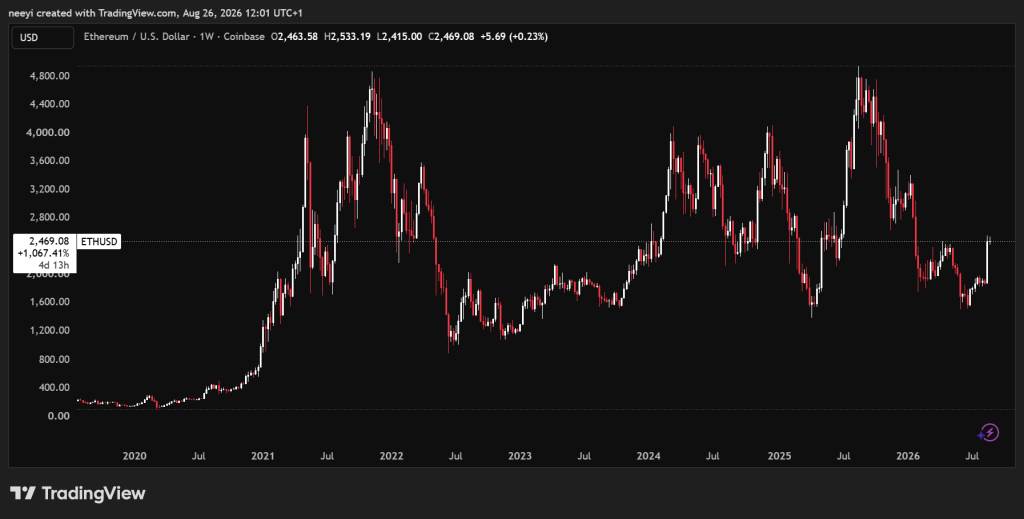
The rebound since that low has brought Ethereum back to about $2470. However, the next important resistance area remains between $2545 and $2800. ETH needs to break through that area to turn the rally since its June low into a stronger trend.
Support levels between $2200 and $2400 are equally important. If you lose this area, it may once again expose a deeper range of $1550 to $1800.
This recent history makes the $20,000 discussion even more interesting. Ethereum is not starting from a major breakthrough, but is still trying to recover from a decline of about 68% from its 2025 high.
Can Ethereum really reach US$20,000 by 2030?
The mathematical logic behind $20,000 ETH explains why this goal is far beyond the reach of ordinary market recovery.
Ethereum's supply is approximately 120 million ETH. As a result, a price of $20,000 would generate a market value of approximately $2.4 trillion. This valuation will put Ethereum on a par with some of the world's largest listed companies.
Such valuations will likely require Ethereum to establish closer connections with mainstream finance.
Tokenization of real-world assets provides a possible path. Analysts such as Tom Lee and Arthur Hayes have discussed extremely bullish Ethereum scenarios, which rely in part on the relocation of traditional financial assets to blockchain networks. Treasury bonds, stocks, real estate, funds and other assets represent markets worth trillions of dollars.
Ethereum does not require all tokenized assets to run on its network, but a larger share of the market could create stronger demand for Ethereum infrastructure.
Another factor comes from EIP 1559. Ethereum destroys some of the transaction fees paid on the network. Therefore, under certain conditions, higher network usage can reduce ETH supply.
The problem is that layer-2 networks reduce the fees users pay directly on the Ethereum main network. This weakens the simple argument that "increased activity in the Ethereum ecosystem automatically leads to greater ETH destruction."
Therefore, the US$20,000 target depends on multiple conditions developing simultaneously:
Ethereum needs to generate stronger institutional demand through ETFs, corporate treasuries or other large investors.
Tokenized real-world assets require massive migration to public blockchains.
Ethereum needs to maintain its dominant share of DeFi, RWA and institutional blockchain activities.
Network growth needs to create stronger economic value for ETH itself.
The main disagreement between Gemini, Claude and DeepSeek is the likelihood of these conditions being achieved before 2030.
Gemini: The probability of Ethereum reaching US$20,000 is 15% to 25%
Gemini gives the clearest probability range of the three models. Its answer is: Yes, Ethereum could reach $20,000 by 2030, although it classified the result as an "extremely bullish scenario" rather than a major expectation.
Gemini sets the probability at approximately 15% to 25%.
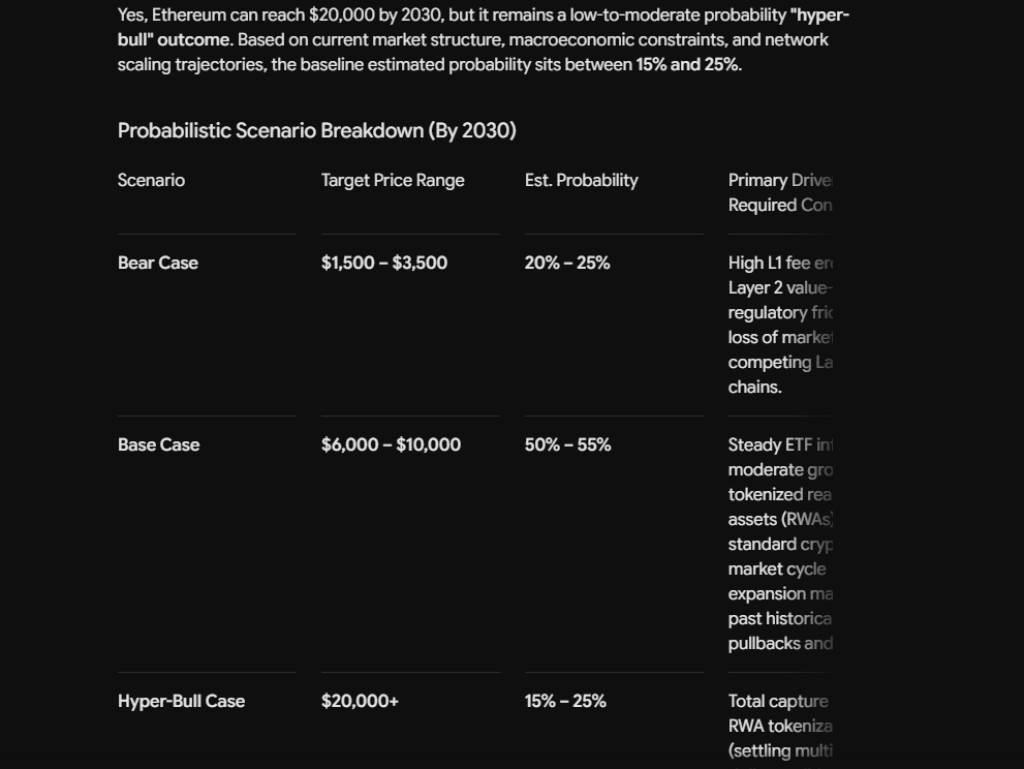
The benchmark scenario is much lower. The model predicts that if ETF demand continues and tokenized real-world assets expand at a moderate rate, the more likely price range for Ethereum is $6000 to $10,000.
Gemini's $20,000 scenario relies heavily on Ethereum as an important infrastructure for tokenized finance. The model argues that Ethereum requires extensive institutional adoption, huge RWA activity, and greater supply reduction through EIP 1559.
Based on the supply of approximately 120 million ETH units, the market value of US$20,000 Ethereum will be close to US$2.4 trillion. Therefore, Gemini believes that this goal will only be achieved if Ethereum's growth far exceeds its current role in the cryptocurrency space.
Gemini Ethereum Price Forecast Summary:
Scenario| 2030 ETH prices| estimated probability| What needs to happen
Bear scenario| $1500 to $3,500| 20% to 25%| L1 Economic weakness, regulatory pressure, loss of market share
Benchmark scenario| $6000 to $10,000| 50% to 55%| Continued ETF demand and moderate RWA growth
Extreme bullish scenario| More than US$20,000| 15% to 25%| Large-scale tokenization, institutional adoption, and more powerful ETH destruction
Therefore, Gemini is positive about the possibility, but does not view $20,000 as the most likely outcome.
Claude: The probability of Ethereum reaching US$20,000 is low, ranging from 8% to 15%
Claude is more cautious than Gemini, setting the probability of Ethereum reaching US$20,000 at approximately 8% to 15%.
Its reasoning starts with the Ethereum price itself.
ETH needs to rise about 8 times from $2470. Such an increase is not unprecedented for Ethereum. ETH has achieved greater returns in previous cycles, including expansion between 2020 and 2021.
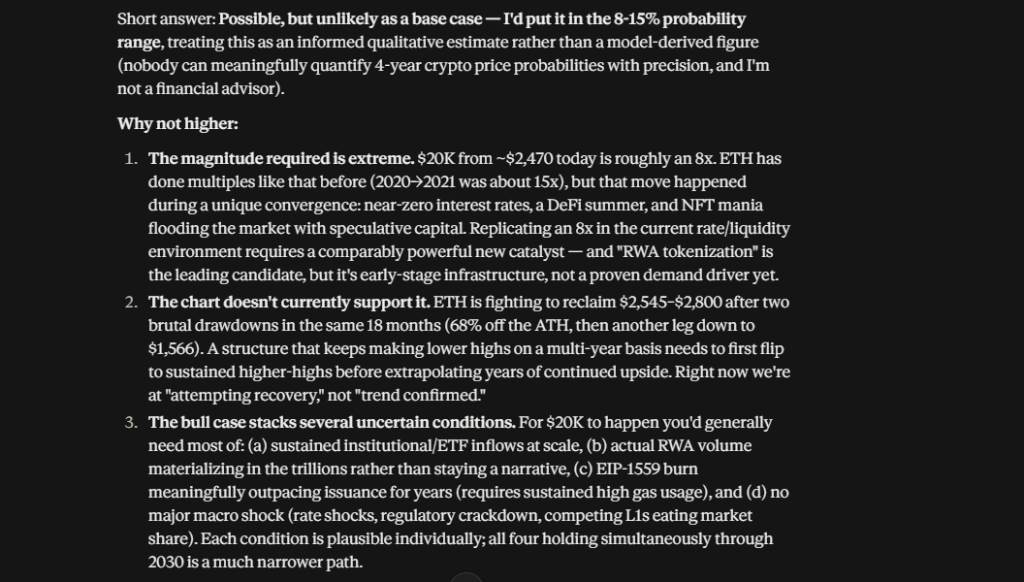
However, starting conditions are different today. Ethereum first needs to break through resistance between $2545 and $2800 and build a stronger and higher price sequence. As a result, Claude views the current trend as a rebound from a cyclical low of $1566 rather than a confirmation that another major expansion has begun.
Claude believes that if Ethereum adoption continues without another extreme cryptocurrency market cycle, its more likely 2030 range is around $3000 to $8000.
Before Claude's $20,000 scenario becomes a reality, several conditions need to be met at the same time:
Inflows of spot Ethereum ETFs need to remain strong for several years.
Real-world asset activity needs to grow to trillions of dollars rather than staying in the smaller cryptocurrency space.
EIP 1559 destruction needs have become economically important again.
Ethereum needs to defend its position relative to Solana and other Layer 1 competitors.
Claude did not deny the possibility of $20,000 because Ethereum's historical volatility suggests that an eight-fold increase in a few years can occur. However, the model believes that the realization path is much narrower than Gemini believes.
Scenario| Claude's View
More Likely 2030 Range| $3000 to $8000
probability of reaching $20,000| 8% to 15%
required increase from $2,470| About 8 times
main bullish drivers| ETF inflows, RWA adoption, stronger ETH destruction, institutional demand
Key risks| Weak technical structure, macro pressures, competition, and reduced main-network fee activity
Therefore, Claude believes that Ethereum has a real chance of reaching US$20,000, but he views this result as a close tail scenario rather than a core forecast.
DeepSeek: Institutional tokenization may push Ethereum towards $20,000
DeepSeek also believes Ethereum can reach $20,000, although it does not present this goal as the most likely outcome.
Its arguments are highly focused on Ethereum becoming a settlement network for tokenized financial assets. DeepSeek believes that large-scale institutional adoption and tokenization of real-world assets are core requirements to move towards $20,000.

This argument has also appeared in the forecasts of major analysts and financial institutions. Tom Lee has discussed Ethereum's goal of $20,000 or higher based on factors such as the growth of tokenized finance. DeepSeek also cited bullish agency forecasts from Standard Chartered Bank and VanEck as examples of how high Ethereum's valuation could reach with a significant expansion in adoption.
DeepSeek also points to an important weakness in bullish arguments.
Ethereum's EIP 1559 mechanism once supported the strong deflation argument because higher transaction fees meant more ETH could be destroyed. But the adoption of second-tier networks has significantly reduced main-network fees, which means ecosystem growth will not necessarily pull ETH out of circulation at the rate assumed by some early bullish models.
Competition also poses another obstacle. Networks such as Solana and Avalanche are also vying for DeFi users, applications, institutional projects and tokenized assets.
Therefore, DeepSeek believes that $20,000 is a reasonable bullish scenario rather than a benchmark scenario. Ethereum needs to lead institutional tokenization, create stronger value for ETH through online activities, and attract enough capital to support trillions of dollars in valuations.
Question| DeepSeek's View
Can ETH reach US$20,000? | Yes, technically feasible
Is $20,000 a benchmark scenario? | No
Exact probability|
Key drivers not provided| Market value required for institutional adoption and RWA tokenization
| Approximately US$2.4 trillion
The biggest risk| Weak ETH destruction, L2 value capture, competitive Layer 1 networks
As a result, DeepSeek is bullish on Ethereum's long-term potential, but its reasoning relies on Ethereum becoming a more important player in the global financial infrastructure.
Gemini is the most bullish among the three AI models for Ethereum reaching US$20,000.
Compare the three predictions side by side to make it easier to see the differences.
AI Model| Can ETH reach US$20,000? | Key 2030 expectations| $20,000 probability| Main reasons
Gemini| is| Baseline scenario US$6000 to US$10,000| 15% to 25%| Institutional adoption and RWA expansion
Claude| is| More likely $3000 to $8,000| 8% to 15%| Historically feasible, but current structure remains weak
DeepSeek| is| Exact baseline interval not provided| not provided| Tokenization may make Ethereum a financial infrastructure
Based on the probability estimates provided, Gemini is the most bullish. Its upper limit estimates give a 25% probability that Ethereum will reach US$20,000 by 2030.
Claude is much more conservative, with a probability of 8% to 15%. DeepSeek agreed that $20,000 was possible, but did not give an exact probability.
What's interesting is the consensus point among the three models: None of them believe that $20,000 is a simple continuation of Ethereum's current recovery.
Frequently Asked Questions
How much will an Ethereum cost in 2030?
There is no single consensus on Ethereum (ETH) prices in 2030. However, major institutions generally forecast its value to be between US$8000 and US$22,000, with aggressive bullish scenarios reaching US$40,000 to US$154,000, and conservative estimates at around US$3000 to 5000. Because the cryptocurrency market is highly speculative and volatile, these long-term forecasts can vary significantly depending on analytical models, institutional adoption rates, and network traffic.
Can Ethereum catch up with Bitcoin?
Whether Ethereum can catch up with Bitcoin in total market capitalisation-a hypothetical event known in the crypto community as a "rollover"-remains hotly debated. Although Ethereum has greater functional practicality through smart contracts and pledge proceeds, Bitcoin still maintains a huge lead as the leading means of storing digital value.