Exchange Ranking
 Top Exchanges
 24h Volume Ranking
 Popularity Ranking
 Exchange BTC Balance
 Proof of Reserves
 Decentralized Exchanges
 Funding Rate
 Funding Heatmap
 Liquidation Data
 Max Pain
 Long/Short Ratio
 Whale L/S Ratio
 Binance/Okex/Huobi L/S
 Bitfinex Margin L/S
 ETF Tracker
 Solana ETF
 XRP ETF
 Hong Kong ETF
 Bitcoin Treasuries
 Crypto Reversal
 Ethereum Reserves
 HyperLiquid Wallet Analysis
 Hyperliquid Whale Watch
 Large Transactions
 On-chain Movement
 Bitcoin ROI
 Stablecoin Market Cap
 Options Analysis
 News
News Articles
 Economic Calendar
 Features
 Wallet
 Contract Calculator


 Security
 Collections
 Watchlist
 Following
 INJ
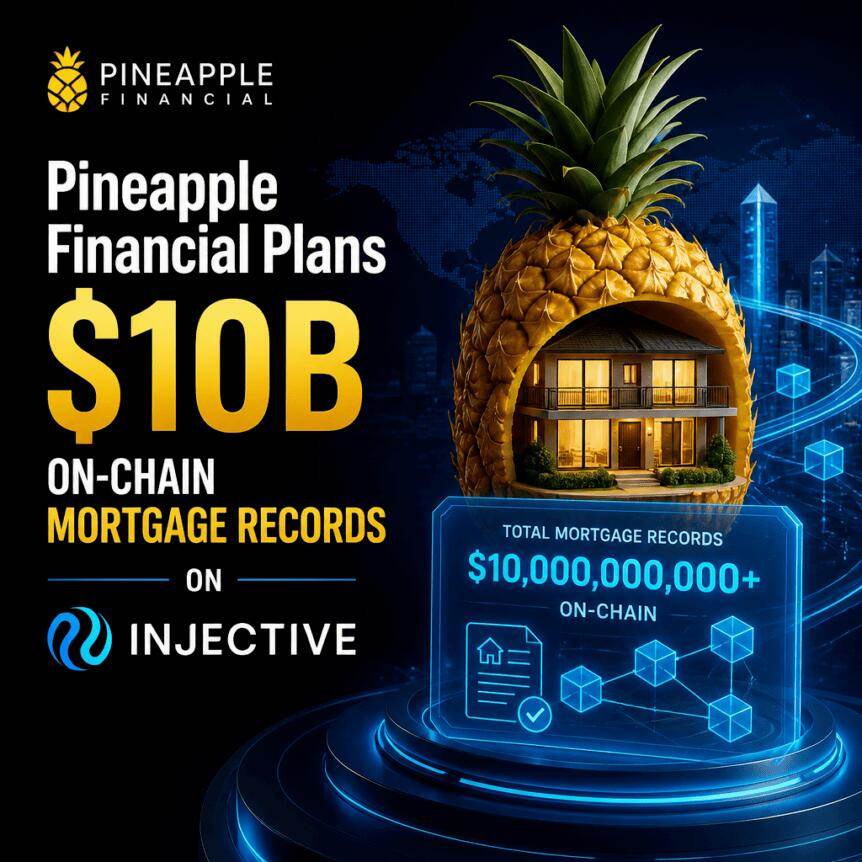
INJ Pineapple Financial moved more than US$1 billion in residential mortgage records to Injective, marking an important step in large-scale asset listing.
Pineapple Financial announced that it has successfully migrated more than US$1 billion in residential mortgage records to the Injective network. The move marks a key step in the company's strategy to move most of its funded loan portfolio online. Effective said Friday that Pineapple Financial ultimately expects to bring more than 29,000 funded mortgages worth more than $10 billion to the network.
This approach aims to keep each mortgage loan linked to its underlying loan documents through on-chain records, rather than repackaging the loan into new mortgage securities. This architectural design helps maintain the integrity and transparency of the data structure.
Core Points
- Mass migration launches: Pineapple Financial reported that it has migrated more than US$1 billion in mortgage records to Injective as part of its existing portfolio migration.
- Long-term goals are ambitious: Injective points out that Pineapple Financial plans to connect more than 29,000 funded mortgages worth more than $10 billion to the network.
- Data granularity is fine: Each mortgage is represented by an on-chain record containing more than 500 data points to support verification, audit trails, and risk analysis.
- The nature of the token is clear: Token Terminal data shows that the market value of PAPL0 assets is approximately $1.1 billion, which reflects mortgage record tokens rather than direct ownership of underlying loans.
How Pineapple Financial tokenizes mortgages on Injective
Injective's update positions this migration as a way to digitize and manipulate mortgage data on a Layer-1 network built specifically for financial applications. According to the company, Pineapple Financial's on-chain records are linked to underlying loan documents, aiming to avoid creating new mortgage instruments in the process.
Each mortgage record contains more than 500 data points. Effective describes the dataset as intended for verification and audit workflows, as well as risk analysis that relies on fine-grained loan level information in a consistent format.
According to Pineapple Financial's own dashboard cited by Injective, the initiative has expanded since its launch in December 2025. The current migration includes 2,079 mortgage records, a significant increase from 1,259 when the project was launched.
The meaning of PAPL0 and the importance of its structure
Token Terminal tracks PAPL0 as an asset related to mortgage records on Injective. Data cited in the announcement showed that, according to Token Terminal, the asset market value of PAPL0 is approximately US$1.1 billion, up 48.2% in the past nine months.
The key is that Token Terminal's project framework (as described in the original materials) states that the tokens are intended to represent mortgage records, not ownership of the underlying loan itself. This distinction is critical for investors and counterparties trying to understand what is actually transferred or cited when token balances change-especially in real-world asset (RWA) systems, where legal ownership, service rights, and data integrity may not always map perfectly with the token mechanism.
This record-based model may also affect the way due diligence is performed for market participants evaluating RWAs. On-chain records are positioned as a structured data layer, potentially improving traceability and audit readiness, rather than relying on tokens as agents for the entire legal construct.
Pineapple Financial's broader connection with Inject and the on-chain treasury
The migration of mortgage records is part of the broader relationship between Pineapple Financial and Inject. The information also pointed out that there is an independent digital asset vault related to the Injective native token INJ, and Pineapple Financial is described as an Injective vault with US$100 million.
As part of this setup, Pineapple Financial pledged INJ from the treasury. Kraken was designated as the primary verifier, linking this arrangement to the established institutional infrastructure used to verify network activities.
Real estate tokenization continues, but remains small
The move is part of a general trend to bring real estate and other traditional illiquid assets into blockchain. Tokenization is often promoted as a way to divide interests, improve transferability and expand access rights-but the speed of adoption varies depending on asset type and jurisdiction.
Earlier this year, several major financial institutions attracted attention for their association with tokenized real estate fund structures. In June, Apex Group joined other companies such as Goldman Sachs, Archax and LRC Group to participate in a tokenized real estate fund effort, in which fund shares are issued as digital tokens through Goldman Sachs 'digital asset platform. In this structure, blockchain-based ownership is used for the fund shares themselves, rather than just recording property-related information on the chain.
Dubai has also expanded its tokenized real estate initiative. The report mentioned that in February, the Dubai Land Authority launched the second phase of the pilot after approximately US$5 million in property was tokenized, and transactions were recorded on the XRPL ledger.
Still, despite the frequent appearance of announcements, tokenized real estate appears to represent only a small portion of the overall RWA ecosystem. Data cited in the source shows that the division has approximately $226.5 million in distributed value, an increase of 11.7% in the past 30 days. This contrasts with the approximately US$38.8 billion in tokenized RWA tracked by RWA.xyz.
Focus on Future Observation
As Pineapple Financial increases the number of mortgage records on the chain, and Injective aims to expand to more than 29,000 mortgages worth more than $10 billion, the key question in the next stage is how to represent this record-based model in practice-particularly in terms of verification workflows, audits, and how market participants interpret the relationship between tokenized records and legal rights attached to underlying loans.