Exchange Ranking
 Top Exchanges
 24h Volume Ranking
 Popularity Ranking
 Exchange BTC Balance
 Proof of Reserves
 Decentralized Exchanges
 Funding Rate
 Funding Heatmap
 Liquidation Data
 Max Pain
 Long/Short Ratio
 Whale L/S Ratio
 Binance/Okex/Huobi L/S
 Bitfinex Margin L/S
 ETF Tracker
 Solana ETF
 XRP ETF
 Hong Kong ETF
 Bitcoin Treasuries
 Crypto Reversal
 Ethereum Reserves
 HyperLiquid Wallet Analysis
 Hyperliquid Whale Watch
 Large Transactions
 On-chain Movement
 Bitcoin ROI
 Stablecoin Market Cap
 Options Analysis
 News
News Articles
 Economic Calendar
 Features
 Wallet
 Contract Calculator


 Security
 Collections
 Watchlist
 Following
 BTC
BTC Local law enforcement relented, but prosecutors stayed tough
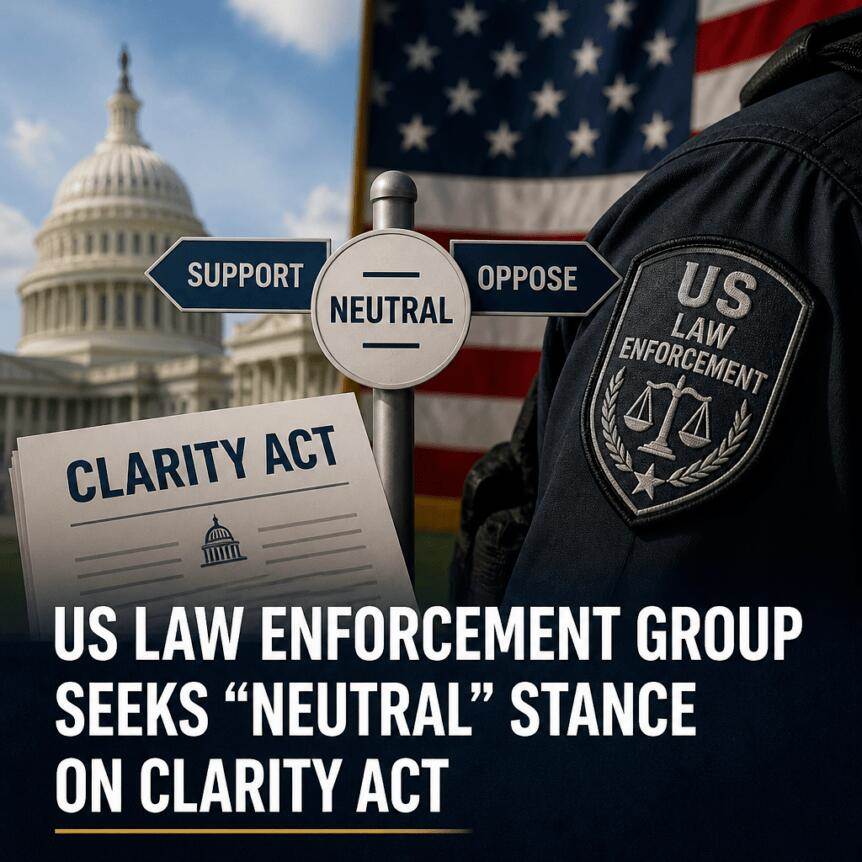
The National Sheriff's Association (NSA) shifted to neutrality on the Digital Asset Market Clarification Act, becoming the last major police organization to abandon its active opposition to cryptocurrency market structure legislation. The association announced the shift in a letter to Senate leadership, citing the complexity of the bill and the large number of important details that still need to be reviewed.
Previously, the association warned that the legislation could exempt crypto-mixers, turbulent platforms and decentralized financial agreements from anti-money laundering regulations, which could facilitate illegal financial activities. In contrast, the U.S. Association of Major County Sheriffs shifted to a neutral stance in July this year, provided that regulatory research led by the U.S. Treasury can ensure effective participation by state and local governments.
However, federal prosecutors did not adopt the same attitude. According to reporters, the National Association of District Prosecutors (NDAA) and the Association of Assistant Federal Prosecutors are not expected to change their positions. The two groups want to narrow protections for developers who have never held user funds so prosecutors retain the power to prosecute individuals who knowingly transfer illegal funds.
The National Association of District Prosecutors stated in a letter that section 604 of the bill would "seriously hinder the ability of law enforcement agencies and prosecutors to investigate, track and prosecute criminal activities involving cryptocurrencies and other digital assets." Both the White House and the cryptocurrency industry reject these stricter restrictions.
The vote to end the debate on September 15 is imminent
The CLARITY Act will face a major procedural test on September 15, 2026. At that time, the Senate will vote on a motion to determine the likelihood of the legislation passing this year. The vote was not a direct vote on the bill itself, but under Senate rules a super majority of 60 votes is needed to move forward with the follow-up process.
The Republican Party currently holds 53 seats, which means that at least seven Democrats need to join the Republican Party to reach the required threshold of votes. Previously, the National Sheriff's Association's opposition provided political cover for key swing Democrats, including Sen. Catherine Cortez Mastow, D-Nevada, to withdraw support due to law enforcement provisions. As the stance of this leading law enforcement critic shifted, resistance eased before the September vote, but the bill's passage before the November election remains uncertain due to unresolved ethics provisions and a tight congressional schedule.
The CLARITY Act aims to establish a regulatory framework for cryptocurrencies and other digital assets, similar to the system established by the GENIUS Act of 2025 for payment stablecoins. The House of Representatives passed the bill with a vote of 294 - 134 in July 2025. However, due to differences within the Senate on ethics, reward mechanisms, decentralized finance (DeFi) and regulatory powers, the legislative process failed to advance quickly.