
 Exchange Ranking
 Top Exchanges
 24h Volume Ranking
 Popularity Ranking
 Exchange BTC Balance
 Proof of Reserves
 Decentralized Exchanges
 Funding Rate
 Funding Heatmap
 Liquidation Data
 Max Pain
 Long/Short Ratio
 Whale L/S Ratio
 Binance/Okex/Huobi L/S
 Bitfinex Margin L/S
 ETF Tracker
 Solana ETF
 XRP ETF
 Hong Kong ETF
 Bitcoin Treasuries
 Crypto Reversal
 Ethereum Reserves
 HyperLiquid Wallet Analysis
 Hyperliquid Whale Watch
 Large Transactions
 On-chain Movement
 Bitcoin ROI
 Stablecoin Market Cap
 Options Analysis
 News
News Articles
 Economic Calendar
 Features
 Wallet
 Contract Calculator


 Security
 Collections
 Watchlist
 Following
RobinhoodChain has turned tokenized stocks into building blocks for decentralized transactions, with bizarre consequences
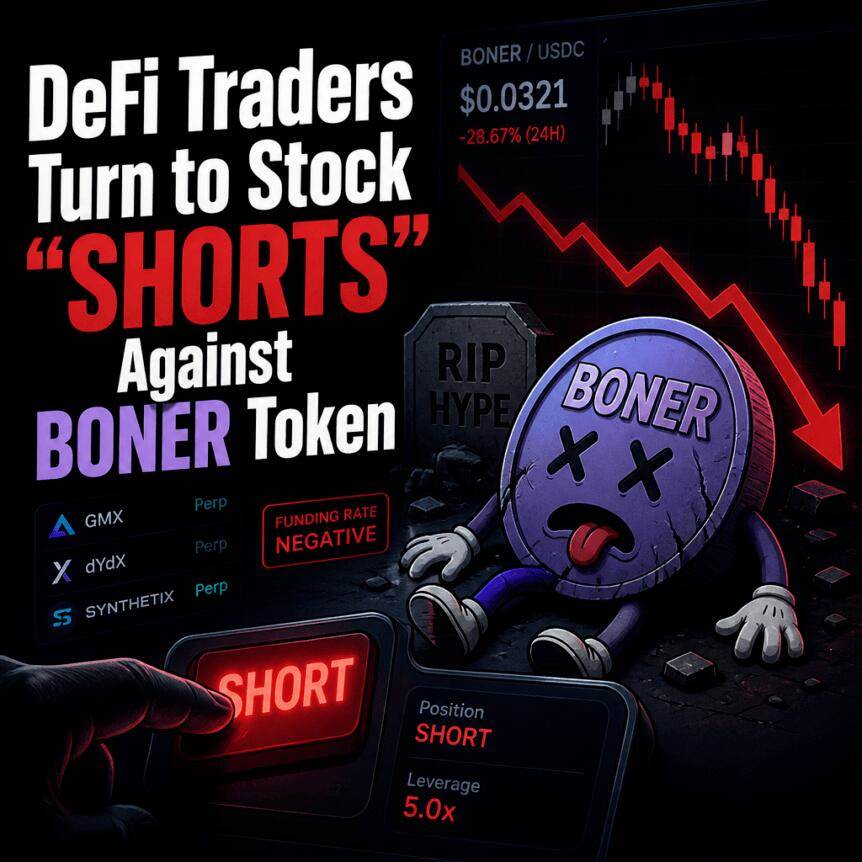
RobinhoodChain has turned tokenized stocks into a common building block for decentralized transactions-sometimes with truly puzzling consequences. The liquidity pool surrounding BONER and Hims & Hers (HIMS) tokenized medical stocks once caused on-chain token prices to deviate significantly from the New York Stock Exchange (NYSE) reference benchmark prices.
According to the original report citing The Defiant, the BONER/HIMS liquidity pool held 31,198 HIMS tokens at one point in time, more than half of the 58,714 tokenized HIMS shares in circulation. This imbalance caused the price of tokenized HIMS to soar to $132.64, while the actual closing price of HIMS shares traded on the NYSE was $28.84, based on historical pricing cited by sources.
Key Points
- The distribution of tokens in the liquidity pool may temporarily overwhelm the "reference" price of tokenized stocks, especially when reserves on the chain are thin.
- In DEX-like markets, tokenized equity can be traded like programmable assets, but price signals may be unreliable when arbitrage and issuance mechanisms are limited.
- Automated market makers (AMMs) on decentralized exchanges (DEX) make it possible to pair tokenized stocks with almost any liquid asset-whether or not the pairing is intuitively reasonable.
- Even skeptics believe that tokenized equity is a stepping stone to broader DeFi practicality, although traditional financial institutions may still dominate the price discovery process.
- Demand for liquidity in tokenized stocks has begun to arise, but it is unclear whether the on-chain market will become the main benchmark for equity.
Strange pairings are possible when stocks are linked
The core concept of the RobinhodChain Stock Token Market is simple: rather than trading tokenized stocks only in fiat currency or traditional financial instruments, users can deposit tokenized shares into a liquidity pool and trade them with other tokens. In this model, traders use pool pricing algorithms rather than order books to exchange between different assets.
It is this flexibility that makes the BONER/HIMS incident eye-catching. The Memecoin is paired with tokenized Hims & Hers shares, allowing traders to exchange between pure crypto-native tokens and on-chain representation of listed healthcare companies. The incident demonstrated how "real-world assets" behave when they become composable components within DeFi.
Thomas Probst, research analyst at Kaiko, emphasized the perspective of size and combinability: "Listed stocks effectively become a combinable DeFi asset on an unprecedented scale, just as Ether did."
The larger trend is that tokenized equity is increasingly being seen as universal liquidity-a resource that can be inserted into various on-chain strategies. In less than three months since its launch, Robinhood users have reportedly created a variety of unusual pairings, including combinations involving artificial intelligence themes and other crypto-native assets in addition to memecoin.
Why BONER/HIMS deviated from base stocks
While the idea of exchanging stock tokens for memecoins may seem meaningless, the way DeFi markets operate does not require economic "reasons" beyond the pool mechanism itself. The key difference is that on-chain markets do not automatically behave like traditional stock trading-especially when liquidity conditions are tight.
According to comments attributed to the original article, the huge gap between the share price of tokenized HIMS and the real NYSE-listed HIMS is mainly related to "weak reserves" and "temporary restrictions on issuance." This combination creates situations where the token price fluctuates violently and is out of touch with the reference asset.
Angelo Aspris, a finance scholar at the University of Sydney, warned that these conditions could "increase the likelihood of strategic exploitation or manipulation." In other words, when the on-chain market is short of resources relative to trading needs, it may not reliably reflect the real-world prices it should track.
Probst adds important nuances to arbitrage. In traditional markets, multiple participants and continuous transactions work together to keep prices aligned. In a tokenized stock AMM setup, arbitrage may rely on a small number of participants and may be disrupted when real-world markets close:
"Arbitrage here relies on individual participants rather than the mechanism of continuous competition seen in traditional stock markets. As a result, these pools may generate unreliable price signals that cannot be truly transmitted to the reference market."
This interpretation helps frame what happens in practice. When the liquidity pool is severely unbalanced-for example, holding a large amount of tokenized total liquidity-on-chain conversion prices may jump. If the arbitrage cannot quickly readjust prices, the divergence may persist long enough to become significant.
Is this a new market, or is it just AMM with stranger assets?
From the bottom line, the system is built on the familiar DEX infrastructure: automated market makers that price assets based on liquidity pools and algorithmic formulas. According to reports, the novelty lies not in the mechanism itself, but in what it can contain. In traditional stock markets, equity is traded with currency and established financial instruments. On the chain, tokenized stocks can form half of a liquidity pair with any sufficient number of other tokens.
Reid Noch of TD Securities mentioned in the original article that AMM is still "very new" compared to traditional markets. He also hinted that if tokenized stocks are mainly used to provide liquidity for memo-like transactions, it may be difficult to promote the concept to more conservative institutional participants:
"As long as they are mainly used to drive liquidity in memo-coins, it will be difficult for traditional players to take them seriously."
Similarly, another suspicion raised in the source is whether these AMM venues will become places where investors discover the "true" price of tokenized equity. The report included the idea that price discovery may occur more in traditional markets, with AMM acting as an arbitrageur to keep quotes aligned rather than becoming the dominant reference standard.
Still, the incident also highlights the practical implications for market participants: Even if price discovery remains imperfect, on-chain structures can generate real trading activity and liquidity needs for tokenized stocks-testing how well they perform when exposed to DeFi incentives and round-the-clock trading.
Future Outlook: Demand exists, reputation needs to be built
A clear message conveyed in potential comments is that tokenized equity has found utility within DeFi, even though its earliest application scenarios seem unconventional. Sergej Kunz, co-founder of 1inch, believes that opportunities are broader than the assets currently appearing on the chain, and that tokenized equity is important because they can access the open financial system. Angelo Aspris also described how programmable equity exposure ultimately works as collateral, loanable inventory, or derivative margin investments.
The BONER/HIMS example also suggests that memecoin pairing may be more about "composability" experiments than "valuation"-using aggressive, highly liquid on-chain tokens to stress test whether stock tokens can operate safely as DeFi building blocks. Kunz's view is that memin pairs may not be the main use case for tokenized equity, but they still contribute "demand, transaction volume and liquidity" to these tools.
At the same time, some important issues remain. Original reports pointed to vulnerabilities caused by weak reserves and issuance restrictions, as well as the possibility that AMM prices may not be reliably transmitted to the underlying reference market when trading conditions diverge. For readers, the key indicators of observation are clear: whether liquidity on the chain has become deeper and more stable, whether arbitrage has become more continuous rather than sporadic, and whether trading activity has moved beyond novel pairing.
If tokenized equity can resolve these frictions, on-chain markets may move beyond curiosity itself-moving from isolated experiments to a powerful infrastructure of programmable exposure to real-world assets. Currently, BONER/HIMS serves as a vivid example of how when stocks are combinable, market results can be as extraordinary as the pairing itself.

















![Top 6 altcoins in the next 100-fold crypto bull market in 2026 [CoinMarketCap Recommended]](/d/file/20260911/3c4ea3e9add411f1b20ab80d425f811e.jpg)


