Exchange Ranking
 Top Exchanges
 24h Volume Ranking
 Popularity Ranking
 Exchange BTC Balance
 Proof of Reserves
 Decentralized Exchanges
 Funding Rate
 Funding Heatmap
 Liquidation Data
 Max Pain
 Long/Short Ratio
 Whale L/S Ratio
 Binance/Okex/Huobi L/S
 Bitfinex Margin L/S
 ETF Tracker
 Solana ETF
 XRP ETF
 Hong Kong ETF
 Bitcoin Treasuries
 Crypto Reversal
 Ethereum Reserves
 HyperLiquid Wallet Analysis
 Hyperliquid Whale Watch
 Large Transactions
 On-chain Movement
 Bitcoin ROI
 Stablecoin Market Cap
 Options Analysis
 News
News Articles
 Economic Calendar
 Features
 Wallet
 Contract Calculator


 Security
 Collections
 Watchlist
 Following
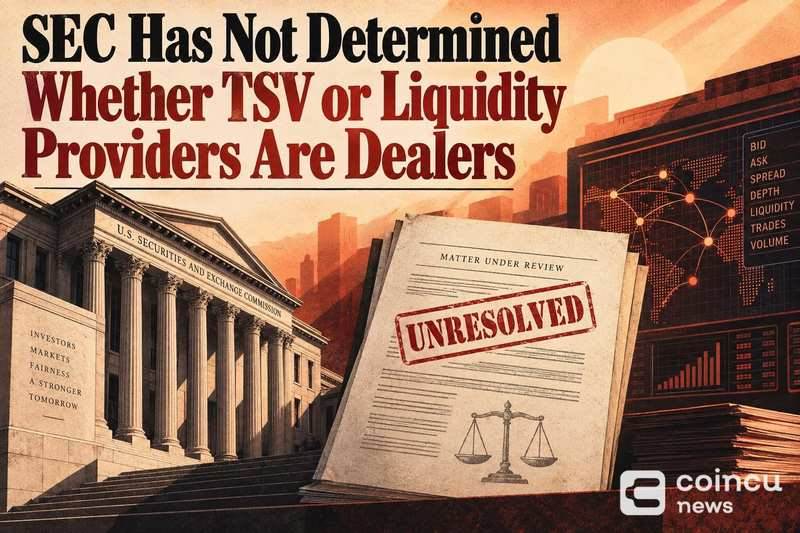
美国证券交易委员会尚未就交易平台场所(TSV)或流动性提供者是否构成交易所或交易商作出认定
美国证券交易委员会(SEC)尚未确定交易平台场所(TSV)或流动性提供者是否符合联邦证券法下“交易所”或“交易商”的定义。随着监管机构继续评估数字资产市场的结构,这一具有深远影响的分类问题仍处于悬而未决的状态。
SEC已明确与未明确的界限
由于缺乏正式的SEC认定,目前TSV运营商和流动性提供者在美证券法中最相关的两个分类——即“交易所”和“交易商”——中均未获得确定的监管地位。这两种 designation(指定/身份)是截然不同的,各自伴随着独立的注册义务、合规负担和监督框架。SEC所声明的“不予认定”本身就是一种既定状态,而非延期处理或隐含豁免。
在监管语境下,“TSV”指的是一类区别于传统交易所的交易基础设施类别。而“流动性提供者”则是作为市场参与者报价并吸收订单流的主体,其功能处于交易商活动与类似交易所的中介职能之间的边界地带。SEC并未将这些区别合并为单一结论,也未单独解决这些区别。
为何“交易所”和“交易商”标签至关重要
Under U.S. securities law, entities classified as "exchanges" must register with the SEC and comply with rules on fair access, transparency and market integrity. In contrast, a "dealer" must register as a broker-dealer and meet capital, record keeping and code of conduct requirements. Although the two regimes overlap in some areas of operation, they impose very different structured obligations. For market participants, misclassification or lack of clarity on which label to apply can pose legal risks.
For TSV operators and liquidity providers active in the digital asset market, this unresolved classification issue means that their compliance strategies remain temporary in nature. Until the SEC's position is clear, companies cannot finalize registration decisions, legal structures, or product designs with full regulatory certainty.
The SEC's innovative exemption framework for tokenized NMS stock trading demonstrates how the agency can create conditional paths in other contexts without permanently addressing the underlying classification issue. This model may affect how TSVs and the status of liquidity providers will be handled in the future.
How to evaluate TSVs and liquidity provider activities
TSV classification analysis
Classification of TSVs requires a fact-specific review of how they match orders, whether they operate as a multilateral trading facility, who controls access, and whether their functions replicate the functions of registered national stock exchanges. Because the SEC has not yet released the factual record it is evaluating, it cannot accurately describe the contours of the analysis.
Liquidity provider activity
For liquidity providers, the key to dealer classification is whether the entity is engaged in the business of buying and selling securities for its own accounts, as part of its regular business. Automated Market Makers, Request-for-Quote systems, and proprietary trading desks each present different factual characteristics that regulators must evaluate one by one. No single operating model can solve all types of liquidity providers once and for all.
Outstanding classification boundaries
As digital asset infrastructure blurs the role traditional finance assigns to different licensed entities, the boundaries between similar exchanges and the activities of similar dealers have become more controversial. The SEC's ongoing review reflects this complexity, as do related developments, such as broader market structural pressures that have prompted regulators to examine how liquidity functions in the crypto arena differ from their traditional financial analogies.
Significance of outstanding issues to market participants
Companies that operate TSVs or provide liquidity in digital asset markets should view the lack of SEC determinations as a positive risk factor rather than regulatory approval. The agency may issue guidelines, no-action letters, rulemaking proposals, or enforcement actions, each with a different impact on existing operations. Legal advisers and compliance teams need to pay close attention to changing regulatory signals ahead of major policy decisions and track any SEC employee statements, committee members 'public remarks, or formal rulemaking notices directly related to these entity types.
The next specific trigger point to focus on most is any SEC rule-making or ruling order that defines operating standards used to distinguish between exchange and dealer functions in the context of digital assets. Prior to the announcement of the designation, TSV operators and liquidity providers remained in a classified gray area with actual legal and operational risks.
Frequently Asked Questions (FAQ)
Has the SEC classified TSV as an exchange or dealer?
No. Based on current regulatory records, the SEC has not yet determined whether TSV belongs to the exchange or dealer classification. No formal rulings, orders, or employee guidance documents were found.
Has the SEC classified liquidity providers as exchanges or dealers?
No. The SEC has not issued a resolution to determine whether liquidity providers in digital asset markets qualify as exchanges or dealers. Any indications beyond this confirmed missing status require source confirmation from SEC documents or official statements.
读者接下来应关注什么?
请密切关注SEC的规则制定通知、员工公报、命名TSV或流动性提供者活动的执法行动,或描述该机构对这些实体类型分析框架的正式委员声明。此外,数字资产市场结构的国会听证会(其中SEC官员作证)也是前瞻性指引的来源。SEC在处理代币化证券交易方面的创新豁免方法,可能为在最终确定永久分类之前如何构建有条件地位框架提供先例。