Exchange Ranking
 Top Exchanges
 24h Volume Ranking
 Popularity Ranking
 Exchange BTC Balance
 Proof of Reserves
 Decentralized Exchanges
 Funding Rate
 Funding Heatmap
 Liquidation Data
 Max Pain
 Long/Short Ratio
 Whale L/S Ratio
 Binance/Okex/Huobi L/S
 Bitfinex Margin L/S
 ETF Tracker
 Solana ETF
 XRP ETF
 Hong Kong ETF
 Bitcoin Treasuries
 Crypto Reversal
 Ethereum Reserves
 HyperLiquid Wallet Analysis
 Hyperliquid Whale Watch
 Large Transactions
 On-chain Movement
 Bitcoin ROI
 Stablecoin Market Cap
 Options Analysis
 News
News Articles
 Economic Calendar
 Features
 Wallet
 Contract Calculator


 Security
 Collections
 Watchlist
 Following
 ADA
ADA  BTC
BTC  ETH
ETH  IOTA
IOTA  XLM
XLM  XMR
XMR  XRP
XRP Ripple and Stellar: The evolution of crypto financial infrastructure from 2018 ECB data
In a presentation hosted by the European Central Bank (ECB), Ripple was classified as a corporate payment settlement domain, while Stellar was associated with digital IOUs. The 2018 table divides the financial roles of major cryptocurrencies and clearly distinguishes the status of "settlement" and "digital value" in different blockchain applications. Over the years, payment settlement and digital asset issuance remain core application scenarios for Ripple and Stellar ecosystems.
Ripple: Focus on the rise of the clearing role
ALLINCRYPTO has recently attracted attention to classifications in the ECB's historical data. The post noted that Ripple was described as a corporate payment settlement network, while noting Stellar's independent classification in terms of digital IOUs. 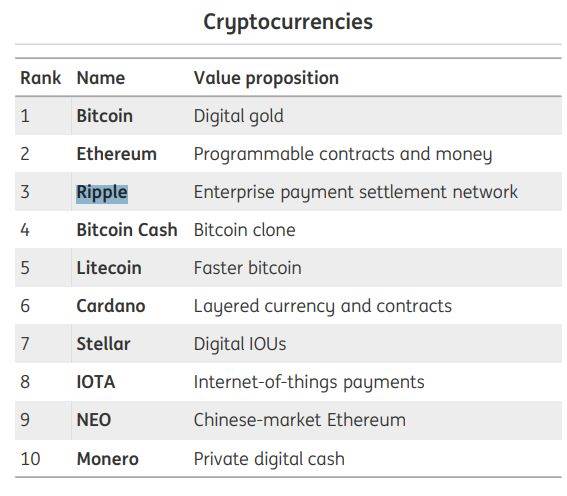
Source: X
Ripple ranks third among the cryptocurrency items listed in this table. Bitcoin ranks first and is regarded as "digital gold"; Ethereum stands for programmable contracts and currencies; and Ripple's value proposition focuses on corporate payment settlement. This classification gives Ripple a unique position in the historical framework. It does not emerge as another universal cryptocurrency that competes through currency characteristics, but rather binds its role directly to the financial settlement infrastructure.
This distinction is crucial because settlement requires specialized institutional and institutional connections. Enterprise payment systems must address issues such as transfer, liquidity, counterparty and transaction processing. As such, the table connects Ripple to a well-defined financial function.
Hengxing: Represents digital financial value
Hengxing is ranked seventh in the table, and its value proposition is listed as a "digital IOU." This description is different from Ripple's settlement-oriented classification, which refers to digitally represented claims or financial obligations.
Thetable lists Stellar coins with projects pursuing specialized financial applications. IOTA is associated with IoT payments, Monero represents private digital cash, and Cadano combines tiered currencies and contracts in another category. These classifications demonstrate how cryptocurrency research separates networks based on expected functions. These projects are not considered interchangeable systems serving the same financial purposes, and each project is given a specific description that reflects its perceived use cases.
https://cryptonewsland.com/wp-content/uploads/2026/04/EliteFXLabsBanner-0.webp
The classification of "digital IOUs" also provides the context for tokenized financial value. Digitally represented claims can support transfers, ownership records and financial instruments. This concept is in line with the broader development of blockchain-based financial infrastructure.
The Continuing Evolution of Financial Applications
The presentation hosted by the European Central Bank did not establish institutional endorsements for any network, nor did it show that the central bank uses XRP or XLM for settlement. Instead, it documents how the two projects were defined during discussions in 2018.
This distinction remains important when interpreting ALLINCRYPTO's comments. The post viewed the classifications as evidence of long-standing financial use cases. However, historical recognition does not establish subsequent adoption or future market demand.
Ripple's settlement description is consistent with its broader payment infrastructure narrative. Its ecosystem continues to emphasize cross-border payments and financial settlements. Likewise, Stellar continues to develop applications involving payments and tokenized assets.
Therefore, the value of charts lies in historical continuity rather than forecast. The classification in 2018 cannot determine how financial networks will develop in a few years. However, it can record the understanding of its intended role at the time.
This comparison also shows how institutions discuss how to separate cryptocurrency specialization. Bitcoin is digital scarcity, Ethereum is programmable finance, and Ripple is corporate clearing. Hengxing occupies another financial segment through its digital IOU classification.
This framework helps explain why the payment-focused blockchain narrative remains unique today. Settlement networks address the flow of funds between financial systems, while tokenized assets are digital representations of value. These two functions can coexist in the broader development of blockchain-based markets.