Exchange Ranking
 Top Exchanges
 24h Volume Ranking
 Popularity Ranking
 Exchange BTC Balance
 Proof of Reserves
 Decentralized Exchanges
 Funding Rate
 Funding Heatmap
 Liquidation Data
 Max Pain
 Long/Short Ratio
 Whale L/S Ratio
 Binance/Okex/Huobi L/S
 Bitfinex Margin L/S
 ETF Tracker
 Solana ETF
 XRP ETF
 Hong Kong ETF
 Bitcoin Treasuries
 Crypto Reversal
 Ethereum Reserves
 HyperLiquid Wallet Analysis
 Hyperliquid Whale Watch
 Large Transactions
 On-chain Movement
 Bitcoin ROI
 Stablecoin Market Cap
 Options Analysis
 News
News Articles
 Economic Calendar
 Features
 Wallet
 Contract Calculator


 Security
 Collections
 Watchlist
 Following
 ETH
ETH  SOL
SOL Summary of core points
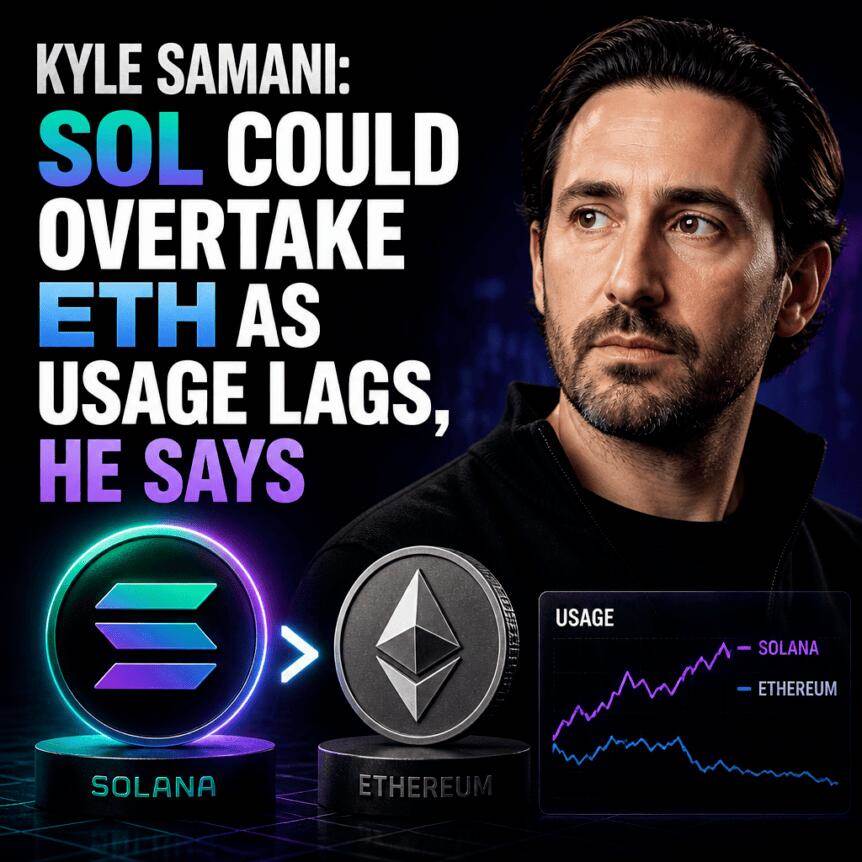
Kyle Samani predicts that more cryptocurrency companies will default to develop based on Solana rather than Ethereum, citing operational convenience and network "functionality" as main reasons. He believes that Ethereum's value capture ability is "in doubt" and points out that Ether's biggest role today is mainly related to stablecoins and mortgage lending. According to TradingView, in the past month, Ether has gained about 30%, while Solana has gained about 34%. Over a longer window of time, Solana has dropped about 59% over the past year, while Ethereum has dropped about 45%. Rate data cited from DefiLlama showed that Solana charged a higher monthly fee than Ethereum during the cited time period, further supporting Samani's arguments about operations and usage.
Why Samani thinks Solana may replace Ethereum's "default" status
In an interview with Cointelegraph's "Trade Secrets" column, Samani said he expects Solana to overtake Ether in the current market cycle. His core argument is not only about technical capabilities, but also about how companies integrate their operations on a single chain. "They will switch the default settings to Solana because it is the most functional network of any company and it will be easier to integrate operations around Solana whenever possible."
From an investor's perspective, the implications are straightforward: If Solana is the default choice for more new products, deployments, and enterprise-level releases, then the demand for Solana ecosystem resources may intensify relative to Ethereum. At the same time, Samani's framework suggests that he views network selection as a compound interest effect-once a company standardizes an environment, switching costs increase in the next round of financing, partnerships, and product iterations.
Samani's forecasts also pose valuation challenges. The report points out that to reach Ether's current market value (approximately $293 billion at the time of the cited discussion), SOL's market value needs to grow approximately fivefold, compared with approximately $58 billion in the basic comparison.
Criticism of Ethereum's ability to capture value
In addition to his preference for Solana, Samani is strongly skeptical of Ethereum's ability to capture and maintain economic value for token holders. He describes Ethereum as a large smart contract network, but its asset value capture appears to him to be vague or limited. "This is an asset worth hundreds of billions of dollars with questionable or possibly non-existent value capture capabilities and it has not grown at all."
Samani believes investors may not find Ether's valuation attractive compared to other opportunities offered at what he calls a "more reasonable price." He also suggested that Ethereum's continued relevance stems mainly from stablecoins and stablecoins or capital strategies that use Ether as collateral-rather than from broader organic adoption that he believes will drive stronger capture mechanisms.
值得注意的是,报告中将这一批评与他关于公司将转向 Solana 的预测结合在一起。如果投资者接受“使用”和“运营便利性”比抽象的平台地位更能驱动产品生态系统的假设,那么 Ethereum 的角色可能会从默认的构建环境转变为更专业的结算和流动性基础——至少对于某些类别的新部署而言是这样。
近期市场和费率数据揭示了什么
Cointelegraph 的报告将 Samani 的理论表现与链上活动指标联系起来。在最近的市场反弹中,ETH 和 SOL 都以相似的百分比区间走高,但在所引用的窗口期内,Solana 的表现略强:据 TradingView 称,Ether 在过去一个月上涨约 30%,而 Solana 上涨约 34%。
当讨论从短期反弹转向之前的低迷期时,比较变得更加微妙。Cointelegraph 引用的 TradingView 数据显示,SOL 在过去一年下跌约 59%,而 ETH 下跌约 45%。换句话说,Solana 经历了更大的相对损失和稍强的近期收益——这种不对称性对于评估风险、回撤容忍度以及“均值回归”与新体制可能性的交易者来说至关重要。
费率为我们提供了另一个视角。报告指出,虽然 SOL 代表的市值不到 Ethereum 的五分之一,但 Solana 在周费和月费方面已超过 Ethereum。根据文章中引用的 DefiLlama 费率排名,Solana 在过去 30 天内产生了 2300 万美元的费用,在月度费用中排名第四,而 Ethereum 产生了 1260 万美元的费用,排名第六。
对于开发者和投资者来说,费用生成可以从多个角度解读。它可能标志着对区块空间和链上执行的需求增加,但也可能反映应用程序组合的变化或由波动性驱动的使用情况。尽管如此,在 Samani 更广泛的论点——“功能性”和运营整合——中,更高的费率吞吐量被呈现为证据,表明 Solana 即使在与 Ethereum 规模竞争时,也能提供可衡量的经济活动。
Samani 立场的转变及其对 Solana 的持续押注
文章还回顾了 Samani 过去几年与加密货币行业的关系。今年二月,他表示辞去 Multicoin Capital 管理合伙人的职务,结束了他在该行业十年的职业生涯,称这是一个“苦乐参半的时刻”。报告指出,当时他对加密货币的整体方向感到沮丧,并短暂删除了一条 X 帖子,他在其中表示不再相信 web3 愿景,认为加密货币不如许多狂热爱好者预期的那样有趣。
但同一份报告表明,他的前景并未转化为退出。九月,Samani 加入了加密交易平台 Backpack 的美国董事会,这表明他仍然参与行业的运营层面,而不是完全退出。
具体到 Solana,报告将其定位为长期押注。据 Cointelegraph 在该文中引用,Samani 表示他于 2016 年通过 Ethereum 进入加密货币领域,后来对 Ethereum 开发者解决扩展问题的方式感到不满。他在 2017 年 5 月创立 Multicoin 后不久遇到了 Solana,Multicoin 随后主导了 Solana 在 2018 年的早期投资轮次。
报告的语境中也提到了 Multicoin 的突出地位:它引用该公司在 2025 年 5 月报告管理资产达 59 亿美元,使其成为最突出的加密货币投资公司之一。潜在的信息是,Samani 当前的预测并非来自旁观者的视角——它与持续的投资和信念结构相关联。
报告进一步补充了传记背景:在联合创立 Multicoin 之前,Samani 联合创立了 Pristine,这是一家医疗保健 IT 公司,为外科医生使用的 Google Glass 构建软件。
接下来值得关注什么
Samani 的预测取决于更多公司是否将 Solana 视为默认运营环境——以及 Ethereum 的价值捕获叙事是否继续削弱代币持有者的利益。投资者应密切关注 Solana 生态系统整合的具体迹象,以及持续的费率和使用情况比较,以观察这一“默认切换”论点是否在评论之外成立。