Exchange Ranking
 Top Exchanges
 24h Volume Ranking
 Popularity Ranking
 Exchange BTC Balance
 Proof of Reserves
 Decentralized Exchanges
 Funding Rate
 Funding Heatmap
 Liquidation Data
 Max Pain
 Long/Short Ratio
 Whale L/S Ratio
 Binance/Okex/Huobi L/S
 Bitfinex Margin L/S
 ETF Tracker
 Solana ETF
 XRP ETF
 Hong Kong ETF
 Bitcoin Treasuries
 Crypto Reversal
 Ethereum Reserves
 HyperLiquid Wallet Analysis
 Hyperliquid Whale Watch
 Large Transactions
 On-chain Movement
 Bitcoin ROI
 Stablecoin Market Cap
 Options Analysis
 News
 Articles
 Economic Calendar
 Features
 Wallet
 Contract Calculator


 Security
 Collections
 Watchlist
 Following
 BTC
Shielded Bitcoin: Bitcoin privacy protocol without forking
Alloc Init's cryptography research team published a paper introducing the "Shielded Bitcoin" protocol. The protocol aims to keep transactions on the underlying layer of Bitcoin (BTC) while hiding the amount of the transfer, sender and recipient information.
This paper, published on September 24, was co-authored by Clara Shikhelman, Mikhail Komarov and Aleksei Moskvin. 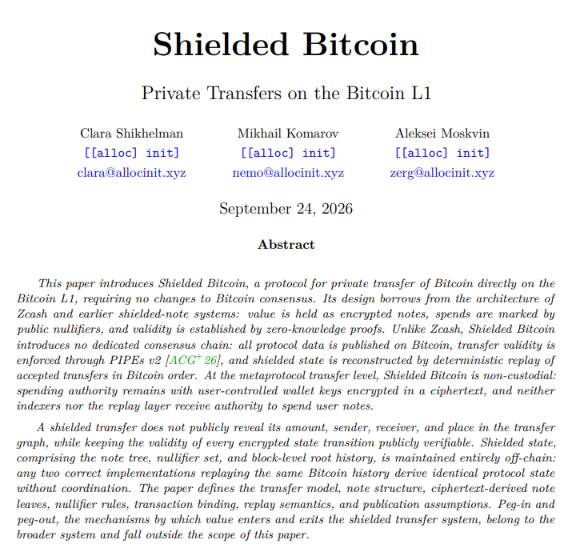
No need to change the design of the consensus rules
This design does not require any modifications to the consensus rules of Bitcoin. Instead, value is expressed in the form of a cryptographic ticket, and a public token called a "nullifier" is issued when the ticket is spent rather than the public ticket itself. Each transfer is accompanied by a zero-knowledge certificate that is used to verify that the sender has the funds and has not created or destroyed value, and does not disclose the people involved or the specific amount.
No need for a separate blockchain
Shielded Bitcoin's core structure draws on Zcash (ZEC), which uses a similar cryptographic ticket and null prover system. The paper describes a key difference from the model: Zcash runs its own blockchain to track and block balances, while Shielded Bitcoin does not have its own chain. The transmitted data is posted directly to the Bitcoin network, and software called Indexer reconstructs a private balance record by playing back each accepted transfer in the order of the Bitcoin record.
Because this replay process is deterministic, any two indexers processing the same Bitcoin history are expected to produce the same record set without having to communicate with each other. The paper points out that during this process, disbursement rights are always retained in the user's wallet key, and neither the software reading the blockchain nor the playback layer itself can move the user's funds.
Comparison with Existing Privacy Schemes
The paper compares Shielded Bitcoin with several existing Bitcoin privacy methods. Existing tools such as CoinJoin and Silent Payments make it more difficult to track ownership through pattern analysis, but transaction amounts will still be visible on the public ledger under these methods. Another proposal, called Shielded CSV, pursues a similar goal but requires users to store their transaction history locally, which means that if users lose this data, the history may not be recoverable. The authors of Shielded Bitcoin believe they avoided this problem by publishing everything needed to restore private status directly to Bitcoin.
Release costs and open issues
The paper reveals specific technical trade-offs rather than presenting the design as completed. The cryptographic proof of each transfer is published in the Bitcoin transaction using a data field called OP_RETURN. According to the data cited in the paper, the proof size depends on the underlying proof system used and ranges from approximately 160 to 192 bytes. The authors point out that this release method adds fee costs to each private transfer in addition to Bitcoin's standard network fees.
若干设计选择仍未解决。论文指出,允许用户在不下载并重放整个比特币区块链的情况下验证自身交易历史的方法尚未解决,被列为未来工作。作者也未就典型转账的标准输入和输出数量达成一致,指出这一选择会影响外部观察者区分单个转账的难易程度。
论文还概述了一项可选功能,允许机构使用单独的零知识证明来验证所收到的资金源自批准来源,并仅通过认证接收者传递,而不向该验证之外的任何人透露基础转账历史。作者将此合规层描述为严格的选择加入(opt-in),声明没有此额外验证的票据在基础 Shielded Bitcoin 协议下仍然有效。
论文将资金进入和退出屏蔽系统的机制——即入金和出金(peg-in and peg-out)——列为其范围之外,并表示该功能计划使用同一研究小组发布的另一协议 Bitcoin PIPEs v2 来构建。