Exchange Ranking
 Top Exchanges
 24h Volume Ranking
 Popularity Ranking
 Exchange BTC Balance
 Proof of Reserves
 Decentralized Exchanges
 Funding Rate
 Funding Heatmap
 Liquidation Data
 Max Pain
 Long/Short Ratio
 Whale L/S Ratio
 Binance/Okex/Huobi L/S
 Bitfinex Margin L/S
 ETF Tracker
 Solana ETF
 XRP ETF
 Hong Kong ETF
 Bitcoin Treasuries
 Crypto Reversal
 Ethereum Reserves
 HyperLiquid Wallet Analysis
 Hyperliquid Whale Watch
 Large Transactions
 On-chain Movement
 Bitcoin ROI
 Stablecoin Market Cap
 Options Analysis
 News
News Articles
 Economic Calendar
 Features
 Wallet
 Contract Calculator


 Security
 Collections
 Watchlist
 Following
 UNI
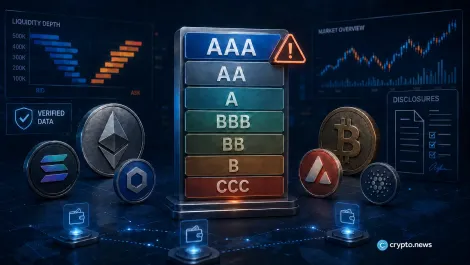
UNI DefiLlama and Forgd launched an AAA to CCC token rating system, and Uniswap exclusive AAA rating
DefiLlama and Forgd jointly launched an AAA to CCC rating system covering 128 of the 149 listed tokens. Currently, Uniswap is the only item on the dashboard to receive an AAA rating with a combined score of 60.80.
Scoring mechanism: Multiply rather than average
The Universal Token Rating system uses a method of multiplying disclosure scores and performance scores rather than traditional average calculations. Points will be deducted if projects lack key information disclosures, weak liquidity arrangements, or token economics are beneficial to insiders. The submitted project information will be cross-verified with exchange data, on-chain data and market maker data.
AAA ratings only indicate strong current conditions and do not predict investment returns and do not eliminate investment risks.
Uniswap leads, followed by Meteora and Curve
Uniswap ranks first in the real-time updated universal token rating dashboard by DefiLlama with a disclosure score of 7.87 and a performance score of 7.72. Meteora ranks second with an AA rating of 58.48, while Curve DAO ranks third with 53.32 points.
The system was co-developed by token advisory platform Forgd to grade assets by combining project disclosure information with transaction data. Its disclosure assessment covers areas such as token economics, internal wallet addresses and business arrangements; while its performance assessment focuses on liquidity, bid-ask spreads, trading venue coverage and market maker behavior.
Why choose the multiplication formula?
Ryan Celaj, research director at DefiLlama, told crypto.news that these two components are indispensable, because simply averaging may conceal serious problems in one area and make advantages in another appear too prominent.
"We deliberately multiplied the project's disclosure score with the performance score because they are both necessary conditions for credibility." The word 'necessary' is the key. It's not just that two factors participate in the calculation together, but that both must meet the standards." Celaj explained.
According to this formula, an item with a disclosure score of 10 and a performance score of 2 will have a combined score of 20. Celaj pointed out that if an average method was used, despite the weak market performance of the project, the score would be much higher and thus misleading.
The requirements for both axes are strict, and high scores are difficult to match.
Both scores range from 0 to 10. After multiplying, a comprehensive result with a full score of 100 is obtained. The AAA threshold is 60 points, which means that even if the other score is a perfect 10 points, as long as any component falls below 6 points, the token cannot enter the highest-ranking category.
Level AA starts with 40 points. As the weaknesses increase, the interval division between levels A, BBB, BB and B becomes narrower. Celaj said these thresholds make it difficult to obtain the highest levels and create a clearer distinction between assets downstream of the list.
Although letter ratings are similar to ratings in traditional finance, Celaj emphasized that they do not estimate the probability of default and should not be considered equivalent to ratings issued by traditional credit rating agencies. This format is adopted because institutional investors are already familiar with the AAA to CCC scale.
The method also connects established policies with observable results. Projects may publish detailed market-making terms or token distribution plans, but performance scores test whether liquidity, trading activity and wallet behavior are consistent with these statements.
Uniswap founder responds to rating results
Uniswap founder Hayden Adams has attracted attention because UNI received the only AAA rating. He quoted the ranking in an X post posted on August 27, calling it "the result of a neutral, unbiased rating system" and calling past criticism of Uniswap "psychological warfare and bearish sentiment on encrypted Twitter."
Hayden Adams (@haydenzadams) August 27, 2026
This is the result of a neutral, unbiased rating system.
I hope you haven't fallen into the trap of years of crypto Twitter psychological warfare and bearish sentiment.
Market maker behavioral impact rating
Forgd founder and CEO Shane Molidor said that private contracts do not prevent platforms from evaluating whether market-making arrangements have created lasting liquidity.
According to Molidor, Forgd monitors more than 500 market makers participating in projects through reports and application programming interface (API) data. Its system measures contributions to volume and depth, uptime, compliance with agreed goals, and each provider's record in other tasks.
"We don't just judge sustainability based on disclosed contracts," Molidor said,"Forgd already monitors market makers 'performance through its platform, giving us access to the more than 500 participating market maker reports and API data we track."
According to the executive, Forgd compares first-party information with exchange and on-chain data, including price spreads, two-way depth, venue coverage and organic trading activity. Analysts will also examine how liquidity performs during periods of volatility, during token unlocking, and after issuance incentives end.
Molidor said such checks are intended to distinguish persistent liquidity from volume that is temporarily backed by token loans, options or other incentives. The project does not need to publish all commercial terms, but sufficient verifiable evidence must be provided for Forgd to understand the arrangements and commitments being evaluated.
Acceptable evidence may include relevant contract terms, amendments, token loan terms, options, wallet identifiers, liquidity goals, uptime requirements, incentive structures, market maker reports, and API records. Forgd also provides its market-maker monitoring software for free, allowing lower-rated projects to submit more data for review.
Market quality becomes the focus of institutions
As institutions increase their exposure to tokenized assets, market quality has become an important issue. According to reports, as of August 27, Stellar's RWA (real-world assets) value increased from approximately US$785 million in January to more than US$3 billion in July, but slightly more than US$2 million was entered into the Blend pool receiving RWA. Data shows that there is a huge difference between the assets issued on the chain and the amount actually used in decentralized lending.
Project statement cannot directly determine rating
Declaring profiles provides token issuers with the opportunity to submit evidence, but Molidor and Celaj stated that the process does not allow issuers to assign or control their ratings.
Missing information can have a negative impact on disclosure scores. Molidor pointed out that if a project provides favorable details and hides weaknesses, full disclosure credit cannot be obtained.
"The downside is that some ratings will seem artificially low until the project provides the necessary disclosures," Molidor said,"But the upside is that transparency is not bad for the project, nor is selective disclosure good."
Performance scores are checked individually using exchange records, on-chain events, and Forgd's monitoring tools. Input indicators include depth, spread, volume, exchange coverage, derivatives status, token economics and compliance with market-making goals.
Celaj said there is a cap on exceptionally strong performance in individual categories, preventing one indicator from offsetting persistent weaknesses elsewhere. The methodology also excludes locations deemed unreliable from relevant calculations.
Ratings are continuously updated, non-one-time audit
Ratings are continuously updated, rather than relying on a single audit. Major disclosures that are not updated for more than 60 days will be subject to penalties, while verifiable events (such as token unlocking and exchange listings) will automatically enter performance evaluations.
Despite these controls, both executives acknowledge limitations. Molidor said the system cannot prove that undisclosed business relationships do not exist. It can identify missing information, inconsistent claims, and activities that are inconsistent with project accounts, but its rating cannot guarantee that every relationship has been found.
Celaj also stated that no rating model can be considered unmanipulable. DefiLlama has made public its methodology and category-level results so that users can track ratings and challenge controversial information, while the team plans to adjust the system when the project finds ways to exploit system vulnerabilities.
AAA ratings do not predict returns
Neither DefiLlama nor Forgd have collected enough long-term evidence to claim that higher-rated tokens have suffered fewer declines or market failures.
Molidor said that because the system uses these conditions as inputs, a high-performance score necessarily corresponds to a stronger measurement depth, a narrower spread, and broader liquidity. Price declines can still be caused by security breaches, governance failures, or market conditions where ratings are not evaluated.
"AAA rating means that at this point in time, the token demonstrates a strong combination of high-quality disclosures and observable market performance under the UTR methodology," Molidor said. "But that doesn't mean that the token is risk-free, the price will rise, or that institutions can use it to replace their own legal, technical and financial due diligence."
According to Molidor, CCC ratings indicate significant issues with disclosure, performance, or both. It does not establish conclusions that the project is fraudulent or inevitable failure, but guides agencies to focus on areas that require additional review.
Celaj describes ratings as a screening and monitoring tool rather than investment advice. In his view, the system creates a dataset that researchers can eventually use to test whether combining disclosures with market data produces better predictive signals than evaluating each category individually.
Institutional interest gives practical meaning to the test
Institutional interest gives practical meaning to the test, especially for tokens tied to real-world assets. On July 31, an article by Ondo Finance reported that monetized securities had exceeded US$36 billion in 2026, including approximately US$12.88 billion in tokenized U.S. Treasury bonds.
For U.S. institutions, token ratings may help organize initial market structure reviews, but regulated tokenized products will still be subject to separate custody, qualification and securities requirements. On August 3, BlackRock launched two tokenized money market products backed by cash, short-term U.S. Treasurys and Treasury-backed repo agreements, with transfers limited to approved investor and compliance wallets.
UTR does not assess all risks attached to such assets. Celaj specifically pointed out that its methodology does not measure cybersecurity risks, which have led to some of the largest declines in cryptocurrency history.