Exchange Ranking
 Top Exchanges
 24h Volume Ranking
 Popularity Ranking
 Exchange BTC Balance
 Proof of Reserves
 Decentralized Exchanges
 Funding Rate
 Funding Heatmap
 Liquidation Data
 Max Pain
 Long/Short Ratio
 Whale L/S Ratio
 Binance/Okex/Huobi L/S
 Bitfinex Margin L/S
 ETF Tracker
 Solana ETF
 XRP ETF
 Hong Kong ETF
 Bitcoin Treasuries
 Crypto Reversal
 Ethereum Reserves
 HyperLiquid Wallet Analysis
 Hyperliquid Whale Watch
 Large Transactions
 On-chain Movement
 Bitcoin ROI
 Stablecoin Market Cap
 Options Analysis
 News
News Articles
 Economic Calendar
 Features
 Wallet
 Contract Calculator


 Security
 Collections
 Watchlist
 Following
 XRP
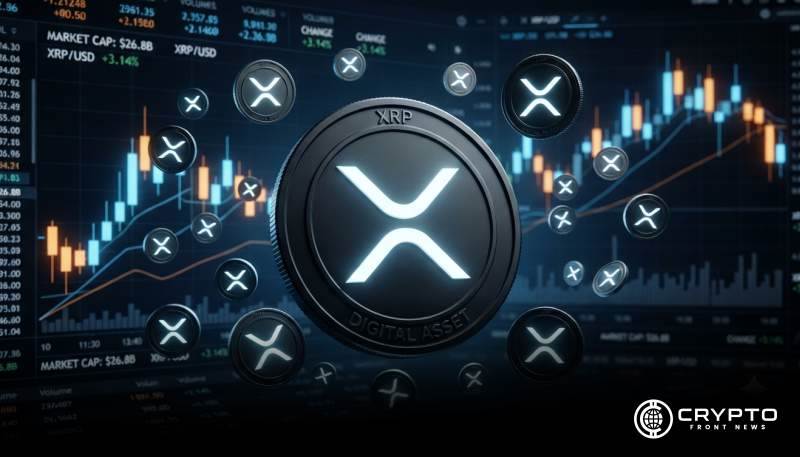
XRP Order book trading volume has surged and market concentration has increased significantly
As the number of accounts handling large XRP transactions has decreased, order book trading volume has increased significantly by 79%, indicating that daily exchange activity has become more concentrated. At the same time, the RLUSD balance reached US$539 million, a year-on-year increase of 642%; during the second quarter, the proportion of XRPL (XRP ledger) in the total RLUSD balance increased to 34%.
Although retail activity across the crypto industry has weakened, XRPL's transaction infrastructure has expanded through licensing venues and faster settlement speeds. In the second quarter of 2026, despite the general decline in retail participation, XRP's liquidity still deepened and orderbook activity increased significantly.
The trend of large-scale trading flows appears
In an article released on the X platform, ALLINCRYPTO gave a warning before the official release of the Evernorth report. The article cited data showing that order book trading volume increased by 79% year-on-year, and the average trading volume per active account in the second quarter was nearly three times the previous level.
During the entire quarter, the average daily trading volume of the order book was 3.57 million XRPs, an increase of 79% from the previous level of approximately 1.99 million. At the same time, the number of active order book accounts dropped from an average of 1,864 to 1,111. The average trading volume for a single active account climbed from 1,072 XRPs to 3,217 XRPs. It is worth noting that order books accounted for 81% of decentralized exchange (DEX) trading volume in the second quarter, compared with only 54% a year ago.
This centralization trend points to larger flows of funds in ledger exchange activities. Although the specific data does not clarify the type of participant, this may reflect the influence of professional traders, market makers or automated trading algorithms.
RLUSD growth injects deep liquidity into XRPL
In the second quarter, the average daily trading volume of the overall DEX was approximately 4.42 million XRPs, representing an annual increase of approximately 20%. However, on a month-on-month basis, total trading volume fell 16% from the first quarter. The decline during this quarter mainly reflects the exceptionally heavy trading volume background in January, so the positive significance of annual growth needs to be understood in context.
The RLUSD balance averaged US$539 million in the second quarter, compared with US$730 million previously, achieving a year-on-year growth of 642%, and there was no quarterly decline during the period. During the same period, the value transferred through RLUSD increased by 925%. The total RLUSD balance on XRPL increased from 20% to 34%. At the same time, the size of stablecoins across the industry declined for the first time since 2023. Against this backdrop, XRPL recorded stronger RLUSD growth, demonstrating its resilience in the broader stablecoin contraction environment.
In addition, a tokenized U.S. Treasury fund also completed the asset delivery process on the chain, and the redemption process took less than five seconds. Ethereum-style smart contracts have also migrated to sidechain software that is being actively maintained.
Weak retail activity accompanies market structural changes
In the second quarter, the average number of active trading accounts on the ledger was 16,587, and the average number of newly opened accounts was 2,783. Both indicators dropped by about 25%. Across the blockchain space as a whole, transaction volume on on-chain exchanges fell 46% over the same period. These account data suggest retail participation is weakening in the broader market. In addition, transaction fees on seven major programmable networks also fell by 38%, indicating that this trend has exceeded the scope of XRPL and has become a common phenomenon in the industry.
Despite this, the U.S. spot XRP ETF recorded a net inflow of US$273 million in the second quarter and remained positive during April, May and June. Progress has also been made at the regulatory level: an Office of the Comptroller of the Currency (OCC) rule that came into effect on April 1 regulates the activities of the National Trust Bank, focusing on custody and other non-trust activities and not targeting digital assets; on May 14, the CLARITY Act was advanced from the Senate Banking Committee.
Summary and Outlook
As of September 3, 2026, the price of XRP is approximately US$1.37, and current market data shows that its daily trading volume exceeds US$2 billion. The token is under close scrutiny, and its trend is closely related to changes in ledger liquidity and transaction structure.
Amendments to the agreement strengthened the capabilities of licensed domains and multipurpose tokens, and RLUSD also expanded to multiple blockchain networks in the second quarter. These developments, coupled with the activation of licensed trading venues in February, have jointly promoted the evolution of the ecosystem. Overall, the quarter was characterized by deepening orderbook activity but decreasing active accounts. The growth of RLUSD added another layer of dollar-denominated liquidity to the book. At the same time, retail participation in XRPL and the broader cryptocurrency market remains weakening.