Exchange Ranking
 Top Exchanges
 24h Volume Ranking
 Popularity Ranking
 Exchange BTC Balance
 Proof of Reserves
 Decentralized Exchanges
 Funding Rate
 Funding Heatmap
 Liquidation Data
 Max Pain
 Long/Short Ratio
 Whale L/S Ratio
 Binance/Okex/Huobi L/S
 Bitfinex Margin L/S
 ETF Tracker
 Solana ETF
 XRP ETF
 Hong Kong ETF
 Bitcoin Treasuries
 Crypto Reversal
 Ethereum Reserves
 HyperLiquid Wallet Analysis
 Hyperliquid Whale Watch
 Large Transactions
 On-chain Movement
 Bitcoin ROI
 Stablecoin Market Cap
 Options Analysis
 News
 Articles
 Economic Calendar
 Features
 Wallet
 Contract Calculator


 Security
 Collections
 Watchlist
 Following
 NEAR
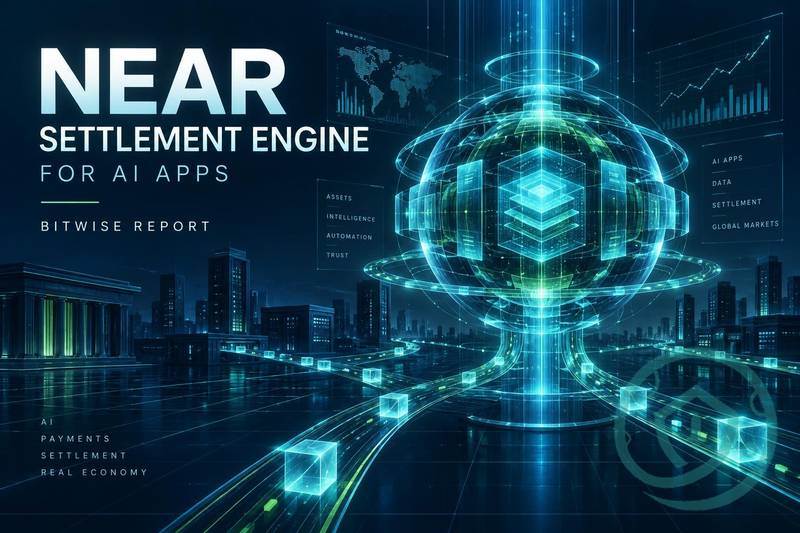
Bitwise Research Report: NEAR Protocol serves as a settlement engine for AI applications
A Bitwise research report positions NEAR Protocol as a settlement engine for artificial intelligence (AI) applications. The report emphasizes that the high-throughput, low-latency architecture of the NEAR network makes it an ideal infrastructure for handling the transaction load generated by autonomous AI systems along the chain.
The core argument of thereport treats "clearing" as an independent infrastructure function, distinguished from computing or storage. Under this framework, the settlement layer is the underlying support for finalizing transactions, enforcing agreements between the parties, and creating verifiable and untamperable records for each interaction, whether initiated by a human or an AI agent.
What Bitwise's argument means for AI activities on the chain
AI applications that need to coordinate resources, pay reasoning fees, or negotiate service agreements between agents need a reliable mechanism to shut down these interactions in a final manner. The settlement infrastructure provides transaction finality, verifiable records accessible to any participant, and a surface for machine-to-machine activity coordination without the need for a trusted intermediary of arbitration results.
Bitwise's framework points out that NEAR's account model and sharding execution environment have characteristics that match the throughput requirements of AI-driven workloads. Unlike human-paced transactions, AI agents can generate a large number of small and interdependent operations that the settlement layer must process without compromising the guarantee of finality due to congestion. Currently, NEAR Protocol is expanding its enterprise-class AI infrastructure to include confidential computing capabilities that address the verification needs of sensitive AI workloads.
The concept of "settlement engine" also overlaps with NEAR's AI cloud direction. The network has shifted to natively support model reasoning and agent coordination, as reflected in its move to integrate cutting-edge model APIs into its AI cloud. The settlement layer underlying these inference calls will provide AI agents with a consistent mechanism for cost allocation and cross-task output recording.
Settlement is infrastructure, not a product feature
positions NEAR as AI's settlement infrastructure, placing it in the same category as the network that evaluates the finality of institutional transactions. Other blockchain projects are pursuing a similar positioning: Solana and JPMorgan Chase are targeting faster institutional settlements; Lloyds Bank and Visa are testing USDC-denominated settlements on the Canton network. Bitwise's report applies similar settlement logic to the AI application layer rather than the traditional financial space.
对于 AI 开发者而言,实际的启示在于:链上结算可以取代代理之间的链下会计,减少 AI 系统进行价值交换时对中心化托管的需求,并创建可审计的代理间协议日志。在没有任何单一运营商控制所有参与者的多代理架构中,这些特性尤为重要,信任必须通过协议保证而非合同关系来建立。
Bitwise 的框架表明,分析师越来越关注哪些结算层能够捕捉来自自主 AI 系统的活动。随着这些系统从实验性部署向生产基础设施转变,它们正通过链上结算轨道路由真正的经济价值。