Exchange Ranking
 Top Exchanges
 24h Volume Ranking
 Popularity Ranking
 Exchange BTC Balance
 Proof of Reserves
 Decentralized Exchanges
 Funding Rate
 Funding Heatmap
 Liquidation Data
 Max Pain
 Long/Short Ratio
 Whale L/S Ratio
 Binance/Okex/Huobi L/S
 Bitfinex Margin L/S
 ETF Tracker
 Solana ETF
 XRP ETF
 Hong Kong ETF
 Bitcoin Treasuries
 Crypto Reversal
 Ethereum Reserves
 HyperLiquid Wallet Analysis
 Hyperliquid Whale Watch
 Large Transactions
 On-chain Movement
 Bitcoin ROI
 Stablecoin Market Cap
 Options Analysis
 News
 Articles
 Economic Calendar
 Features
 Wallet
 Contract Calculator


 Security
 Collections
 Watchlist
 Following
 SUI
Sui's real-time stress test sets a record: Programmable offline "tunnel" throughput peaks at 40.61 million TPS
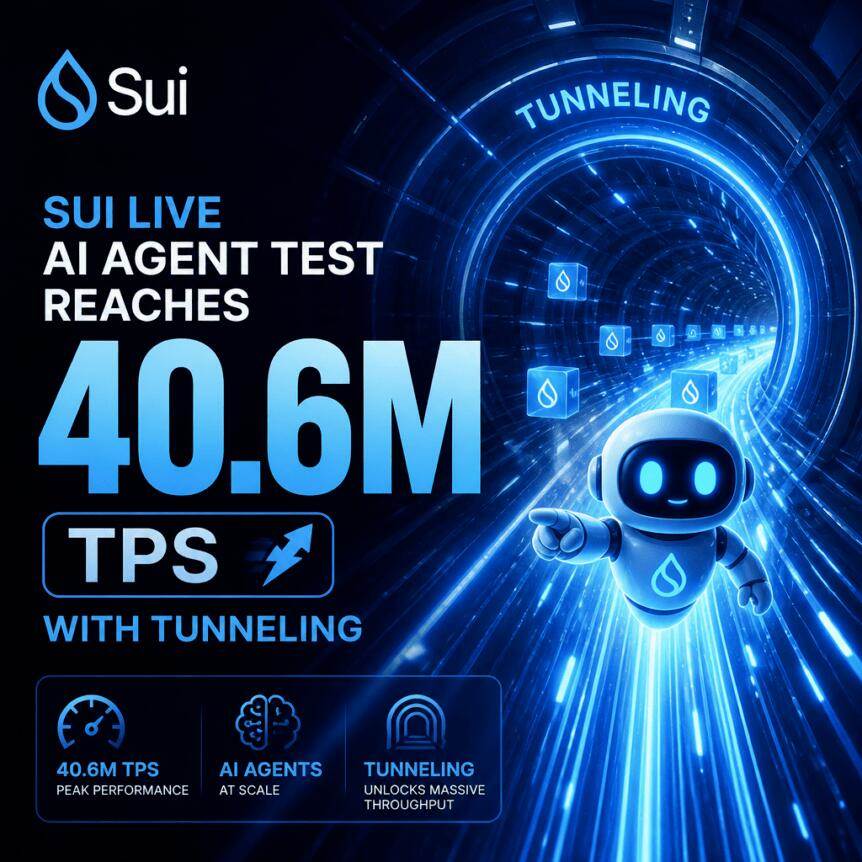
Sui recently announced the results of a real-time stress test, demonstrating that its programmable offchain "tunnel" technology can process transaction traffic at extremely fast speeds, with a peak throughput of 40,614,180 transactions per second (TPS). The demonstration was held at the Sui Basecamp event in Singapore on Wednesday and was designed to simulate the high-frequency activity scenarios expected when a large number of software agents continue to interact.
According to Sui, the test results exceeded the benchmark record previously set in July, when similar settings reached approximately 6.1 million TPS. In this new test, Sui said activities are processed offline through their "tunnels" and state is settled to the Sui blockchain when the tunnels are closed-a mechanism that allows throughput to scale without forcing every transaction to be executed directly on the chain.
Core Points
- Peak performance: Sui reported peak real-time tunnel throughput of 40,614,180 TPS, a significant improvement from the approximately 6.1 million TPS tested in July.
- Technical principle: High throughput comes from off-chain tunnel processing, and on-chain settlement is only performed when the tunnel is closed.
- Scale and diversity: During the demonstration, Sui launched more than 10,000 tunnels on the main network, handling multiple types of traffic from payments, games, and chat applications.
- Independent audit: CertiK, acting as an independent auditor, is reviewing test data and is expected to issue a formal report.
- Application Scenario Positioning: Sui positions this work as suitable for AI agent-to-agent interactions, rather than targeting transaction volumes at the scale of human users.
Sui's latest data from the July benchmark to a peak of 40.6 million TPS
is based directly on the previous July throughput demonstrations. During testing at Sui Basecamp in October, the network stated that during the stress testing window, off-chain tunnels processed more than 40 million TPS transactions, reporting a peak of 40,614,180 TPS.
This significant improvement has practical implications: it shows that Sui's architecture can handle significantly increased traffic while maintaining the same universal tunnel concept. The so-called "tunnels" are programmable channels that process activities offline and settle to the blockchain after they are closed. This billing model is designed to reduce the burden of performing each operation on the chain, thereby avoiding throughput constraints due to execution bottlenecks on the chain under high loads.
How programmable tunnels change execution models
The core of this demonstration is Sui's programmable off-chain tunnel-a mechanism that moves transactions to off-chain processing and retains on-chain settlement steps at the end of the session. Sui describes it as a mechanism that supports high-frequency activity, eliminating the need for every transaction to be processed completely on-chain in real time.
During testing, Sui opened more than 10,000 tunnels on the main network. Transaction flows cover multiple categories, including payments, games and chat applications. This diversity is noteworthy because it means that testing is not limited to a single narrow workload; rather, Sui attempts to reflect patterns common in interactive applications, where message-like interactions can be very frequent.
For developers and operators, the key issue is not only whether the system can reach a certain number in controlled stress testing, but also whether the tunnel model can support real application behavior under load. The separation of off-chain processing and on-chain clearing is designed to make this possible-especially when the number of interacting entities exceeds what is typically generated by human users.
Built specifically for AI proxy traffic, not human browsing
Sui's presentation of the results focuses on the shift in people's expectations about the behavior of digital systems. Adeniyi Abiodun, co-founder and chief product officer of Mysten Labs and original contributor to Sui, pointed out that traditional transaction goals do not conform to agent-driven usage models.
Sui was built for a moment when millions of AI agents traded every day.
There is no market in the world that requires 6 million transactions per second, let alone 40 million: humans can't move that fast, but agents can.
This is an important editorial point: If a high TPS statement is intended to replace user behavior rather than promote new machine-to-machine interactions, it may sound abstract. By linking tunneling methods with AI agents, Sui effectively positions its throughput improvements as infrastructure, serving a potentially different traffic characteristic-in which message frequency and autonomous behavior can push the system into areas that traditional benchmarks cannot cover.
Verification steps and follow-up concerns
Sui stated that CertiK acted as an independent auditor during the demonstration and was reviewing test data. The company said the audit report is expected to be released in the next few days, which will help determine how the tests were built, what they measured and how to interpret results beyond peak TPS numbers.
This verification process is critical to readers because stress testing can be influenced by implementation choices-such as workload design, tunnel life cycle rules, and precise criteria for counting "transactions" within the tunnel pipeline. An independent review may clarify whether the peak of 40.6 million TPS reflects full-link throughput from application intent to on-chain settlement, or whether it mainly refers to off-chain tunnel processing rates with subsequent settlement.
As the audit report approaches, the market may focus on two practical issues: how well test workloads map to real AI proxy applications, and what performance tradeoffs exist when tunnel closures and settlements occur. Until these details are reviewed, Sui's results are best seen as a strong signal of the ability to architecture in simulated high-frequency conditions, rather than a guarantee that it will perform the same in all production scenarios.
In the meantime, investors, builders and users should pay close attention to CertiK's findings and Sui's description of its tunneling methods in its subsequent technical documentation-particularly regarding settlement behavior, real application workloads, and any constraints that may arise outside of controlled demonstrations.