
 Exchange Ranking
 Top Exchanges
 24h Volume Ranking
 Popularity Ranking
 Exchange BTC Balance
 Proof of Reserves
 Decentralized Exchanges
 Funding Rate
 Funding Heatmap
 Liquidation Data
 Max Pain
 Long/Short Ratio
 Whale L/S Ratio
 Binance/Okex/Huobi L/S
 Bitfinex Margin L/S
 ETF Tracker
 Solana ETF
 XRP ETF
 Hong Kong ETF
 Bitcoin Treasuries
 Crypto Reversal
 Ethereum Reserves
 HyperLiquid Wallet Analysis
 Hyperliquid Whale Watch
 Large Transactions
 On-chain Movement
 Bitcoin ROI
 Stablecoin Market Cap
 Options Analysis
 News
News Articles
 Economic Calendar
 Features
 Wallet
 Contract Calculator


 Security
 Collections
 Watchlist
 Following
 BTC
BTC  ETH
ETH Ethereum launches $1 million challenge, ETH whales sell millions
Today, Ethereum has seen a series of major technological developments, whale activity, institutional pledges and security concerns. The Ethereum Foundation has launched the "Better Codes" challenge, giving participants the opportunity to compete for part of the $1 million Proximity Prize to advance post-quantum research. At the same time, ETH Whales took profits after a recent rebound, SharpLink Gaming added millions of ETH pledges, and the Tornado Cash fishing incident raised new security concerns. ETH's price today (4:00 a.m. UTC time on August 21, 2026) rose 4.4%, now at US$2,351.90, with a market value of US$283.87 billion, and a 24-hour trading volume of US$24.96 billion.
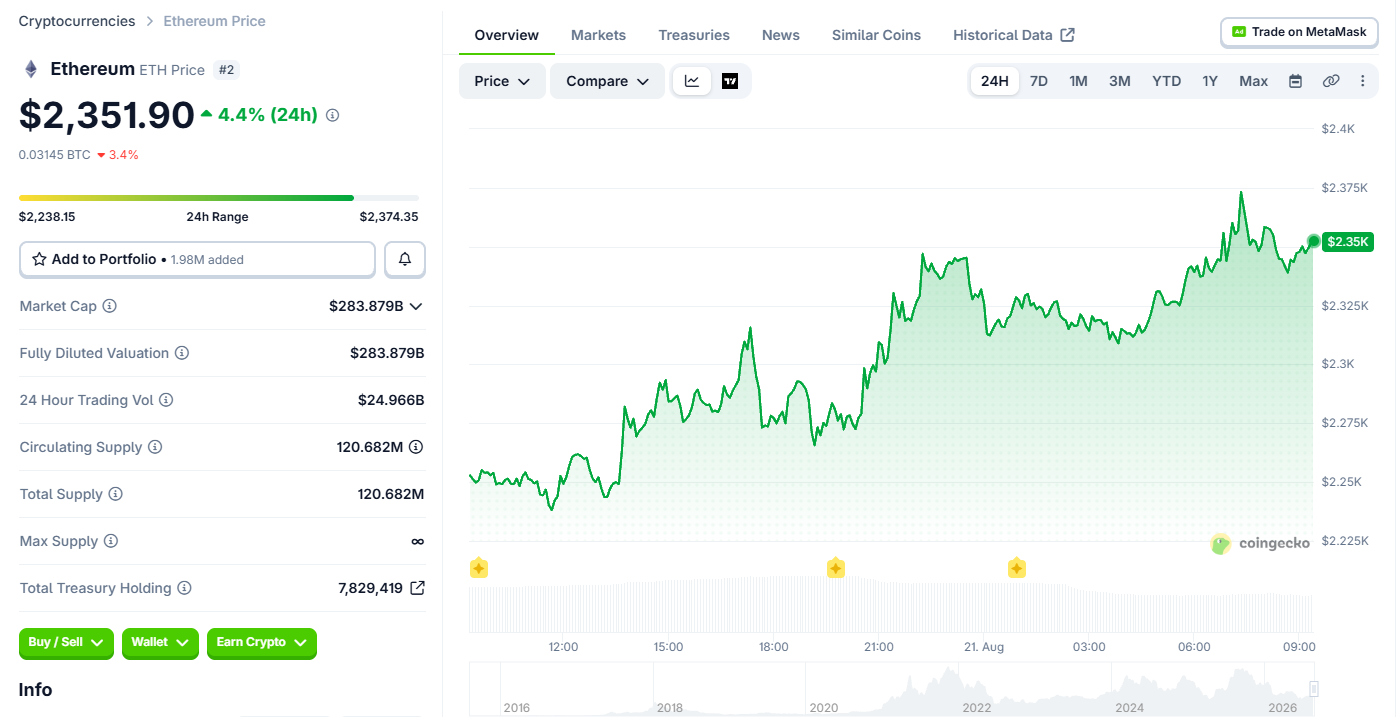
Overview of key developments in Ethereum today
Better Codes launched : The Ethereum Foundation has launched an AI-driven research challenge tied to the US$1 million Proximity Prize to support post-quantum security research.
7 Siblings ETH sell-off : Whales/institutions sold thousands of tokens after a sharp rebound in prices, indicating profit-taking following the recent rise in ETH.
SharpLink Pledge : 39,319 new tokens (approximately US$91 million) were added for pledge, indicating that large institutions continue to invest.
Tornado Cash Phishing : Users lost 1,010 tokens while accessing an old hijacked domain name, highlighting the risk of domain name verification.
Whale short clearing : Trader 0x004E made multiple losses while shorting BTC and ETH, indicating increased volatility and risk in the leveraged market.
The Ethereum Foundation launches a $1 million post-quantum research challenge
The foundation has launched a new research initiative called "Better Codes" to improve post-quantum security of networks. The program invites researchers to use AI agents and automated tool chains to find more powerful mathematical proofs for hash-based SNARKs-a technology that is at the heart of Ethereum's many proof infrastructure. Winning submissions will have the opportunity to share the $1 million Proximity Prize provided by the foundation. The challenge is jointly operated by ZK Security, EigenLabs and Yukon Research, and the platform went online this week on better.codes.
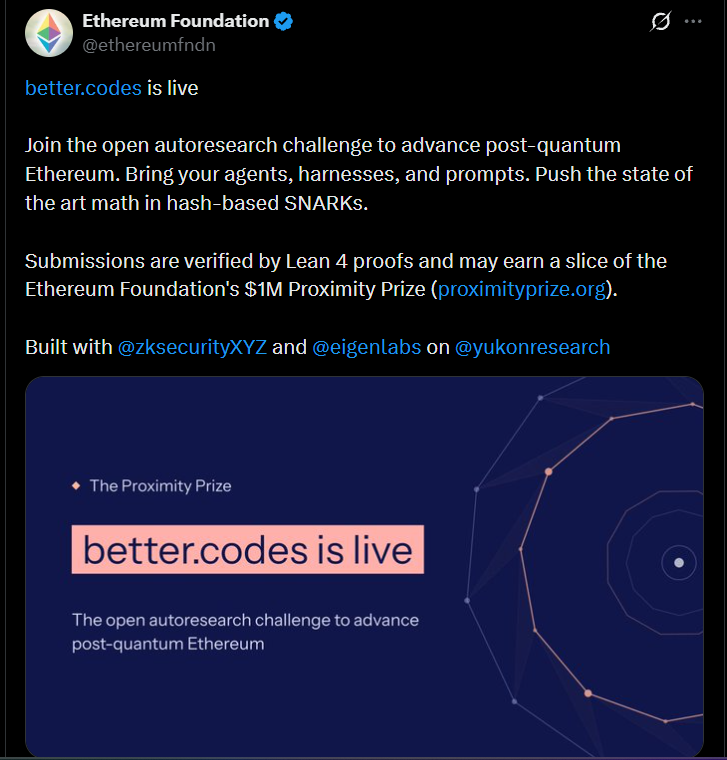
What are Better Codes? How does the Ethereum Research Challenge work?
Better Codes selects a clear question from the Proximity Prize research plan and converts it into an open competition. The target is the Reed-Solomon proximity problem called koala IRS 12. Participants connected their own AI models and research tools to gradually increase the "provable" reliability boundary of the issue and move towards the 128 security goals, with progress recorded on the public rankings. Each submitted result must be formally verified. Participants log in using GitHub, clone the challenge repository, and submit a proof that exactly matches the established theorem statement. The Lean 4 proof checker verifies mathematical logic and is accepted after passing. The proof of success and the new technologies or lemmas discovered during the process will be publicly released for other participants to continue to advance on this basis and avoid duplication of effort.
Why is post-quantum security important to Ethereum?
The driving force behind Better Codes stems from the gap between cryptographers 'beliefs about certain security guarantees and actual mathematical proof. Hash-based SNARKs are already at the core of systems such as zkRollups and zkVM, and their role will become even more important as Ethereum builds a long-term quantum-resistant roadmap. Closing the gap between "possibly safe" and "provably safe" is designed to give developers and users more confidence in the cryptographic foundation on which extended solutions increasingly rely.
7 Siblings and other ETH whales take profits after Ethereum rebound
Not everyone is holding on to it. The on-chain tracker marks a wallet called "7 Siblings", and its operating pattern is relatively consistent: buy after a sharp short-term decline and sell when a sharp short-term rebound. The wallet reportedly bought tokens during the decline in February and June, with an entry price of approximately $1789 in June. After the price rebounded by more than 20% in about a day and a half, the wallet began to sell heavily, selling thousands of tokens at prices ranging from $2338 to $2346, making a profit of tens of millions of dollars. This is not the only big player to reduce their positions. Another wallet tracked as 0xFD10 was also reported to have sold tens of millions of dollars worth of pledged ETH and ordinary ETH, indicating that profit-taking is currently quite common among some large households.
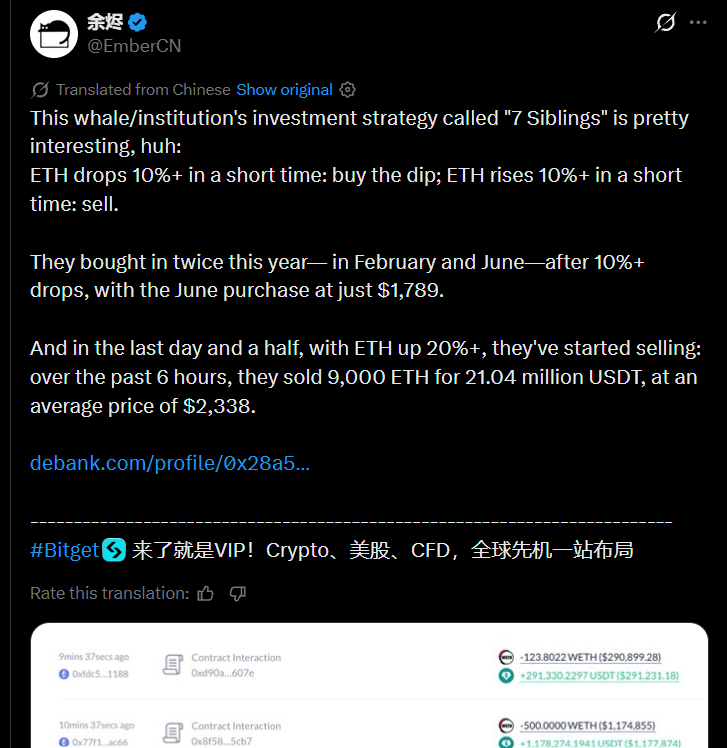
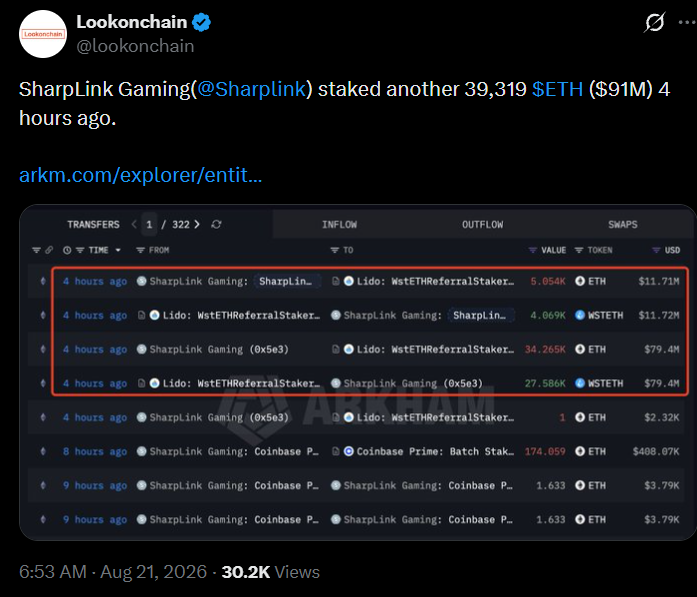
SharpLink Gaming pledged another 39,319 ETH pieces worth US$91 million
At the same time, not all big players are selling. Gaming company SharpLink Gaming reportedly added more than 39,000 ETH units to pledge, worth approximately US$91 million. The contrast is noteworthy: some whales are cashing out after a rebound, while at least one institution is increasing long-term pledge positions, highlighting the current emotional divide among major ETH holders.
Tornado Cash phishing attack reportedly stole 1,010 ETH
There was also a costly cryptographic security incident this week. According to community reports, a user clicked on an old link to Tornado Cash's original domain name, which expired because the team was unable to renew it under sanctions. The attacker reportedly took over the abandoned domain name and set up a fake front end to steal deposit certificates, stealing approximately 1,010 ETH pieces in approximately 12 hours. Trackers believe that nearly 4,000 ETH pieces involved in similar thefts in the past year may be related to the same gang. Interestingly, on-chain analyst Specter questioned the victim himself, pointing out that he had been involved in currency mixer activities and had links to hacker-related channels-suggesting that this could be an attack between malicious actors rather than a simple theft against innocent users.

Bitcoin and Ethereum rebound, ETH whale short positions are liquidated
In addition, aggressive derivatives bets have also suffered a backlash. A trader identified as 0x004E reportedly opened short positions in BTC and ETH of approximately $81.6 million. As prices rose, the BTC portion of the trade was fully liquidated, and the trader allegedly lost approximately $3.28 million in eight failed short attempts in just two days.
What will happen next for Ethereum and ETH prices?
Taken together, this series of Ethereum dynamic shows that the ecosystem is developing in multiple directions at the same time. Long-term technology development continues to advance through programs such as Better Codes, institutions such as SharpLink are still establishing pledged positions, while short-term traders are actively taking profits, and some even suffer losses in leveraged trading. Security incidents such as the Tornado Cash phishing incident also remind us that even for experienced users, infrastructure risks remain. These scenarios do not point in a single clear price direction, but depict an active and increasingly mature market-with technological development, capital flows and risks occurring simultaneously.
This article is for information purposes only and does not constitute financial, investment or trading advice. The cryptocurrency market is highly volatile, and readers should study and consult a qualified financial adviser before making investment decisions.
























