Exchange Ranking
 Top Exchanges
 24h Volume Ranking
 Popularity Ranking
 Exchange BTC Balance
 Proof of Reserves
 Decentralized Exchanges
 Funding Rate
 Funding Heatmap
 Liquidation Data
 Max Pain
 Long/Short Ratio
 Whale L/S Ratio
 Binance/Okex/Huobi L/S
 Bitfinex Margin L/S
 ETF Tracker
 Solana ETF
 XRP ETF
 Hong Kong ETF
 Bitcoin Treasuries
 Crypto Reversal
 Ethereum Reserves
 HyperLiquid Wallet Analysis
 Hyperliquid Whale Watch
 Large Transactions
 On-chain Movement
 Bitcoin ROI
 Stablecoin Market Cap
 Options Analysis
 News
News Articles
 Economic Calendar
 Features
 Wallet
 Contract Calculator


 Security
 Collections
 Watchlist
 Following
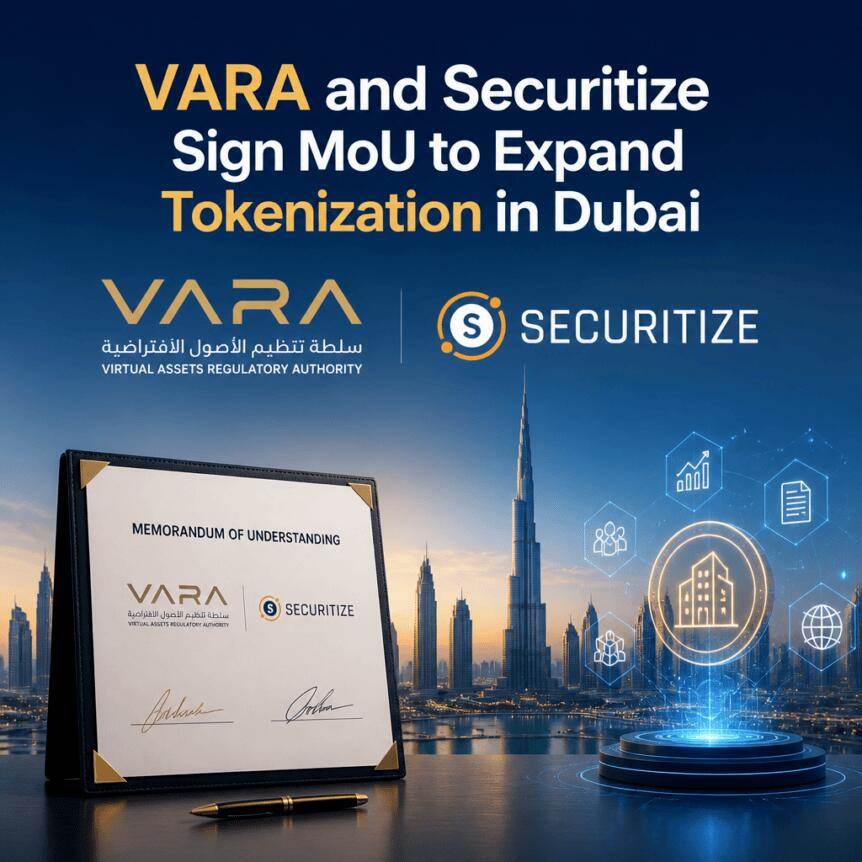
Dubai regulator VARA signed a memorandum of cooperation with BlackRock's tokenization platform Securitize
The Dubai Virtual Assets Authority (VARA) signed a memorandum of understanding with BlackRock's tokenization platform Securitize to deepen regulated tokenization capabilities in United Arab Emirates. The agreement, announced Thursday, establishes a collaboration framework rather than a single product launch.
The actual value of the agreement for investors and market participants lies in its goal: to combine institutional tokenization expertise with Dubai's regulatory approach to help the development of a trusted tokenization market in a clear compliance environment.
Core Points
VARA and Securitize signed a memorandum of understanding to cooperate on regulated tokenization projects in Dubai. The framework aims to combine VARA's regulatory perspective with Securitize's experience in institutional tokenization, but does not promise specific technical solutions or release dates. Dubai is actively expanding its licensed ecosystem, including VARA's recent issuance of its 50th Virtual Asset Service Provider (VASP) license. Tokenized asset activity continues to grow in the "real world assets"(RWA) space, with RWA.xyz reporting that both the number of holders and the overall tokenized value have increased over the past month. The signing of the memorandum comes as tokenization efforts are extending into other regulated markets, including developments in tokenized stock trading in the UK.
Regulatory and Institutional Collaboration Framework for Tokenization
The Dubai Virtual Assets Authority (VARA) and Securitize said their memorandum is aimed at supporting tokenization projects in Dubai and the wider United Arab Emirates. The two sides described the agreement as a collaborative framework aimed at encouraging institutional participation and strengthening the emirate's digital asset ecosystem. Crucially, VARA and Securitize position the memorandum as an arrangement that helps shape how tokenized financial products operate under Dubai's regulatory framework. This distinction is crucial because tokenization is still in its early stages in many jurisdictions: markets are developing rapidly, but regulatory clarity often lags behind product innovation. [TAG
In response to a question about infrastructure goals, a VARA spokesperson said the memorandum aims to establish a broad framework for collaboration aimed at identifying the respective strengths of both parties to support the development of Dubai's "trusted, regulated tokenization market." The spokesperson stressed that the intention was to combine VARA's regulatory perspective with Securitize's institutional tokenization experience. "The aim is to combine VARA's regulatory perspective with Securitize's experience with institutional tokenization to determine how collaboration can help support the development of a trusted, regulated tokenization market in Dubai." At the same time, the spokesman said that no specific projects were expected "at this stage." This suggests that the memorandum is primarily about coordination and regulatory integration efforts-which may include planning, standards and operational discussions-rather than immediate deployment of tokenized products.
Why the momentum of Dubai's license issuance is crucial
Dubai has been committed to positioning itself as a digital asset innovation center, and VARA's evolving licensing program is an important signal for the market. Earlier in July this year, VARA issued its 50th virtual asset service provider (VASP) license, this time the license was awarded to the tokenization platform Tribe Tokenisation FZE. This expansion provides the context for VARA's agreement with Securitize. An increasing number of licensed participants can make it easier for institutional projects to find compliance paths, counterparties and operating expectations. In other words, the memorandum not only establishes a new partnership, it also integrates into the broader regulatory building efforts already underway in Dubai.
Nevertheless, readers should note that there is still uncertainty: Since the memorandum does not announce any specific tokenized products, its market impact will depend on the results of subsequent collaboration-especially whether these results can be translated into new product approvals, clearer operating guidelines, or broader institutional participation.
RWA demand continues to grow: both the number and value of holders rise
The Dubai agreement comes at a time when investor interest in tokenized assets, particularly real-world assets (RWA), continues to surge. According to data provider RWA.xyz, the number of RWA holders has increased by 103% in the past 30 days to 3.2 million; during the same period, the total value of tokenized assets has increased by 2% to $38.5 billion. The data helps explain why institutional tokenization platforms and regulators are now beginning to align. The prospects for tokenization depend on liquidity, legal certainty, and scalable issuance and custody methods-areas where regulatory and institutional infrastructure can promote each other.
RWA.xyz also ranked tokenization platforms based on asset size under management (AUM). Securitize is listed as the largest tokenization platform, managing US$4.9 billion in tokenized assets. According to the same data provider, Ondo Finance ranks second with $3.5 billion. This competitive landscape is meaningful: partnerships between regulators and leading tokenization participants may influence which standards dominate-especially as regulators tend to adopt a structured, institution-oriented approach to tokenized financial products.
Tokenization trend surpasses United Arab Emirates
Dubai's push comes as other fintech hub jurisdictions accelerate tokenization efforts. Days before VARA and Securitize's announcement, the London Stock Exchange partnered with crypto exchange Kraken (through its parent company) to launch tokenized stock trading on the exchange's night-time trading platform, with the goal of trading 24 hours a day, five days a week. Although London's move focuses on tokenized stocks rather than RWA tokenization, it reflects a broader trend: traditional market operators are experimenting with tokenized market structures to improve transaction continuity and potentially broaden access channels. For participants, these developments together highlight a convergence trend: Regulators and large financial institutions are increasingly viewing tokenization as more than just a technology experiment, but something closer to mainstream market infrastructure.
Dubai's next step is worth watching.
Since the memorandum does not include announced projects "at this stage", the next signs of momentum are likely to come from subsequent updates that will clarify the specific content of the two parties will cooperate and how these collaborations match tokenized product launches under the Dubai Rules. Market participants should focus on any specific measures that can transform the agreement framework into regulated products-especially in the context of the continued expansion of Dubai's VASP licensing ecosystem.