Exchange Ranking
 Top Exchanges
 24h Volume Ranking
 Popularity Ranking
 Exchange BTC Balance
 Proof of Reserves
 Decentralized Exchanges
 Funding Rate
 Funding Heatmap
 Liquidation Data
 Max Pain
 Long/Short Ratio
 Whale L/S Ratio
 Binance/Okex/Huobi L/S
 Bitfinex Margin L/S
 ETF Tracker
 Solana ETF
 XRP ETF
 Hong Kong ETF
 Bitcoin Treasuries
 Crypto Reversal
 Ethereum Reserves
 HyperLiquid Wallet Analysis
 Hyperliquid Whale Watch
 Large Transactions
 On-chain Movement
 Bitcoin ROI
 Stablecoin Market Cap
 Options Analysis
 News
News Articles
 Economic Calendar
 Features
 Wallet
 Contract Calculator


 Security
 Collections
 Watchlist
 Following
 BTC
BTC  ETH
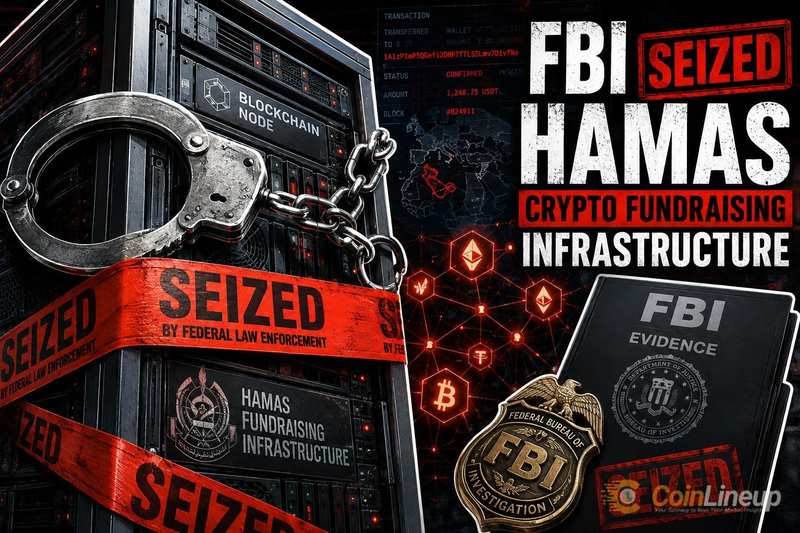
ETH The FBI seals Hamas-related cryptocurrency fundraising infrastructure
The U.S. Department of Justice said in announcing its continued efforts to combat Hamas terrorist financing that the FBI has seized Hamas-related cryptocurrency fundraising infrastructure and intercepted some new donations that have not yet reached the organization.
What the FBI seized
Simply put, the government controls the digital tools used to raise funds for Hamas. These tools include wallets and accounts linked to fundraising activities, rather than a full-scale crackdown on cryptocurrencies themselves. The Justice Department said the operation was part of its continued attempt to undermine Hamas's terrorist financing program through seizure. The FBI intercepted new donations sent through these channels.
The so-called "fundraising infrastructure" refers to the online channels for transferring donated funds, i.e. wallets and payment channels used to collect funds, rather than the digital currency in any individual wallet.
Facts: The FBI seized Hamas-related cryptocurrency fundraising infrastructure and intercepted new donations.
Myth: This is not a ban on cryptocurrencies, nor is it an action against ordinary holders.
Unclear information: The specific amount seized and the type of cryptographic assets involved have not been confirmed in the existing evidence.
Media reports said this is the latest in a series of measures aimed at Hamas financing. Earlier this year, officials detailed how the Justice Department and the FBI seized cryptocurrencies in a Hamas funding investigation.
What this means for cryptocurrency users
The main message is simple: using cryptocurrency does not allow illegal fundraising to escape the supervision of law enforcement agencies. Transfers on blockchain can still be tracked and blocked. This is contrary to the widespread view that cryptocurrencies are completely anonymous or not subject to the jurisdiction of authorities.
For ordinary users who hold small amounts of Bitcoin or Ethereum on exchanges, this action will not have any impact on their personal funds. Target specific fundraising networks, not ordinary users.
What needs to be clear is that the information we know is limited. Existing research does not confirm any price or trading volume response, so it is impossible to draw conclusions about market volatility. Such enforcement actions are advanced in conjunction with other global crackdowns, such as the crackdown on cryptocurrency fraud networks.
What unknown
remains after the seizure has only been partially verified. Due to the early stage of the investigation, many important details have not yet been made public. Existing materials do not confirm the specific dollar amount seized or the types of cryptographic assets involved, nor do they list all seized wallets or accounts.
Key follow-up questions remain: Will more wallets, middlemen or related platforms be named? Will the government detail the transfer route of intercepted donations? These are specific matters worthy of attention as official documents are released.
Regarding how to deal with the seized cryptocurrencies in the future, the government has previously transferred a large number of seized bitcoins. For novices, the practical conclusion is that cryptocurrencies are traceable, law enforcement is active, and the honest answer is that some details of the case have not yet been confirmed.