Exchange Ranking
 Top Exchanges
 24h Volume Ranking
 Popularity Ranking
 Exchange BTC Balance
 Proof of Reserves
 Decentralized Exchanges
 Funding Rate
 Funding Heatmap
 Liquidation Data
 Max Pain
 Long/Short Ratio
 Whale L/S Ratio
 Binance/Okex/Huobi L/S
 Bitfinex Margin L/S
 ETF Tracker
 Solana ETF
 XRP ETF
 Hong Kong ETF
 Bitcoin Treasuries
 Crypto Reversal
 Ethereum Reserves
 HyperLiquid Wallet Analysis
 Hyperliquid Whale Watch
 Large Transactions
 On-chain Movement
 Bitcoin ROI
 Stablecoin Market Cap
 Options Analysis
 News
News Articles
 Economic Calendar
 Features
 Wallet
 Contract Calculator


 Security
 Collections
 Watchlist
 Following
 BTC
BTC  ETH
ETH Revolt's U.S. market targets launch in 2027 after receiving primary approval from OCC
This week, with the U.S. Office of the Comptroller of the Currency (OCC) conditional approval for the financial technology giant to establish National Bank in the United States, Revolt's ambition to enter the U.S. market took an important step. The decision marks the clearest signal that the company plans to operate as a full national institution rather than relying solely on cooperative banks to serve its U.S. customers.
 What is the actual approval of the OCC
According to the official Corporate Decision No. 1390, the OCC has conditionally and preliminarily approved Revolut Bank US, and the National Association has its headquarters in Stanford, Connecticut, without physical branches. The regulator also approved a related exemption request covering residency requirements for members of the entity's board of directors.
This license is preliminary and conditional only-meaning that final authorization will not be granted to officially open until the entity meets a lengthy series of pre-opening requirements. It is worth noting that this preliminary green light does not cover the company's proposed retail foreign exchange business, which requires a separate written no-objection letter from the OCC before launching.
Structure and ownership arrangements of new entities
Under the approved structure, the new institution will serve as Revolut Holdings US Inc. (a Delaware registered company), which is itself wholly owned by U.K. -based Revolut Group Holdings Ltd. The U.S. holding company and its British parent company have applied to the Federal Reserve to become holding companies respectively, while deposit insurance applications filed with the Federal Deposit Insurance Corporation (FDIC) are still under active review.
This layered corporate structure is quite standard for foreign entities seeking a National Bank license, reflecting the need to obtain approval from multiple regulators before final approval of Revolut's U.S. Markets plan.
Products planned by the new institution
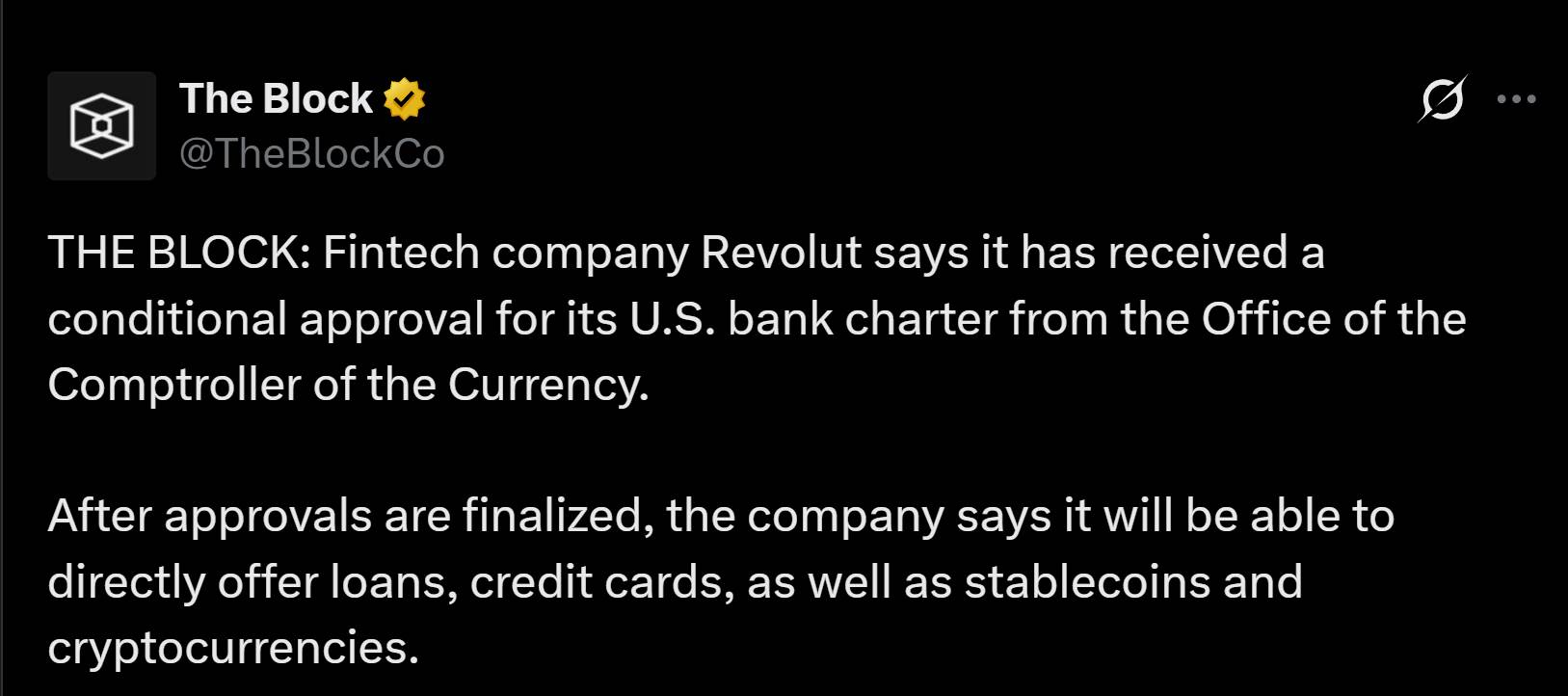
Once all approvals are finalized, the company said it will be able to directly provide loans, credit cards, FDIC-insured deposits, and access to stablecoins and cryptocurrencies to U.S. customers. The OCC document confirms that the entity plans to provide digital asset custody services in a non-trustee capacity through its UK-regulated affiliates, although digital asset revenue is expected to remain below 2% of total revenue in the first three years. It will not hold any digital assets on its own balance sheet, and any stablecoin activity using the company's brand name will be conducted through third-party issuers, whose role is limited to marketing and customer access.
The key conditions attached to this stage include:
- The minimum tier 1 leverage ratio in the first three years is at least 10%
- 60 days 'notice is required before major changes to business plans
- OCC no-objection letter is required before appointing senior managers or new board members
- Initial paid-in capital is not less than US$95 million
Approval snapshot details
Approval regulator Office of the Comptroller of the Currency (Office of the Comptroller of the Currency) Proposed name Revolut Bank US, National Association Proposed headquarters Stanford, Connecticut Application submission date March 10, 2026 Minimum capital requirement US$95 million Minimum tier 1 leverage ratio 10% for the first three years Planned launch window Why is this in line with the company's broader global expansion strategy in the first half of 2027
Company leadership views this approval as a fundamental milestone rather than a final product. Founder and CEO Nik Storonsky said the conditional approval provided the basis for the company to establish a foundation in the world's largest financial market, while U.S. CEO Cetin Duransoy praised the OCC for being diligent and efficient throughout the review process.
This milestone for Revolut's U.S. market also builds on a broader wave of licensing activity-the company has obtained banking licenses in Mexico, advanced regulatory work in Brazil, Colombia, Peru and Argentina, and separately obtained banking licenses in France, Australia and the United Kingdom, and obtained payment licenses in the United Arab Emirates alone this year. The company said it remains on track to achieve its goal of reaching 100 million global customers by mid-2027.
Conclusion
This conditional concession approval brings Revolut's U.S. market plan closer to reality, although true operations still depend on pending endorsements from the Federal Reserve and the FDIC, as well as final approval from the OCC. With 2027 launch goals now publicly confirmed and stablecoins and cryptocurrency access clearly included in the roadmap, this decision represents an important regulatory milestone for financial technology companies aiming to become fully licensed institutions in the United States.
Disclaimer : This content involves financial markets and is for general information only. Does not constitute financial, investment, trading or legal advice. Cryptocurrency assets fluctuate violently and may depreciate rapidly. Always conduct independent research. Consult a licensed financial adviser before making an investment decision.