
 Exchange Ranking
 Top Exchanges
 24h Volume Ranking
 Popularity Ranking
 Exchange BTC Balance
 Proof of Reserves
 Decentralized Exchanges
 Funding Rate
 Funding Heatmap
 Liquidation Data
 Max Pain
 Long/Short Ratio
 Whale L/S Ratio
 Binance/Okex/Huobi L/S
 Bitfinex Margin L/S
 ETF Tracker
 Solana ETF
 XRP ETF
 Hong Kong ETF
 Bitcoin Treasuries
 Crypto Reversal
 Ethereum Reserves
 HyperLiquid Wallet Analysis
 Hyperliquid Whale Watch
 Large Transactions
 On-chain Movement
 Bitcoin ROI
 Stablecoin Market Cap
 Options Analysis
 News
News Articles
 Economic Calendar
 Features
 Wallet
 Contract Calculator


 Security
 Collections
 Watchlist
 Following
 BTC
BTC Capital structure raises questions about old models
Social media debate adds cycle compression theory
Bitcoin's cycle bottom appears between 770 and 900 days after halving in 2012, 2016 and 2020. However, before the halving of this cycle, Bitcoin had already hit a record high, breaking this historical time rule.
The inflow of funds from spot ETFs has made Bitcoin prices more closely linked to macro liquidity, rather than relying solely on supply shocks caused by halving. A viral post posted by a user on Platform X (formerly Twitter) suggested that the four-year cycle was "compressing" rather than disappearing, changing the timetable.
Has Bitcoin's four-year cycle been broken?
As this cycle unfolds differently from previous cycles,"Has the Bitcoin four-year cycle been broken?" This issue is receiving increasing attention. According to CryptoQuant data, the cycle bottoms in 2012, 2016 and 2020 were formed between the 770th and 900th days after halving.
This time, Bitcoin hit a new all-time high even before the halving occurred. This early rise divided traders: those who believed that the historical rhythm was still valid and those who believed that the model was completely over.
Capital structure raises questions about the old model
Approval of spot ETFs opens the door for an influx of large institutional funds before the halving. Institutional investors typically make decisions based on monetary policy, interest rates and broader liquidity, and do not track how many days have passed since the halving event. This is in sharp contrast to the retail driven market cycles of 2012, 2016 and 2020.
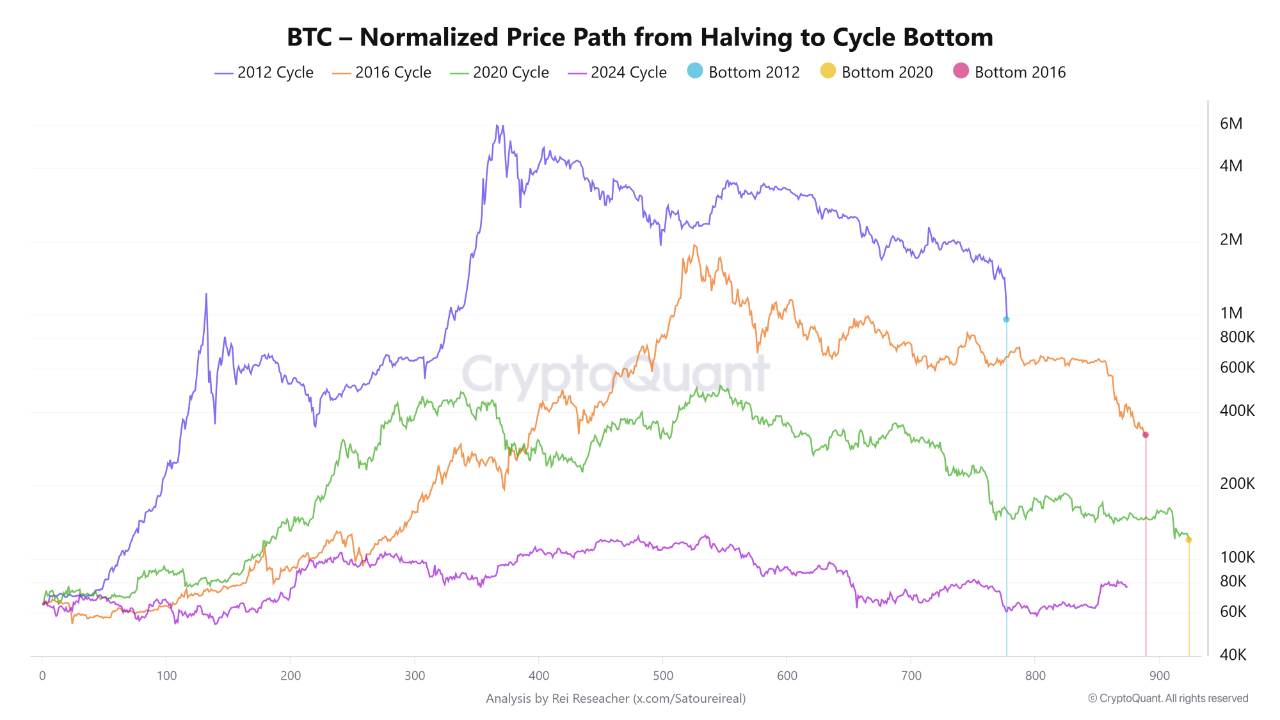 Source: Cryptoquant
The supply shock impact caused by halving is not as strong as before. Newly minted bitcoins account for only a fraction of the daily trading volume flowing through derivatives and major funds. In the early cycles, the reduction in circulation significantly affected the available supply. Today, that effect is diluted by the much larger pool of tradable bitcoins in circulation.
Bitcoin's market capitalization has entered the trillion-dollar level, and the conditions required to change the direction of assets have changed. Promoting a market of this size requires a lot of liquidity support from the global market. The aggressive monetary easing factors that have driven the rebound in the past have not appeared in the near future. Without this liquidity boost, price momentum may build more slowly than in the past.
These shifts raise a real question: Does calculating the number of days after halving still apply? Some observers believe that Bitcoin is increasingly resembling a mature macro asset tied to broader financial conditions. The four-year model may not be dead, but its timing appears to have been disrupted. Many people are now turning to macro indicators rather than waiting for a historically fixed bottom to emerge.
Social media debate adds cycle compression theory
This issue has expanded from analysts to broader social media discussions. A post from the X account "Discover" believes that Bitcoin may have broken its cycle. The post noted that the bottom had been formed approximately 650 days before the next scheduled halving.
[TAG_56





















![[Altcoin Season] Solana and BNB have taken action: Traders are focusing on the next 100 times crypto](/d/file/20260914/ed4ef83dafcd11f19c9ab80d425f811e.jpg)


