Exchange Ranking
 Top Exchanges
 24h Volume Ranking
 Popularity Ranking
 Exchange BTC Balance
 Proof of Reserves
 Decentralized Exchanges
 Funding Rate
 Funding Heatmap
 Liquidation Data
 Max Pain
 Long/Short Ratio
 Whale L/S Ratio
 Binance/Okex/Huobi L/S
 Bitfinex Margin L/S
 ETF Tracker
 Solana ETF
 XRP ETF
 Hong Kong ETF
 Bitcoin Treasuries
 Crypto Reversal
 Ethereum Reserves
 HyperLiquid Wallet Analysis
 Hyperliquid Whale Watch
 Large Transactions
 On-chain Movement
 Bitcoin ROI
 Stablecoin Market Cap
 Options Analysis
 News
News Articles
 Economic Calendar
 Features
 Wallet
 Contract Calculator


 Security
 Collections
 Watchlist
 Following
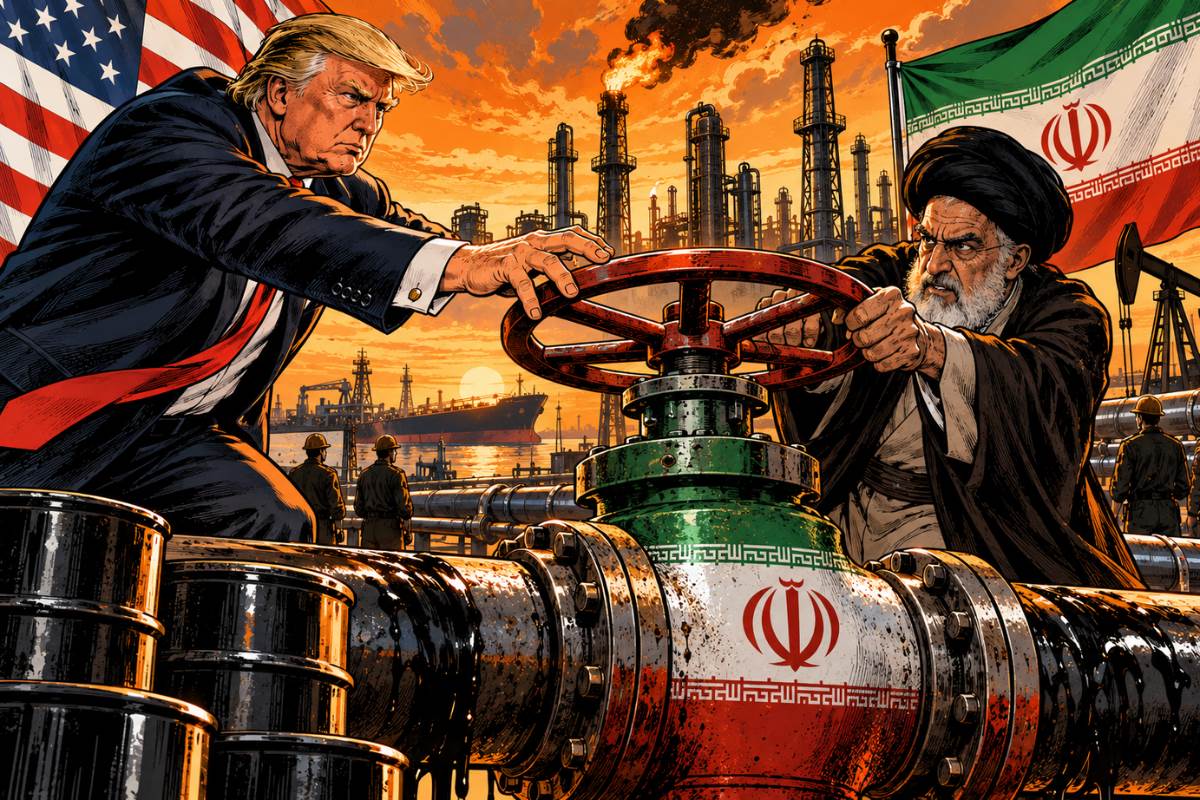
Trump hinted at using the "Venezuelan model" to control oil in Iraq, and the situation in the Middle East pushed oil prices higher than 100 US dollars.
According to Donald Trump's latest statement, Iranian oil will become the core goal of the United States 'long-term presence in the Middle East. The president mentioned a military model similar to that in Venezuela, but did not propose any specific agreement or timetable.
Summary of core points
- Strategic goals: Trump believes that maintaining the U.S. presence in Iran is to ensure access to and control over the country's oil resources.
- Model analogy: The president compared this scenario to the "Venezuelan model," but the terms of which are still full of uncertainty.
- Market reaction: Tensions in the Middle East pushed Brent crude and WTI crude oil prices both above the US$100 per barrel mark.
- Supply risks: The closure of the Saudi East-West oil pipeline and disruptions in the Strait of Hormuz have exacerbated tensions in global supply chains.
- Lack of consensus: There is currently no agreement that clearly stipulates specific conditions for the long-term U.S. presence in Iran.
Trump links withdrawal to Iranian oil
On September 13, Trump discussed this possibility during a visit to Ireland. When asked about the Iranian conflict, he hinted that Washington would extend its commitment to maintain access to Iran's oil resources.
The U.S. president made clear: "We will eventually leave Iran unless we decide to stay and control oil like we did Venezuela." However, this statement is only a political assumption. The White House has not yet released any mechanism that would show the United States can control or exploit Iran's oil resources.
The main elements of this intervention reveal both its strategic intentions and its limitations:
- Trump envisions the United States withdrawing from Iran unless it decides to stay for oil;
- He compares this scenario with a previously announced energy deal with Venezuela;
- He believes the war may end in 2026, perhaps after the November mid-term elections;
- He predicts a significant drop in gasoline prices once the conflict is over.
In addition, Trump claimed that Iran had regularly sought peace talks, although Tehran had previously questioned such claims. Trump stressed that he would only accept a "good deal" but did not provide details of the specific conditions needed to reach the agreement.
The "Venezuelan model" remains shrouded in uncertainty
The analogy with Venezuela stems from an agreement Trump announced at the end of August. In fact, Washington is trying to ensure that U.S. companies can obtain long-term rights to some of the country's vast oil reserves.
According to public information, the project may involve more than 65 billion barrels of reserves, accounting for about one-fifth of Venezuela's official reserves. U.S. companies will obtain rights to specific oil fields through private partnerships, concessions or tenders.
However, the full terms of such arrangements have not been made public. Under Venezuelan law, the state plays a key role in oil extraction, which will complicate the implementation process.
Trump claimed that revenue from Venezuela had "paid for the war multiple times" but did not provide any data to verify this claim. As a result, the precedents cited are incomplete at the financial, operational and legal levels.
Crisis pushes oil prices to a high of $100
These remarks come as tensions in the Middle East are severely disrupting energy markets. Brent crude rose more than 3% to about $108.04 a barrel, while U.S. WTI crude traded close to $103.54 a barrel.
The shutdown of the east-west oil pipeline in Saudi Arabia has heightened concerns. The infrastructure can transport nearly 4 million barrels of oil a day to the port of Yanbu, bypassing the Strait of Hormuz. Its unavailability threatens about 4% of the world's oil supply, and repair can take up to six weeks.
Trade flows through the Strait of Hormuz also fell sharply. Meetings between Iran and other Gulf states aimed at reopening this strategic course have been postponed due to a lack of consensus.
Trump said gasoline prices will "plummet" after the war. The decline may depend on the recovery of exports, maritime security, refining capacity and the duration of Saudi repair efforts.
There is no agreement to allow Washington to stay for a long time
Trump's statement did not define the conditions for the United States 'long-term existence, nor did it clarify the areas involved, private companies or how potential revenue would be distributed. Iran, a BRICS member, has not yet ratified a system similar to Venezuela.
Many indicators will help assess the authenticity of this scenario. Washington's formal proposal, Tehran's public response and the conclusion of the Strait of Hormuz agreement will be a tangible first step.
At the same time, these remarks are mainly aimed at linking the U.S. Iran strategy with energy security. In the absence of detailed plans, the possibility of "retaining oil" remains simply a matter of political will rather than an enforceable decision.