Exchange Ranking
 Top Exchanges
 24h Volume Ranking
 Popularity Ranking
 Exchange BTC Balance
 Proof of Reserves
 Decentralized Exchanges
 Funding Rate
 Funding Heatmap
 Liquidation Data
 Max Pain
 Long/Short Ratio
 Whale L/S Ratio
 Binance/Okex/Huobi L/S
 Bitfinex Margin L/S
 ETF Tracker
 Solana ETF
 XRP ETF
 Hong Kong ETF
 Bitcoin Treasuries
 Crypto Reversal
 Ethereum Reserves
 HyperLiquid Wallet Analysis
 Hyperliquid Whale Watch
 Large Transactions
 On-chain Movement
 Bitcoin ROI
 Stablecoin Market Cap
 Options Analysis
 News
News Articles
 Economic Calendar
 Features
 Wallet
 Contract Calculator


 Security
 Collections
 Watchlist
 Following
 BTC
BTC  XMR
XMR  ZEC
ZEC Key insight: Bitcoin identity crisis triggers privacy coin craze
Bitcoin is no longer just a geek asset, and the influx of institutional investment is creating growing divisions within the cryptocurrency community. Katie Talati, director of research at Arca, pointed out that some early Bitcoin users were frustrated by their increasingly close connections with Wall Street and large financial institutions. This rebound is reigniting market interest in privacy-conscious cryptocurrencies such as Zcash and Monero.
Bitcoin is facing an identity crisis. In an interview with The MilkRoad in mid-September 2026, Katie Talati, director of research at Arca, said that as cryptocurrencies transform from counter-cultural assets to mainstream pillars of Wall Street, long-term investors are growing unease. Talati pointed out that "old crypto players" are witnessing Bitcoin move from its cyberpunk roots to the center of conversation in boardrooms and CNBC financial news. Many people expressed dissatisfaction with the change.
She believes that this friction is driving renewed interest in privacy coins (renewed interest can be understood as "renewed interest" or "resurgence" in this context, translated in Chinese as "renewed interest" or "renewed attention"). Talati notes that some early Bitcoin supporters now prefer assets that "still feel private and uninstitutionalized." Alternative options she pointed out include currencies such as Zcash.
Bitcoin's corporate turn and community division
Talati warned that a "real division" is currently forming in the cryptocurrency field, with early users disgusted with Bitcoin's corporate image. They saw Bitcoin becoming a hot topic on CNBC and being promoted by large companies such as BlackRock. This is far from the spirit of Bitcoin's early days.
This shift has prompted some Bitcoin supporters to question the currency's direction. Talati said the backlash stems from a sense that Bitcoin's original anti-establishment identity is being lost. In her view, this discomfort fuels interest in privacy-conscious assets. Investors who value anonymity are turning to currencies that feel more "private and uninstitutionalized".
This division of the Bitcoin community comes against the backdrop of major players driving mainstream adoption of Bitcoin. For example, several large companies have recently supported Bitcoin security initiatives, and U.S. regulators have also approved multiple Bitcoin spot ETFs. For veteran holders, these development signals suggest that Bitcoin is now a traditional financial product. Talati's comments suggest that as Bitcoin becomes more corporate, some users are hedging by switching to smaller tokens with privacy features.
Privacy coins gain favor
Cryptocurrency analysts report that privacy coins such as Zcash (ZEC) and Monero (XMR) performed strongly this summer. Their gains far exceed most other cryptocurrencies. Currently, Zcash is trading at close to $1,137 and Monero is trading at around $510, both recovering from recent bearish trends.
This funding rotation has occurred as investor interest shifts away from bitcoin, AI tokens and memecoins to privacy coins that provide the level of anonymity that other cryptocurrencies lack. 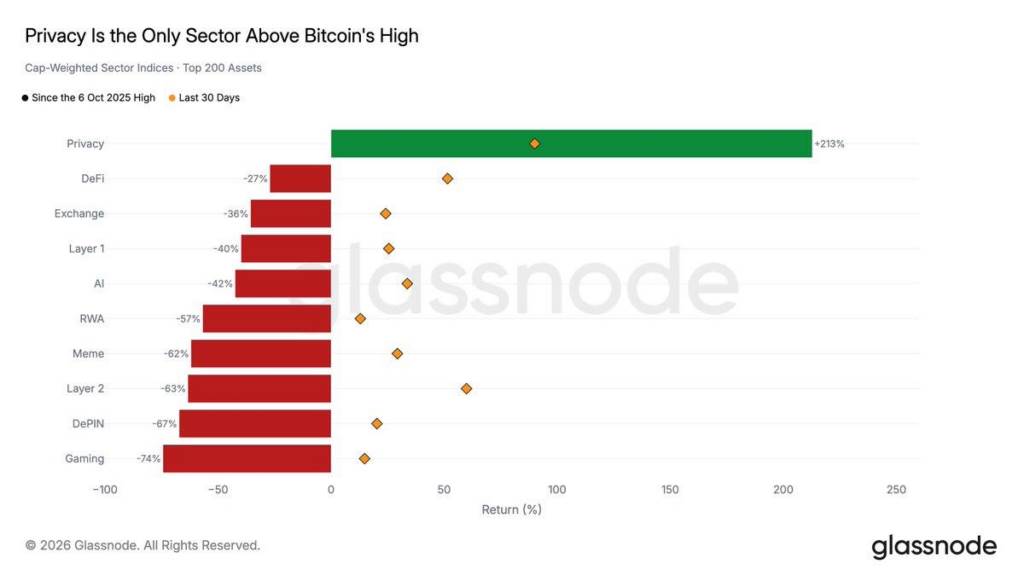 Privacy coins lead the crypto market, rising 213%| Source: Glassnode
Institutional investors have also shown greater interest in privacy coins. For example, Grayscale Investments applied in May 2026 to convert the Zcash investment trust into a spot ETF. This will become the first exchange-traded fund in the United States to focus on privacy coins. As a result, Grayscale's request may have pushed up ZEC's price, and the overall increase suggests institutional investors 'growing interest in privacy coins.
Bitcoin's shift in role stimulates new interest in private coins
Increased regulatory interest in private coins can also be seen as a positive signal. The Coin Republic reports that the U.S. Securities and Exchange Commission (SEC) has ended its review of privacy coin issues without taking enforcement action. As a result, the agency alleviates uncertainty in these markets. Cryptocurrency investors responded enthusiastically to the news, with some believing that approval of the Zcash ETF will herald more inflows of institutional funds. 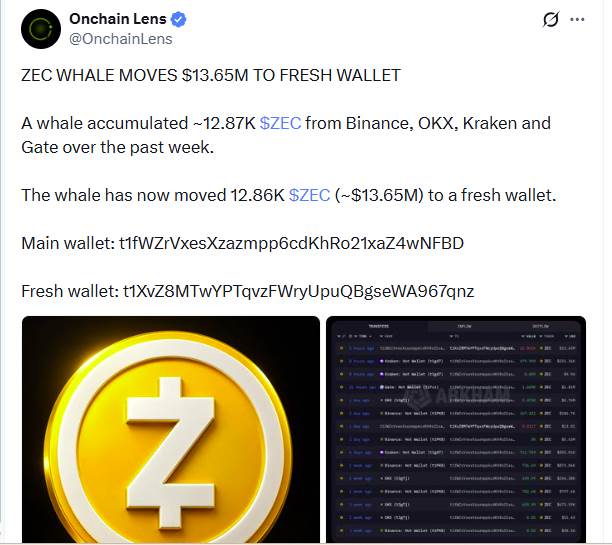 Whales transfer $13.65 million in ZEC to new wallet| Source: X
Tushar Jain, co-founder of Multicoin Capital, even revealed that his company has been accumulating a large number of ZEC positions since the beginning of 2026. They believe this could be used as a macro hedging tool. These developments illustrate the larger trend Talati describes: As Bitcoin abandons its outsider image, traders are beginning to revisit alternatives. Analysts said the recent rebound in ZEC (up about 113% year-to-date) and XMR reflected a "return of stronger demand for privacy-focused assets." Currently, the oldest Bitcoin supporters remain divided. Some embrace its success on Wall Street, while others chase the anonymity that privacy coins bring.