Exchange Ranking
 Top Exchanges
 24h Volume Ranking
 Popularity Ranking
 Exchange BTC Balance
 Proof of Reserves
 Decentralized Exchanges
 Funding Rate
 Funding Heatmap
 Liquidation Data
 Max Pain
 Long/Short Ratio
 Whale L/S Ratio
 Binance/Okex/Huobi L/S
 Bitfinex Margin L/S
 ETF Tracker
 Solana ETF
 XRP ETF
 Hong Kong ETF
 Bitcoin Treasuries
 Crypto Reversal
 Ethereum Reserves
 HyperLiquid Wallet Analysis
 Hyperliquid Whale Watch
 Large Transactions
 On-chain Movement
 Bitcoin ROI
 Stablecoin Market Cap
 Options Analysis
 News
News Articles
 Economic Calendar
 Features
 Wallet
 Contract Calculator


 Security
 Collections
 Watchlist
 Following
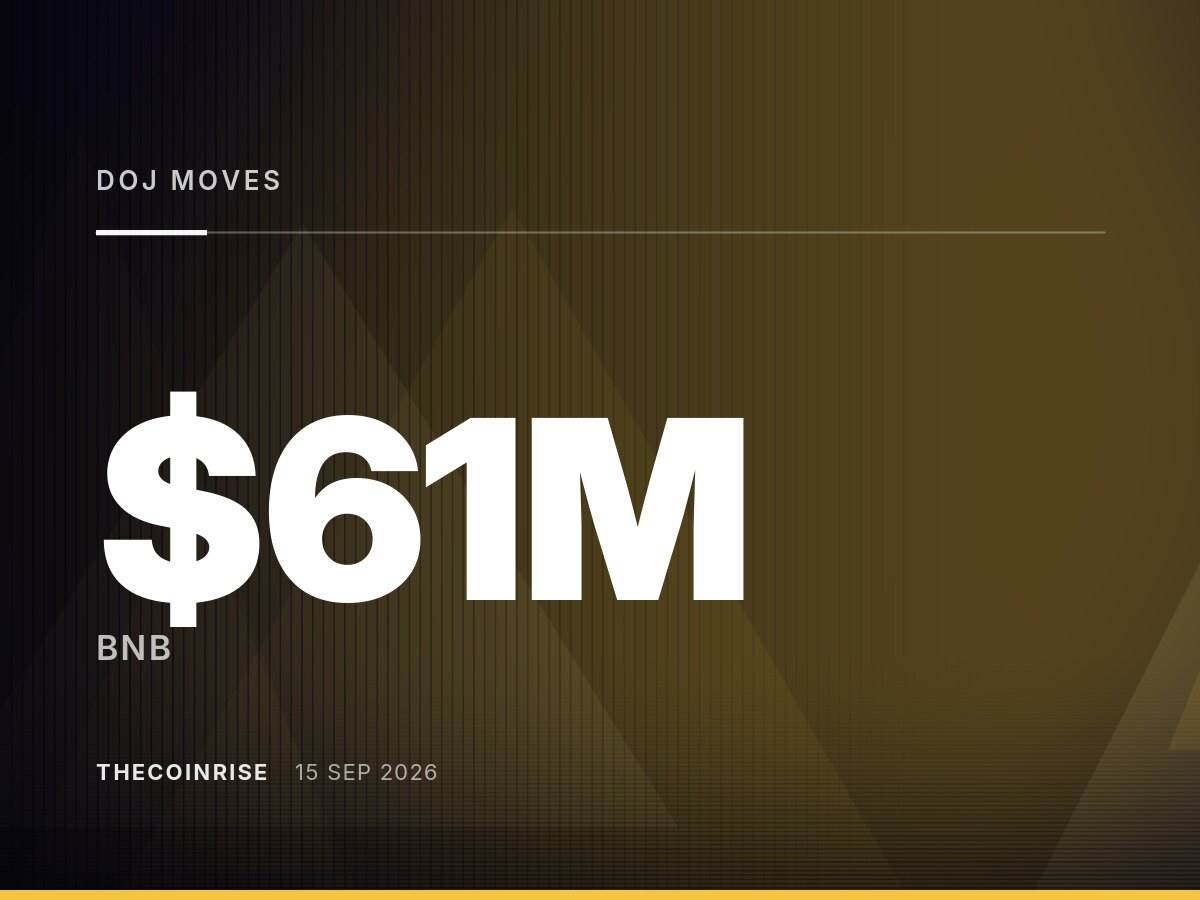
The U.S. Department of Justice seeks to seize US$61 million in Iranian oil proceeds related to Binance accounts
The U.S. Department of Justice has requested a federal court to seize approximately US$61 million in funds, saying the funds represent illegal proceeds from Iranian oil sales. Prosecutors allege that the funds were laundered through accounts held by Binance, the world's largest cryptocurrency exchange by trading volume.
According to relevant reports, the core of this asset confiscation operation lies in accounts that have been confirmed in some form by the U.S. Department of Justice as compliant. Although the two media outlets did not elaborate on the specific nature of the previous guarantees, the obvious contradiction between the "compliance certification" obtained in the past and the current confiscation action constitutes a key focus of the case.
Sanctions Background and Regulatory Environment
Over the years, the United States has imposed extensive sanctions on Iran, including restrictions on its oil exports. Because proceeds from sales of sanctioned oil can be used to fund activities that violate U.S. law, law enforcement agencies at the Treasury and Justice Departments often target such funds. Given the speed and relative anonymity of cryptocurrency transfers compared to traditional banking systems, cryptocurrency exchanges are increasingly becoming the focus of review in such cases.
The exchange has faced heightened regulatory attention since Binance reached a landmark settlement with the U.S. government in 2023 for violating the Bank Secrecy Act and sanctions. The settlement included a $4.3 billion fine and required Binance to overhaul its compliance program. Founder Changpeng Zhao pleaded guilty in the settlement and later resigned as CEO.
Compliance challenges and legal proceedings
New asset forfeiture documents indicate that despite the reforms, questions remain about how funds associated with sanctioned entities flow through Binance platforms. It is unclear whether the account involved was opened before or after the 2023 settlement, and whether Binance itself faces additional legal liability in this specific case.
Such asset forfeiture operations are usually conducted through civil proceedings independent of criminal charges. The government must prove that the targeted funds can be traced to illegal activities, in this case an alleged sanctions violation related to Iran's oil revenue. If successful, the funds will be confiscated by the U.S. government rather than returned to the account holder.
The case highlights U.S. authorities 'use of asset forfeiture as a broader model of combating sanctions evasion involving digital assets. It also reveals tensions between cryptocurrency exchanges 'compliance obligations and their historical use to transfer restricted funds across borders.
Market Impact and Industry Outlook
Given the relatively limited amount involved, this asset forfeiture application is unlikely to have an immediate impact on Binance's trading volume or token prices. However, it has strengthened ongoing regulatory review of centralized exchanges 'compliance frameworks, particularly with regard to sanctions enforcement.
For the broader crypto industry, the case may prompt other exchanges to reassess account monitoring mechanisms associated with sanctioned jurisdictions. Even after a 2023 settlement with the U.S. Department of Justice, continued enforcement actions could still put Binance in the compliance spotlight, affecting its institutional partnerships and regulatory negotiations in other jurisdictions.
This seizure action demonstrates that even after previous compliance settlements, U.S. authorities continue to track sanctioned funds flowing through major cryptocurrency exchanges. As the case progresses, more details about specific accounts and previous assurances from the Justice Department may emerge.
FAQs
What is the Department of Justice trying to seize?
The Justice Department seeks to confiscate approximately $61 million for allegedly representing Iranian oil sales proceeds flowing through Binance accounts.
Why is Binance specifically involved?
Prosecutors said the funds were laundered through accounts held by Binance, and it was reported that the U.S. Department of Justice had previously endorsed these accounts in some form.
Has Binance faced U.S. enforcement actions before?
Yes. Binance settled with U.S. authorities in 2023, admitting violations of the Bank Secrecy Act and sanctions, paying a $4.3 billion fine and agreeing to compliance reforms.
What happens if the forfeiture application is approved?
If the court grants the DOJ request, the targeted funds will be confiscated by the U.S. government rather than returned to the account holder.