Exchange Ranking
 Top Exchanges
 24h Volume Ranking
 Popularity Ranking
 Exchange BTC Balance
 Proof of Reserves
 Decentralized Exchanges
 Funding Rate
 Funding Heatmap
 Liquidation Data
 Max Pain
 Long/Short Ratio
 Whale L/S Ratio
 Binance/Okex/Huobi L/S
 Bitfinex Margin L/S
 ETF Tracker
 Solana ETF
 XRP ETF
 Hong Kong ETF
 Bitcoin Treasuries
 Crypto Reversal
 Ethereum Reserves
 HyperLiquid Wallet Analysis
 Hyperliquid Whale Watch
 Large Transactions
 On-chain Movement
 Bitcoin ROI
 Stablecoin Market Cap
 Options Analysis
 News
 Articles
 Economic Calendar
 Features
 Wallet
 Contract Calculator


 Security
 Collections
 Watchlist
 Following
 BTC
Key points:
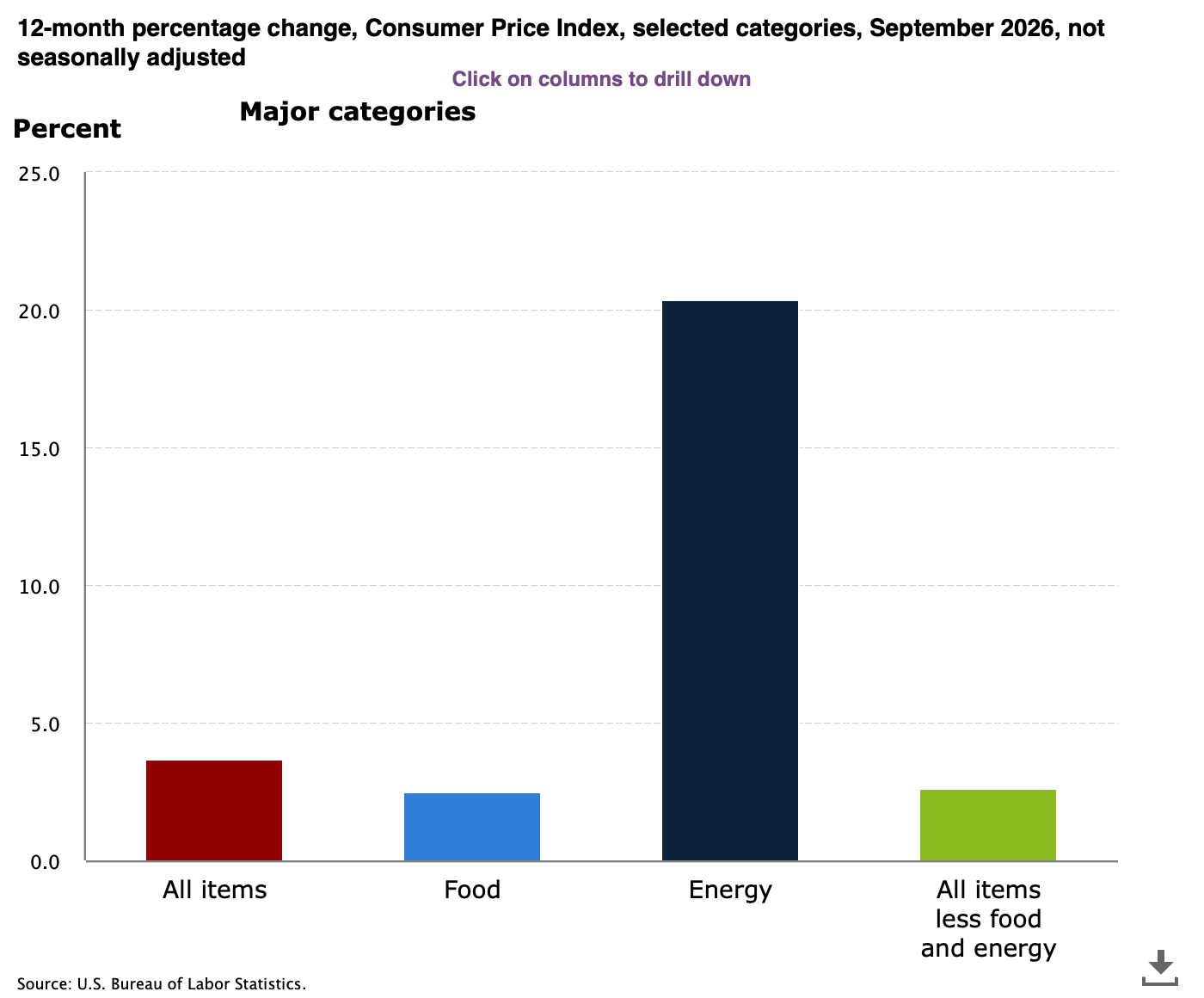
In September, the consumer price index (CPI) increased by 0.6% month-on-month, and by 3.7% year-on-year.
The core inflation rate remained stable at 0.3% for the month, but rose to 2.6% year-over-year.
Gas prices surged by 9.1%, and housing costs also increased rapidly during this month.
The daily closing price of Bitcoin remained above $80,500, which remains a key point of observation in current market analysis.
Producer Price Indexes (PPI), retail sales data, and statements by Federal Reserve officials could influence future market trends.
The trends reflected in September’s reports weren’t limited to the sudden increase in gas prices alone.
According to data from the U.S. Bureau of Labor Statistics, after adjusting for seasonality, the consumer price index increased by 0.6% month-on-month in September, higher than the 0.4% increase in August. Year-over-year, the index rose from 3.4% to 3.7%.
Energy was the main driver of growth this month. Gas prices rose by 9.1%, accounting for more than half of all increases. The broader energy index climbed by 5.2%. Over the past year, energy prices have risen by 20.4%, with gas prices increasing by 34.2%.
However, this report doesn’t only focus on fuel costs. Excluding food and energy, the core CPI increased by 0.3% for the second month in a row. Year-over-year, the rate rose from 2.4% to 2.6%. Housing costs increased by 0.4% in September, following an 0.3% increase in August. Additionally, prices for used cars, airline tickets, entertainment, education, and clothing also rose during this month.
This mixed signal makes market reactions more complex than those associated with purely energy-driven spikes. The rise in oil prices may reverse quickly, but more solid core indicators and higher housing costs are factors that policymakers cannot easily ignore.
Bitcoin’s initial reactions may not adequately address the issue of inflation
. Strong inflation data that exceeds expectations could prompt traders to reconsider the timing and scale of future interest rate cuts. Bond yields and the US dollar tend to react first, while Bitcoin’s movements are often correlated with broader changes in risk preferences.
However, the market’s initial reaction to CPI data often proves incomplete. Traders initially focus on headline figures, then re-evaluate the composition of reports, reactions from traditional markets, and subsequent economic data. Therefore, sharp fluctuations after the release could reverse before the daily closing price.
The daily closing price focuses around the $80,500 level
. Bitcoin’s recent defense of the $81,000 range has established a crucial support zone. If Bitcoin’s daily closing price remains above $80,500, it may indicate that the market has absorbed the initial inflation reactions without breaking this structure.
Chart key points: $80,500 is the current immediate daily closing price level.
Intraday fluctuations may reflect the initial reaction to CPI data; however, closing prices provide a clearer view of whether buyers are still defending a broader support zone.
The range of 80,000 dollars is located below this key level. If prices continue to fall below this level, attention will turn to the point of 70,500 dollars. There may be insufficient support for options positions at that level, and the downward trend could become more volatile. In the upward direction, 90,000 dollars remains relevant. If Bitcoin breaks through this level, option sellers may need to adjust their hedging strategies. If this process coincides with stronger physical demand, it could generate momentum. However, this does not guarantee that prices will continue to rise. Data released on Thursday may either strengthen or weaken the signals related to CPI. Producer Price Index (PPI) and retail sales data will be released at 12:30 UTC. PPI may provide further insight into cost pressures in the supply chain, while retail sales data can reveal whether consumer demand remains resilient despite high prices. At 03:30 UTC on Friday, Federal Reserve Chairman Kevin Warsh is expected to give a speech. Market participants will likely look for clues in his remarks to understand how policymakers balance new inflationary pressures with economic growth and financial conditions. Inflation has raised the threshold for sustainable recovery. The CPI report shows an accelerating pace of price increases, but it also indicates that price pressures have extended beyond energy prices. This puts Bitcoin under immediate technical testing, along with a macro issue that may take several trading sessions to resolve.Currently, it is important to observe whether Bitcoin remains above $80,500 at the end of each day. We will then need to assess whether the data released on Thursday and the comments from the Federal Reserve on Friday serve to strengthen or weaken the reasons for tightening financial conditions.