Exchange Ranking
 Top Exchanges
 24h Volume Ranking
 Popularity Ranking
 Exchange BTC Balance
 Proof of Reserves
 Decentralized Exchanges
 Funding Rate
 Funding Heatmap
 Liquidation Data
 Max Pain
 Long/Short Ratio
 Whale L/S Ratio
 Binance/Okex/Huobi L/S
 Bitfinex Margin L/S
 ETF Tracker
 Solana ETF
 XRP ETF
 Hong Kong ETF
 Bitcoin Treasuries
 Crypto Reversal
 Ethereum Reserves
 HyperLiquid Wallet Analysis
 Hyperliquid Whale Watch
 Large Transactions
 On-chain Movement
 Bitcoin ROI
 Stablecoin Market Cap
 Options Analysis
 News
News Articles
 Economic Calendar
 Features
 Wallet
 Contract Calculator


 Security
 Collections
 Watchlist
 Following
 BTC
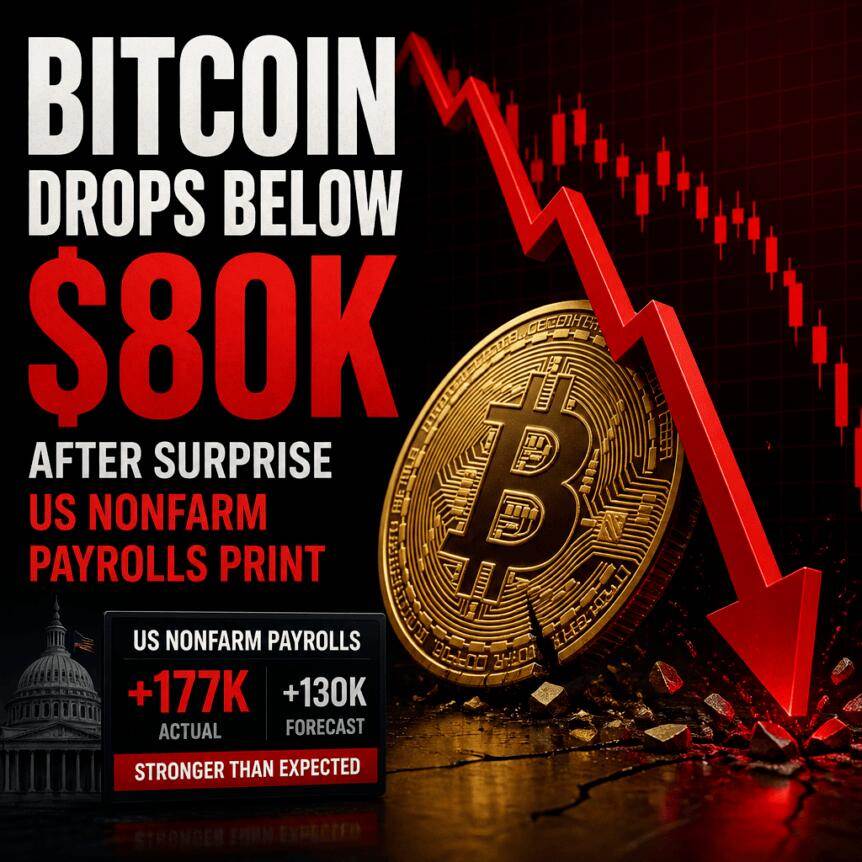
BTC U.S. employment data in August exceeded expectations, Bitcoin rebounded after short-term pressure.
The U.S. employment report in August was released. Its strength far exceeded the expectations of many economists and quickly spread to risky assets including Bitcoin. According to data released on Friday, the U.S. economy added 162,000 non-farm jobs, which is about three times the market consensus estimate of about 56,000. Affected by this news, the Bitcoin price initially fell from approximately US$81,300 to a local low around US$78,600, and then recovered to approximately US$79,500 at the time of writing.
The strong labor market has also injected new volatility into expectations for the next Federal Open Market Committee (FOMC) decision on September 15 - 16. Although the Fed's policy path remains controversial, traders appeared to re-price the probability of suspending interest rates and raising interest rates again after the release of non-farm data. At the same time, the political debate over interest rates is intensifying.
Key Points
- U.S. non-farm payrolls increased to 162,000 in August, well above the economists 'consensus forecast of about 56,000.
- Bitcoin fell from $81,300 to $78,600 under selling pressure, and then rebounded to about $79,500.
- After the data was released, the implied probability of the September 16 FOMC interest rate decision on Polymarket once again returned to a 50/50 split.
- A forked Bitcoin chain based on the Blake2b algorithm (a continuation of the BIP-110 chain) saw early spot trading activity, with the token price on the Neoxa exchange trading at approximately US$350 and traded against USDC.
Strong employment data again changes FOMC expectations
The strength of the labor market is critical to central bank policy because it affects whether inflationary pressures will persist and whether the Fed can comfortably-or even should-relax monetary policy as soon as possible. This latest set of data was significantly higher than forecasts, and traders responded in real time.
Earlier this week, market sentiment about the upcoming FOMC meeting became unstable. In particular, Federal Reserve Governor Christopher Waller said on Thursday that he preferred to pause interest rates while waiting for upcoming inflation data. The comment helped drive a change in the market's implied probability: Polymarket reportedly adjusted the probability of suspending interest rates to 60% and the probability of a 25 basis point rate increase to 40%.
However, Friday's labor force data changed that pattern. After the employment data was better than expected, the implied probabilities returned to a roughly equal split state, with Polymarket showing that the probability of suspending interest rates and raising interest rates by 25 basis points each accounted for 50%.
In addition to the market level, political pressure on the direction of the Fed's policy has also become part of the narrative. U.S. President Donald Trump called for further interest rate cuts on the Truth Social platform, arguing that high interest rates put the United States at a disadvantage and said he would not allow that to happen. The post also portrayed the debate as a shift from the stance of former leadership-Trump had previously criticized former Chairman Jerome Powell for not cutting interest rates, but he did not make a similar request until Friday in the context of targeting the then-new Fed leadership.
Why strong employment data leads to a Bitcoin sell-off
Bitcoin's decline after the employment data is released follows a pattern investors have seen in many interest-sensitive environments: stronger economic data will increase expectations that borrowing costs will remain higher for longer. This could lead to tighter financial conditions and reduce appetite for highly volatile assets.
In this case, the chart reaction is very clear. After the data was released, Bitcoin fell from about $81,300 to a local low of about $78,600, before partially recovering to about $79,500. While the rally suggests traders are not fully committed to a sustained safe-haven trajectory, the initial sell-off highlights how macroeconomic data can quickly override other narratives when the policy path feels uncertain.
As the next FOMC meeting approaches, this employment report provides traders with a data point to calibrate their views on the Fed's response function. What remains uncertain is not only the policy direction, but also whether committee members will ultimately unanimously support a single approach-not least because many traders believe the anchor of forward guidance has weakened compared to previous periods, when signals were clearer.
Blake2b Bitcoin fork finds first meager liquidity
In addition to macro-driven market fluctuations, a technological development within the "Bitcoin fork" ecosystem has also attracted attention. After the BIP-110 soft fork was activated on August 7, the network temporarily split into a chain that enforces BIP-110 rules and a chain that continues to follow the old rule set.
Backers of BIP-110 believe that the branch is in trouble because miners have not allocated enough computing power to continue expanding it. In response, they viewed the result as evidence-at least in their view-of the extent of concentration of influence within the mining layer. Their criticism centers on the fact that only a few mining pools control most of Bitcoin's hashrate, which means that the same entities can strongly influence which chains are advanced and which transactions enter blocks.
Since then, some BIP-110 supporters have taken a different approach. Led by Luke Dashjr, they continued to maintain the BIP-110 chain while changing the Proof-of-Work algorithm to Blake2b. Based on supporters 'reasons, the move aims to make it easier for another group of miners to participate by using DATUM Gateway technology. The related hard fork was launched on August 30.
A key practical impact is that holders of SHA-256 bitcoin balances are mapped to the Blake2b version on a 1:1 ratio: It is reported that all addresses that held SHA-256 bitcoin before (and possibly after) August 7 held the same amount of tokens on the Blake2b chain.
Currently, liquidity is still limited. The only exchange that lists Blake2b bitcoins is Neoxa. Even so, early trading can be seen: According to the order book of the BTCB2/USDC trading pair on Neoxa, the Blake2b token traded at approximately US$350 against USDC, with a spread of approximately 1.1%.
Future Outlook: Macro Volatility and Forking Liquidity
Looking forward, the main driving force behind Bitcoin's recent sentiment may still be macro factors-especially at the September 15 - 16 Fed meeting, new labor and inflation data may still readjust the market's probability weights. At the same time, the story of Blake2b's fork is an independent but related reminder that the development of the "Bitcoin ecosystem" is increasingly moving along parallel paths-and the depth of token availability and liquidity on exchanges may determine whether these narratives transcend niche transactions.