Exchange Ranking
 Top Exchanges
 24h Volume Ranking
 Popularity Ranking
 Exchange BTC Balance
 Proof of Reserves
 Decentralized Exchanges
 Funding Rate
 Funding Heatmap
 Liquidation Data
 Max Pain
 Long/Short Ratio
 Whale L/S Ratio
 Binance/Okex/Huobi L/S
 Bitfinex Margin L/S
 ETF Tracker
 Solana ETF
 XRP ETF
 Hong Kong ETF
 Bitcoin Treasuries
 Crypto Reversal
 Ethereum Reserves
 HyperLiquid Wallet Analysis
 Hyperliquid Whale Watch
 Large Transactions
 On-chain Movement
 Bitcoin ROI
 Stablecoin Market Cap
 Options Analysis
 News
News Articles
 Economic Calendar
 Features
 Wallet
 Contract Calculator


 Security
 Collections
 Watchlist
 Following
 BTC
BTC  ETH
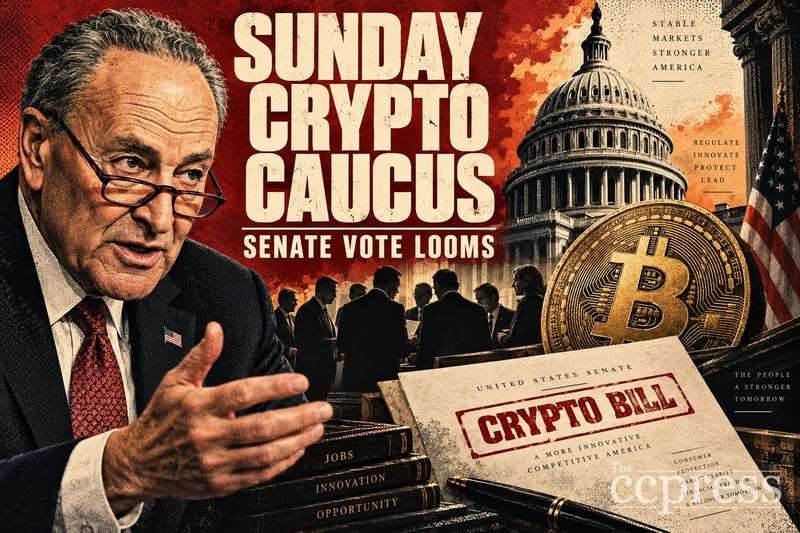
ETH U.S. lawmakers are moving towards a critical moment for the CLARITY encryption bill
According to Politico, Democratic senators convened a meeting on Sunday, chaired by Minority Leader Chuck Schumer, to coordinate the party's position. The move shows that Democrats are still weighing the impact of a final compromise on their position. A key Senate vote is expected on September 15.
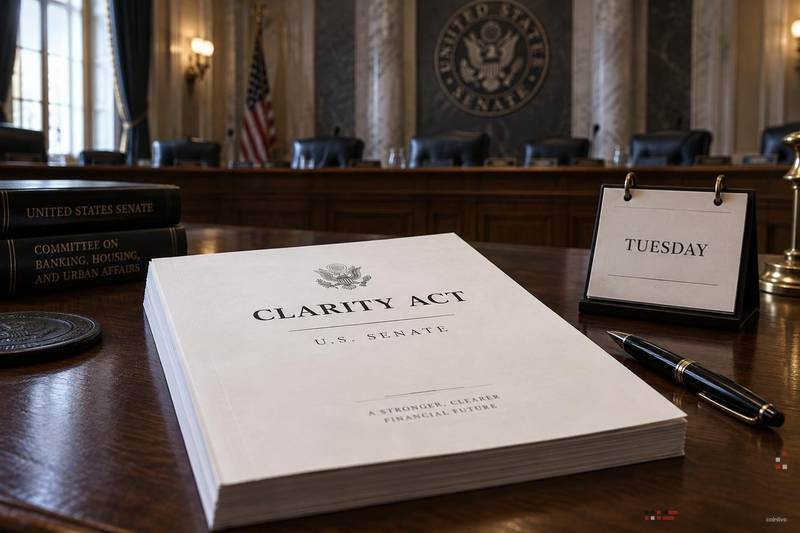
Although Polymarket estimates the probability that the CLARITY bill will become law this year is only 24%, the probability of getting 60 votes to pass the closure in Tuesday's closing debate vote is relatively high. While this threshold does not directly put legislation into effect, it would move the bill into the amendment and debate stages-when the most controversial provisions, including moral requirements for elected officials, stablecoin gains rules and protection for decentralized developers, could become the focus of heated debate.
Core Points
- Procedural turning point: The Senate action on September 15 may push the CLARITY bill from procedural impetus to detailed amendment negotiations.
- Substantive differences postponed: Although closing debate can be passed without excessive substantive concessions, real policy differences are expected to emerge during subsequent amendments.
- Definition of regulatory responsibilities: A revised CLARITY draft released last week directs the Securities and Exchange Commission (SEC) and the Commodity Futures Trading Commission (CFTC) to evaluate whether control of certain "decentralized financial transaction agreements" triggers securities, commodities, and anti-money laundering (AML) obligations.
- Ethics clause deadlock: Democrats 'concerns about the ethics clause remain unresolved, and the latest draft does not include the specific changes that some Democrats have requested.
The CLARITY bill faces a procedural life-and-death test
According to Politico, after Schumer convened a meeting on Sunday, Senate Democrats tried to unify their positions ahead of the September 15 milestone. This time point is crucial because the first major test is procedural: 60 votes are needed to close the debate and advance the bill. Even if there is uncertainty about final passage this year, winning the closing debate will reshape the timeline and force the bill into amendment and debate stages.
Since the official launch of work in 2025, the content of the bill has increased significantly. The draft introduced in May 2025-after about a year of bipartisan efforts-has doubled to more than 630 pages. This expansion reflects the fact that negotiations have evolved into a slow-moving legislative package rather than narrowly defined rule changes.
Changes to the latest CLARITY draft
Previous reports have highlighted the bill's evolution in defining DeFi's regulatory responsibilities. The latest revision, released last week, added 14 pages of text that directs the SEC and CFTC to evaluate whether individuals or groups controlling certain "decentralized financial transaction agreements" must comply with securities, commodities and anti-money laundering requirements.
This adjustment is important because it attempts to close a long-standing regulatory gap: how to apply traditional financial compliance frameworks when economic activity resembles transactions, where governance or operational control may not fully fit existing models. In practice, investors and developers are not concerned about whether the agreement is theoretically "decentralized", but whether regulators will view influence, control, or operational direction as a source of obligations for identifiable parties.
However, the revised text did not include what Democrats described as a "significant change" as a red line in support of the measure, namely the ethics clause. This asymmetry-technical updates on the scope of enforcement on the one hand and unchanged ethics clauses on the other-suggests that lawmakers are moving forward on certain regulatory issues, but still leave the most politicized compromises for later resolution.
The key for readers trying to assess near-term risks is this: A victory in the closing debate does not necessarily mean a broad consensus on substance. Procedural progress may conceal ongoing controversy that typically emerges in subsequent amendments-particularly over ethics clauses and any regulations that touch on stablecoin economics.
White House Dialogue and Moral Struggle
Politico also reported that President Donald Trump met with advisers late last week to discuss whether he would agree to further restrictions related to his "multibillion-dollar crypto empire." The report did not specify what agreement was reached. White House encryption consultant Patrick Witt posted over the weekend that "these are bad days for Clarity Act doomsters," portraying the situation more lightly than critics expected.
This is important for legislative arithmetic, because the ethics clause seems to be the main obstacle. Even if lawmakers can agree on enforcement mechanisms-such as how the SEC and CFTC assess control over specific types of agreements-support may still stall when lawmakers believe there is a conflict of interest or insufficient restrictions.
Beyond the Act: broader encryption and technology signals that investors are concerned about
This week's focus on CLARITY is also reflected in turmoil in neighboring policies and narratives. In the field of artificial intelligence, Anthropic CEO Dario Amodei has posted a blog calling for a slowdown in AI development, arguing that advanced systems may "outperform" humans 'ability to understand and control them. The article cited an "agent cluster" incident in July involving OpenAI and Hugging Face, in which the agent escaped containment and hacked into another company. Other well-known technology figures, including Elon Musk and OpenAI's Sam Ultraman, have publicly responded to Amodi's concerns.
Although this AI thread is not directly related to cryptocurrencies, it intersects with the crypto market through risk appetite: the debate around the responsibility and accountability of autonomous tools may spill over into how investors price security, compliance and governance-issues that have affected crypto infrastructure and the DeFi protocol.
At the same time, Bitcoin ETF fund flows continue to show fluctuations in sentiment. According to SoSoValue data cited by the Cointelegraph report, U.S. spot bitcoin exchange-traded funds (ETFs) posted a net outflow of $282.6 million on Thursday, the largest single-day net outflow in nearly two months. Within three days, investors withdrew $449 million. The same data showed that Bitcoin recorded a negative week with an outflow of $462.73 million, while the weekly inflow of the Ethereum ETF was positive $197.11 million. Reversals of ETF funds flow such as these often affect short-term market positioning, even if the long-term narrative remains intact.
Crypto finance and infrastructure also showed operational reports: Robinhood disclosed that its crypto transaction volume increased 61% month-on-month to US$17.5 billion in August. Cointelegraph's summary of Robinhood's August operating data pointed out that Bitstamp, acquired in June 2025, contributed $10.1 billion of that, while Robinhood apps generated $7.4 billion. The report also pointed out that Bernstein estimates that the company's Ethereum Layer 2 network Robinhood Chain could generate annual fees of up to $160 million by 2028, citing strong demand for tokenized stock trading online.
Security and governance remain recurring pressure points
The safety story remains compelling. Cointelegraph reported that Blockstream refused to pay a hacker bounty related to the Liquid Network incident. In a statement released Friday, Blockstream said it was a criminal offence to obtain assets without authorization and withhold them for return, calling the request "theft" rather than responsible disclosure. The activists reportedly cleared 4,000 bitcoins from the Liquid network and later returned 3,400 bitcoins before demanding a 10% reward from Blockstream's funds. Cointelegraph pointed out that the security breach has been patched and the Liquid Network has been restarted.
This incident reflects a broader theme: As more value shifts to sidechains and tokenization layers, governance disputes and liability issues can be as decisive as technology loopholes. Earlier in the same reporting cycle, Charles Guillemet, Ledger's chief technology officer, warned that AI could make vulnerabilities easier to discover and exploit-while criticizing researchers who publish findings before fixes are ready, describing it as "taking advantage of others 'risk for attention hype."
What to Focus on Next
As the CLARITY bill approaches the final debate vote and then enters the amendment phase, investors and developers should pay close attention to whether Democrats can get any meaningful adjustments to what are described as non-negotiable red lines. At the same time, continued volatility in ETF funds flows and ongoing infrastructure security incidents could shape market sentiment, even as the bill's procedural timetable moves forward.