Exchange Ranking
 Top Exchanges
 24h Volume Ranking
 Popularity Ranking
 Exchange BTC Balance
 Proof of Reserves
 Decentralized Exchanges
 Funding Rate
 Funding Heatmap
 Liquidation Data
 Max Pain
 Long/Short Ratio
 Whale L/S Ratio
 Binance/Okex/Huobi L/S
 Bitfinex Margin L/S
 ETF Tracker
 Solana ETF
 XRP ETF
 Hong Kong ETF
 Bitcoin Treasuries
 Crypto Reversal
 Ethereum Reserves
 HyperLiquid Wallet Analysis
 Hyperliquid Whale Watch
 Large Transactions
 On-chain Movement
 Bitcoin ROI
 Stablecoin Market Cap
 Options Analysis
 News
News Articles
 Economic Calendar
 Features
 Wallet
 Contract Calculator


 Security
 Collections
 Watchlist
 Following
 XRP
XRP  RLUSD
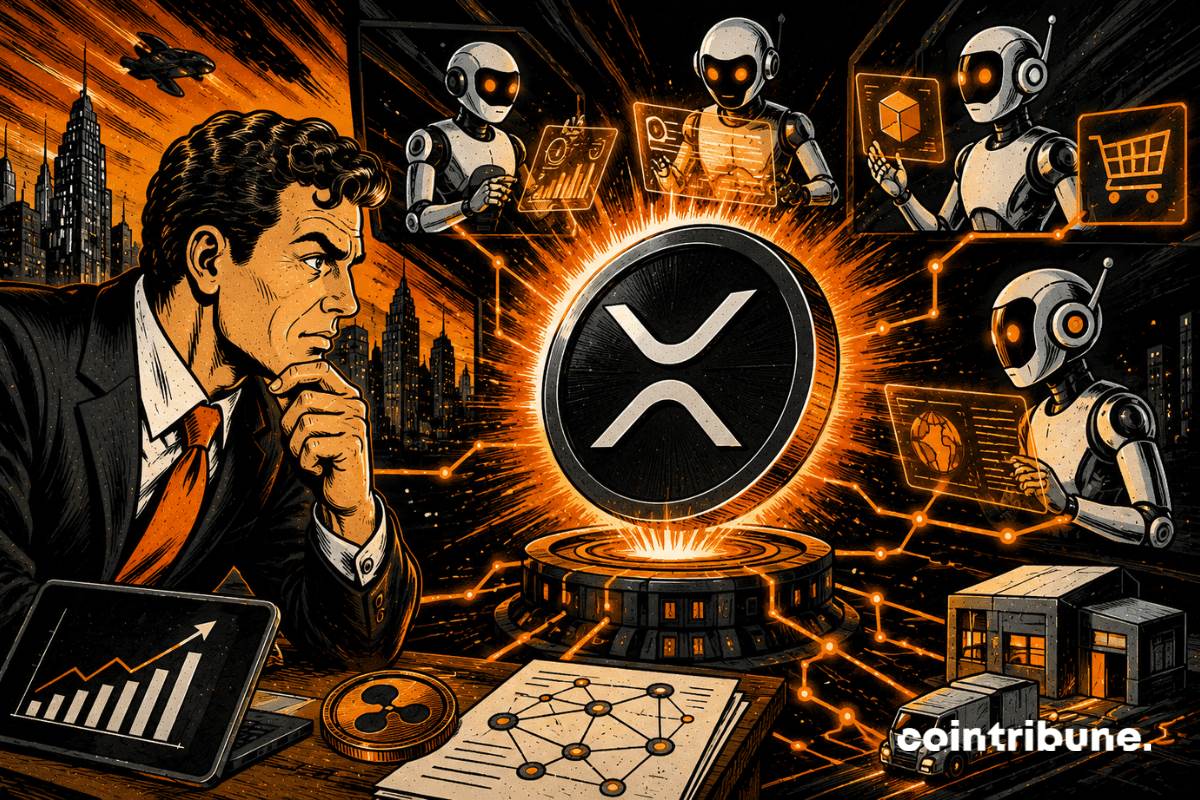
RLUSD Artificial intelligence has moved beyond simple analysis and consultation functions to directly perform payments. Thanks to the emergence and development of autonomous agents capable of conducting banking and commercial transactions, XRP Ledger's role will evolve. In addition to serving as a visible settlement infrastructure, the network can also serve as a secondary financial layer that machines call directly. This revolution has also changed the measurement of technology adoption. In addition to transaction volume, the value of blockchain will now be evaluated by its ability to automate payments, organize the flow of funds, and make the network almost invisible to users.
Summary
More than one million transactions have been executed on XRP Ledger (XRPL) by AI agents without human intervention.
The release of the XRPL AI starter kit and the integration of Mastercard's "Agent Pay for Machines" program have structured payments into XRP and RLUSD.
AI agents are evolving towards specific purchasing behaviors that are subject to budget, merchant restrictions, and strict authorization constraints.
Using the XRPL payment channel, thousands of offline micro-transactions can be aggregated to maintain network scalability.
The rise of spending authorization and transaction automation on the XRP network
The transition from automated procedures to complete economic entities has passed a critical stage on XRPL. Chandler Fang, co-founder of t54, a trusted startup that focuses on AI agents, a former product manager at Ripple and has experience with JPMorgan Chase, points out that machine-to-machine transactions are no longer theory. He said that agents have made more than one million transactions on XRP Ledger and no human participation is required in the system.
Starting from June 10, this momentum has been consolidated with the launch of the XRPL AI starter kit. The toolkit allows x402 payments using XRP and leverages Ripple (U.S. dollar) stablecoin to compensate for computing resources, model reasoning, or API access. On the same day, with the launch of MasterCard's "Agent Pay for Machines" program, the method was commercially expanded. The program brings together more than thirty partners, including Coinbase, Stripe, the Solana Foundation and Ripple (through its subsidiary RippleX).
In addition, the system integrates encrypted settlement channels into traditional payment infrastructure for invoice processing and reserves computing power without manual prior verification. Given these deployments and the $5 million funding support provided by Ripple and Franklin Templeton to t54 in the seed round, Chandler Fang said: "This changes the way we think about how XRPL is adopted."
This gradual process is based on the strict evolution of the authorization mechanisms used to grant software. After consuming digital services at the heart of automated workflows, agents turn to spending authorizations that are bound by concise budgets, merchant restrictions, and user-set approval rules.
The network now needs to develop crypto wallets associated with configurable financial instruments. For merchants, this deployment requires software to be able to present prices, inventory status, delivery conditions and settlement interfaces in a form readable by an autonomous system. Eventually, agents that have established reliable identities, transactions and repayment records will no longer need to pre-invest money on a case-by-case basis. They will immediately gain financial capacity or credit lines.
Numerous strategic initiatives and technological developments constitute a new phase of this institutional adoption:
Strong institutional endorsement: t54 The $5 million funding support received from Ripple and Franklin Templeton demonstrates the industrial relevance of trusted infrastructure for AI.
Bank interoperability: RippleX is integrated into Mastercard's "Agent Pay for Machines" program, placing major crypto participants within the same framework as payment giants.
x402 Payment Standardization: The joint use of XRP and RLUSD ensures full flexibility between fast settlement and currency stability in microservices.
Coexisting off-chain payment channels with crypto assets
Artificial intelligence-driven growth in business flows does not mean that every price comparison or compliance check is achieved by writing directly to XRPL. To maintain the ecosystem's ability to respond to high-frequency requests, the architecture relies on the XRPL payment channel.
This process allows both parties to exchange XRP-based signature statements outside of global consensus, and then settle the final obligation on the ledger through a single transaction. This creates three types of workloads: repetitive low-value payments for Web microservices, lower-frequency but high-value transactions for corporate businesses, and thousands of internal operations aggregated before final settlement on the chain. In this context, settlement needs determine the assets used. Ripple's crypto asset XRP plays a routing and direct settlement role, while RLUSD provides dollar-denominated currency stability for certain purchases.
As a result, these two assets form a functional operational complement within the network. XRP maintains its appeal for cross-border liquidity and instant interoperability, while RLUSD ensures the accounting predictability companies need to manage IT subscriptions or inventory. The coexistence of these two settlement tools facilitates the adaptation of infrastructure to the regulatory and financial requirements of institutional participants, while optimizing transaction costs for ongoing micropayments.
Graphical interface disappears, shift to back-office banking adoption
In the long run, such infrastructure will be completely invisible to end users. Agents are directly embedded in fund management platforms, logistics software or institutional financial applications to assess risks and process blockchain infrastructure choices in the background, without the need for any interface operations by individuals. In this regard, Chandler Fang emphasized: "Long-term adoption does not require everyone to open the XRPL wallet or consciously choose a blockchain before completing the task."
Therefore, trading volume no longer constitutes a relevant adoption indicator. Networks will now be evaluated based on the repeatability of operations, the revenue generated by merchants, strict adherence to allocated budgets, and dispute resolution efficiency. As the former Ripple manager summed up: "By then, XRPL will no longer be judged solely based on the ability of agents to use it, but based on the amount of useful economic activity they choose to settle on."
This shift thus sets a key milestone for integrating decentralized ledgers into the global economic structure. While the shift to transparent underlying transactions is expected to solve interoperability issues between traditional banking systems and blockchain, the speed of adoption will depend entirely on the robustness of the security standards imposed on agents.
Chandler Fang compares this process to the emergence of ChatGPT: Infrastructure deployments that seem long and uncertain suddenly become an obvious solution to the public. Developers and financial institutions now need to test the resilience of these aggregation channels, because the true measure of XRP Ledger's industrial success lies in its ability to carry this security load.