Exchange Ranking
 Top Exchanges
 24h Volume Ranking
 Popularity Ranking
 Exchange BTC Balance
 Proof of Reserves
 Decentralized Exchanges
 Funding Rate
 Funding Heatmap
 Liquidation Data
 Max Pain
 Long/Short Ratio
 Whale L/S Ratio
 Binance/Okex/Huobi L/S
 Bitfinex Margin L/S
 ETF Tracker
 Solana ETF
 XRP ETF
 Hong Kong ETF
 Bitcoin Treasuries
 Crypto Reversal
 Ethereum Reserves
 HyperLiquid Wallet Analysis
 Hyperliquid Whale Watch
 Large Transactions
 On-chain Movement
 Bitcoin ROI
 Stablecoin Market Cap
 Options Analysis
 News
News Articles
 Economic Calendar
 Features
 Wallet
 Contract Calculator


 Security
 Collections
 Watchlist
 Following
September 15: The vote on the landmark encryption bill approaches
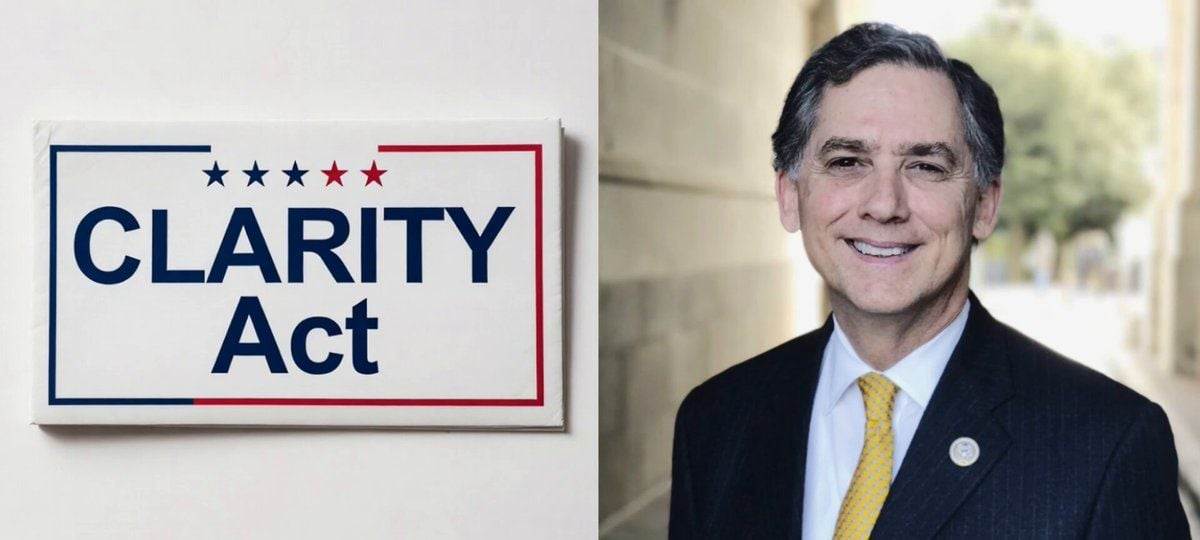
The CLARITY Act is facing a critical turning point. French Hill, chairman of the House Financial Services Committee, said bipartisan negotiations had made progress ahead of the Senate's planned vote.
Previously, due to differences between the two parties on ethics provisions, the Senate postponed the plenary vote before the August 2026 recess and scheduled a procedural closing debate vote on September 15, 2026. The vote needed 60 votes to overcome a filibuster.
As the original sponsor of the legislation, Hill is optimistic that the necessary votes will be reached. He pointed out on September 3 that the Digital Asset Market Clarification Act is expected to receive the 60 votes needed in the Senate to advance, and cited the bill's passage of the House in 2025 with 78 Democratic votes as an example to prove that cross-party support is feasible.
Securities and Exchange Commission Chairman Paul Atkins also expressed confidence that the Senate would advance the bill in September.
Ethics clauses remain a core issue.
In order to ensure smooth passage of the vote, legislators still need to reach consensus on a number of outstanding issues, including government ethics, enforcement clauses, and stablecoin revenue and reward mechanisms. Among them, the ethics clause proved to be the most divisive issue.
Republicans stressed the urgent need for a clear regulatory framework to drive innovation, while Senate Democrats called current ethics provisions "unacceptable" and called for measures to strengthen consumer protection and combat illegal financial activity.
Hill argued that the "best solution to ethics issues is to pass legislation" because it would place everyone-whether related or not-under a strict regulatory framework fully supervised by the Commodity Exchange Commission, Securities and Exchange Commission and banking regulators.
Essentially, the Digital Asset Market Clarity Act aims to establish a clear regulatory division of labor framework that distinguishes which digital assets are securities, commodities, or stablecoins. The bill would grant the Commodity Futures Trading Commission (CFTC) exclusive jurisdiction over the digital commodity spot market, while retaining the Securities and Exchange Commission's jurisdiction over investment contract assets.
For the entire industry, this legislation is of far-reaching significance. While the industry is ready to move forward without the Digital Asset Market Clarification Act, executives and investors say lasting legislation will bring certainty to the market and help attract long-term capital.
Senators will return to Washington on September 14, about 14 working days before the start of the mid-term election campaign season. During this period, any controversial vote will become extremely politically sensitive. The dynamics of the next two weeks will shape the future direction of the U.S. cryptocurrency regulatory system.