Exchange Ranking
 Top Exchanges
 24h Volume Ranking
 Popularity Ranking
 Exchange BTC Balance
 Proof of Reserves
 Decentralized Exchanges
 Funding Rate
 Funding Heatmap
 Liquidation Data
 Max Pain
 Long/Short Ratio
 Whale L/S Ratio
 Binance/Okex/Huobi L/S
 Bitfinex Margin L/S
 ETF Tracker
 Solana ETF
 XRP ETF
 Hong Kong ETF
 Bitcoin Treasuries
 Crypto Reversal
 Ethereum Reserves
 HyperLiquid Wallet Analysis
 Hyperliquid Whale Watch
 Large Transactions
 On-chain Movement
 Bitcoin ROI
 Stablecoin Market Cap
 Options Analysis
 News
News Articles
 Economic Calendar
 Features
 Wallet
 Contract Calculator


 Security
 Collections
 Watchlist
 Following
 HYPE
HYPE  UNI
UNI  PUMP
PUMP  SPK
SPK 2026: Token repurchase becomes the most significant economic model initiative in the crypto market
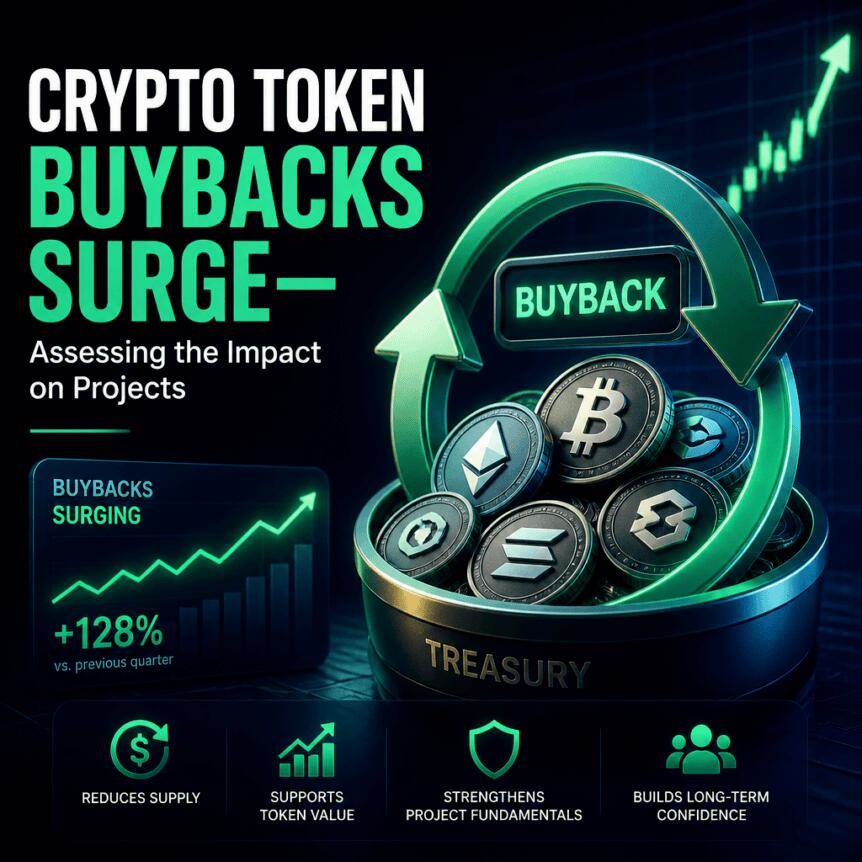
In 2026, token repurchase has become one of the most visible economic model operations in the cryptocurrency field. More and more projects are using revenue generated from the agreement to buy back their own tokens, and then often choose to hold or destroy those tokens. Data from the beginning of the year showed that the team is rapidly transforming the way it connects token value to economic activity, drawing on familiar concepts from traditional finance (TradFi) while adapting it to on-chain mechanisms.
According to relevant reports, since 2026, the expenditure on token repurchase by various projects is approximately US$640 million, an increase of approximately 17% compared with the same period in 2025. It is worth noting that this expenditure level is much higher than the US$366,000 recorded in 2024. Among them, Hyperliquid and Pump.fun accounted for nearly 90% of the total repurchase amount.
Core Points
- Demand creation and supply reduction: Income-driven buybacks are increasingly used to create market demand and, if combined with a destruction mechanism, can reduce circulating supply.
- Communication advantages: Legal experts point out that its main appeal is often a simpler narrative-"buy and destroy" is easier to convey to users than explaining governance mechanisms.
- Fundamental constraints: Repurchase can improve the consistency of interests of token holders, but if the agreement surplus is limited, it cannot solve the fundamental weakness.
- Investor Observation: Investors are watching closely whether buybacks are true value capture or just a financial engineering tool used to temporarily support prices.
- Regulatory concerns: Regulators are focusing on the practical basis of token value, which could reshape the promotional framework for such projects.
Why the "repurchase and destruction" model is popular
The basic logic behind token repurchase is very intuitive. When a project uses revenue to buy back its own tokens, it creates additional demand in the open market. If the repurchased tokens are subsequently destroyed, supply contracts, which can increase scarcity and put upward pressure on prices under favorable conditions.
In addition to market mechanisms, supporters believe that buybacks allow token holders to have a clearer view of the economic performance of the agreement. Orest Gavryliak, chief legal officer of decentralized exchange aggregator 1inch, pointed out that revenue-driven buybacks and demolitions often reflect one of two goals: reducing the supply of tokens in circulation or justifying income from investment agreements.
Gavriliak also highlighted the advantages of communication. He believes that telling users that the project has "bought and destroyed tokens" is much more direct than explaining how governance rights work, how fees are set, or how agreement usage translates into value. This appeal is crucial because many tokens historically have difficulty building simple economic logic. Repurchase attempts to bridge this gap by linking token holders 'earnings to negotiated income rather than relying solely on narrative or speculative momentum.
The transition from "narration-driven" to "value-capturing"
The adoption of repurchase models reflects a broader trend: Some token models are trying to behave less like pure stories, but more like systems that steadily capture value for holders. Max Shannon, senior research associate at Bitwise Europe, believes that repurchase and destruction remains one of the clearest ways to accumulate value from token holders because it creates continuous buying orders for tokens in the open market and links the success of the token directly to the platform's adoption rate.
This is in sharp contrast to the early growth phase of cryptocurrencies, when many participants relied on narrative-that is, buying tokens in anticipation of rising prices rather than based on detailed economic mechanisms. Relevant reports cited specific cases showing that some projects have adopted aggressive strategies in this regard:
- Hyperliquid: The project reportedly uses 99% of its revenue to repurchase and destroy HYPE tokens.
- Pump.fun: The project reportedly uses 50% of its revenue to repurchase and destroy PUMP tokens. The same report pointed out that $446.65 million worth of PUMP tokens have been withdrawn from circulation.
Spark takes a different approach. Spark reportedly acquired more than 143 million SPK tokens through open market buybacks funded by negotiated surpluses, but the tokens were not destroyed. Sam MacPherson, co-founder and CEO of Spark, said the intention was not just to reduce supply; instead, Spark used buybacks to align long-term economic engagement with the success of the agreement. He emphasized that the goal is to avoid simplifying the mechanism into a "dividend mechanism" and maintain flexibility in the use of purchased tokens.
Is repurchase the best use of surplus?
Even if repos are effective at returning value, the bigger investment question is: Are they the highest value use of a dollar of capital under the agreement? MacPherson elaborated on this issue from an opportunity cost perspective: Projects should ask how to use the surplus to create the most lasting value. If the agreement can be reinvested at an attractive rate of return, reinvesting may be better than immediately allocating value through token buybacks.
There are also practical limitations: repurchase does not automatically improve the underlying business. For projects that generate very little real surplus, buybacks can become a means of temporarily influencing token prices without resolving operational constraints. Relevant reports pointed out that strong repurchase and destruction activity did not prevent the tokens from performing poorly relative to previous highs. For example, Pump.fun has been actively buying back and destroying PUMP since July 2025, but the token price is still about 50% below its all-time high in September 2025. The report also pointed out that after Uniswap launched the Unification proposal in November 2025, the UNI token gave up about half of its proceeds.
Shannon warned that multiple factors could cause price changes, so these results do not prove a "failure" of the repurchase. Still, he said investors are starting to debate whether start-ups should spend a smaller percentage of their revenue on buybacks and destruction, and instead invest more in teams and product delivery.
In other words, investors are increasingly distinguishing between plans that enhance the token economy in parallel with business improvements and plans that are primarily price-supporting.
Contemporary coins look like stocks-and regulators 'concerns
Although buybacks are similar to companies' share repurchase programs, token holders typically do not enjoy the same legal rights as shareholders. Gavryliak emphasized the distinction, saying token repurchase is "a market mechanism, not a legally enforceable right." Shannon and Spark's leadership described the goal differently: They saw tokens as an on-chain participation mechanism rather than an equity alternative. MacPherson called Spark's acquisition of SPK a "pseudo-equity" not in a legal sense, but in an economic sense-an attempt to recreate long-term consistency, the ability to participate in governance, and the characteristics of loyal community members who benefit from the success of the agreement.
As regulators review the classification of tokens, buybacks could become a focus-not because they automatically make tokens securities, but because they could influence how the market interprets "sources of value." Discussions referred to the proposed Digital Asset Market Clarity Act of 2025, noting that it is still in the draft stage and should not be considered established law.
Gavryliak's view is that regulators may prioritize whether the token value comes mainly from the network's own functions or from the project team's efforts in marketing and providing returns. He warned against relying on stock-like frameworks without addressing value drivers.
"If it stems from a function of the network itself, then the asset looks like a commodity. But if the value is based on the project team's efforts in development, marketing or providing returns to token holders, then it is already a security. At the end of the day, don't dress a token like a stock and expect it to be a commodity."
This logic implies a deeper investor test: If the repurchase stops, will the holder have any reason to hold? As Gavryliak puts it, if the value proposition of the agreement is not sustainable, the mechanism may be only superficial. "If repurchase stops, is there any reason to hold the token? If the answer is no, the problem is deeper than token economics."
As the repo model becomes popular, investors 'focus in the next stage may no longer be on the size of the positions they buy back, but on what they replace internally-how much surplus is left for development, and whether the token economy can survive without continued financial engineering. Regulators are also signaling that the narrative of "where the value comes from" may be as important as the plan itself.