Exchange Ranking
 Top Exchanges
 24h Volume Ranking
 Popularity Ranking
 Exchange BTC Balance
 Proof of Reserves
 Decentralized Exchanges
 Funding Rate
 Funding Heatmap
 Liquidation Data
 Max Pain
 Long/Short Ratio
 Whale L/S Ratio
 Binance/Okex/Huobi L/S
 Bitfinex Margin L/S
 ETF Tracker
 Solana ETF
 XRP ETF
 Hong Kong ETF
 Bitcoin Treasuries
 Crypto Reversal
 Ethereum Reserves
 HyperLiquid Wallet Analysis
 Hyperliquid Whale Watch
 Large Transactions
 On-chain Movement
 Bitcoin ROI
 Stablecoin Market Cap
 Options Analysis
 News
News Articles
 Economic Calendar
 Features
 Wallet
 Contract Calculator


 Security
 Collections
 Watchlist
 Following
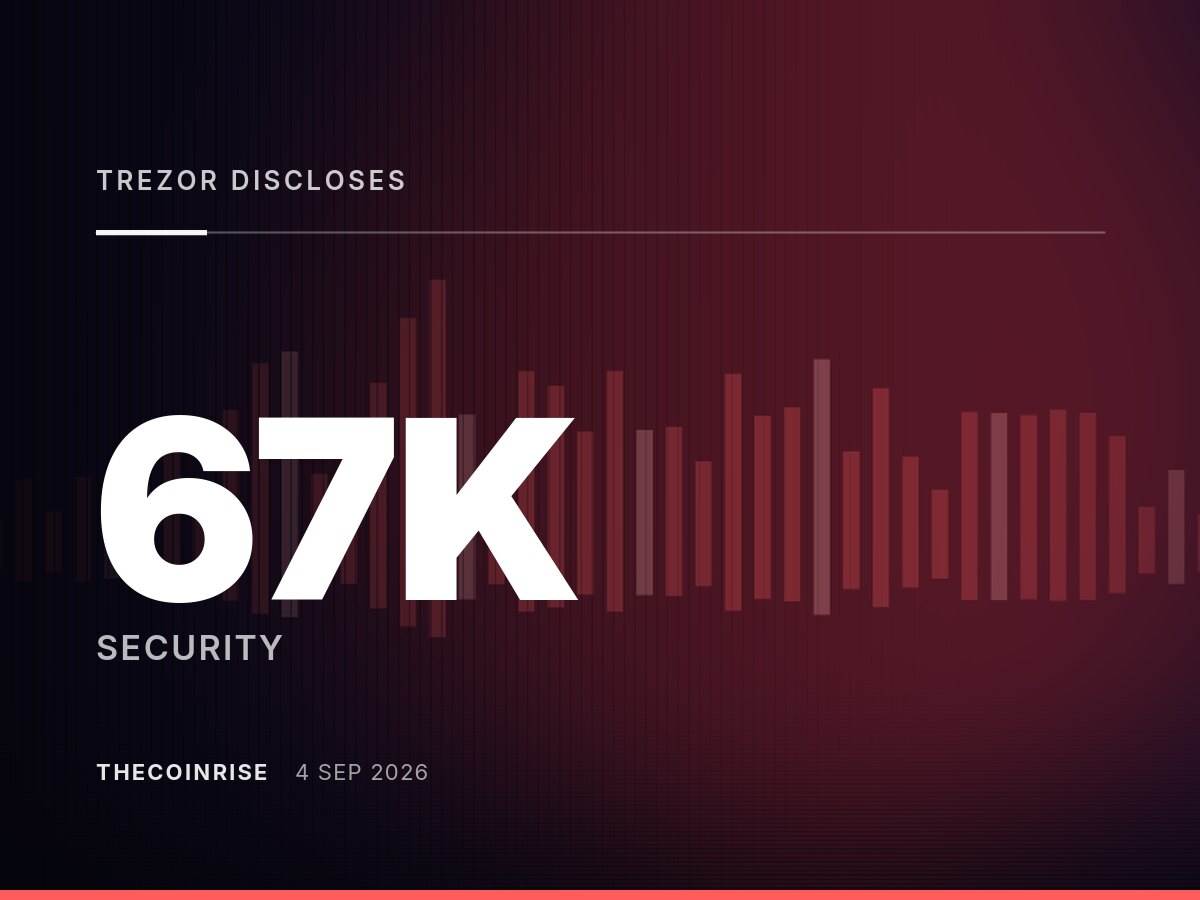
Trezor discloses data breach: Another 67,000 U.S. customers were affected
The hardware wallet manufacturer said the expanded data breach could be traced to third-party fulfillment partners rather than its own systems. As one of the largest manufacturers of hardware cryptocurrency wallets, Trezor has notified customers of a new round of data exposure risks. The company said about 67,000 additional U.S. customers were affected, further expanding the scope of the incident, which was already under investigation.
According to Trezor, the leak originated from ShipMonk, a third-party logistics and performance provider used to ship goods to customers. Trezor does not operate its own warehouse for every order, and outsourcing this function to professional suppliers is common practice in the e-commerce and hardware technology industries.
Risk Analysis and Impact
The source of exposure points to compliance partners rather than Trezor's core systems, which is of great significance to how customers interpret risks. Hardware wallets are designed on the principle that private keys and mnemonics never leave the physical device, which means transportation-related leaks typically do not expose the secure encrypted material that protects users 'funds.
However, data collected during the ordering and shipping process, such as names, addresses and order details, remains extremely valuable to attackers. Exposed shipping information has been repeatedly used in the cryptocurrency industry to plan targeted phishing attacks or implement physical security threats against known wallet holders.
This is not the first time Trezor has notified customers of data exposure due to supply chain-related issues. Disclosure of another 67,000 affected U.S. accounts suggests that the scale of the incident was broader than initially believed, or that its full mapping took longer.
Hardware wallet companies are increasingly targeted precisely because their customer lists effectively identify people who hold large amounts of cryptocurrency. Therefore, even if financial vouchers or private keys are not involved, the disclosure of names and addresses is more serious than a typical retail data breach.
Trezor did not disclose further technical details other than blaming the leak on ShipMonk and specifying the number of new customers affected. The company's communication focuses on directly notifying affected U.S. customers rather than publishing extensive public analysis of the incident's mechanisms.
This incident highlights a recurring theme in the cryptocurrency security space: It is often easier for attackers to break through defenses by compromising third-party vendors than to crack the encryption protections built into the hardware device itself. Wallet manufacturers, exchanges and managed service providers all rely on external logistics, marketing or customer support tools that lie outside their strongest security boundaries.
The current challenge for Trezor is to reassure a security-conscious user base that its core products are not compromised while synchronizing follow-up work on partner data processing. A company's reputation is largely based on trust in the integrity of its hardware, and such supply chain incidents can undermine that trust.
Market Impact
Data breaches by hardware wallet companies typically have a limited direct impact on token prices because private keys and signature operations are not exposed. The more relevant impact is at the reputation and behavioral levels: Affected customers may become more cautious and reluctant to share transportation and personal data with wallet providers; competitors may use the incident to emphasize their own supply chain security practices.
Wider industry implications involve supplier risk management. As the adoption of hardware wallets increases with institutional and retail custody needs growing, leaks originating from compliance or logistics partners are likely to continue to attract the attention of security researchers and regulators in the cryptocurrency space who are concerned about data protection standards. [TAG
Trezor's latest disclosures highlight how third-party vendors-not just core software or hardware-can be weak links in cryptocurrency security. Customers affected by the expanded breach are being notified directly while the company continues to assess the extent of exposure associated with ShipMonk.
Frequently Asked Questions (FAQ)
What caused the Trezor data breach affecting another 67,000 customers? [TAG
Trezor attributed the expanded breach to ShipMonk, the third-party fulfillment provider it uses to route customer orders, rather than its internal systems.
Were the customer's private keys or funds exposed in the breach?
Trezor's disclosures focused on customer data related to shipments and orders. Hardware wallets are designed to ensure that private keys remain on the device, thus limiting the risk to funds of such breaches.
Is this a new leak or an extension of a previous leak? [TAG
Trezor described it as an extension, indicating that 67,000 additional U.S. customers were affected in addition to those notified in earlier disclosures.
What should affected Trezor customers do?
Customers should pay attention to official Trezor's communications, be wary of unsolicited messages that mention details of their order or shipping, and be alert to phishing attempts against known wallet holders.