Exchange Ranking
 Top Exchanges
 24h Volume Ranking
 Popularity Ranking
 Exchange BTC Balance
 Proof of Reserves
 Decentralized Exchanges
 Funding Rate
 Funding Heatmap
 Liquidation Data
 Max Pain
 Long/Short Ratio
 Whale L/S Ratio
 Binance/Okex/Huobi L/S
 Bitfinex Margin L/S
 ETF Tracker
 Solana ETF
 XRP ETF
 Hong Kong ETF
 Bitcoin Treasuries
 Crypto Reversal
 Ethereum Reserves
 HyperLiquid Wallet Analysis
 Hyperliquid Whale Watch
 Large Transactions
 On-chain Movement
 Bitcoin ROI
 Stablecoin Market Cap
 Options Analysis
 News
News Articles
 Economic Calendar
 Features
 Wallet
 Contract Calculator


 Security
 Collections
 Watchlist
 Following
 BTC
BTC  ETH
ETH The U.S. Commodity Futures Trading Commission expands regulatory exemptions for "passive software" providers
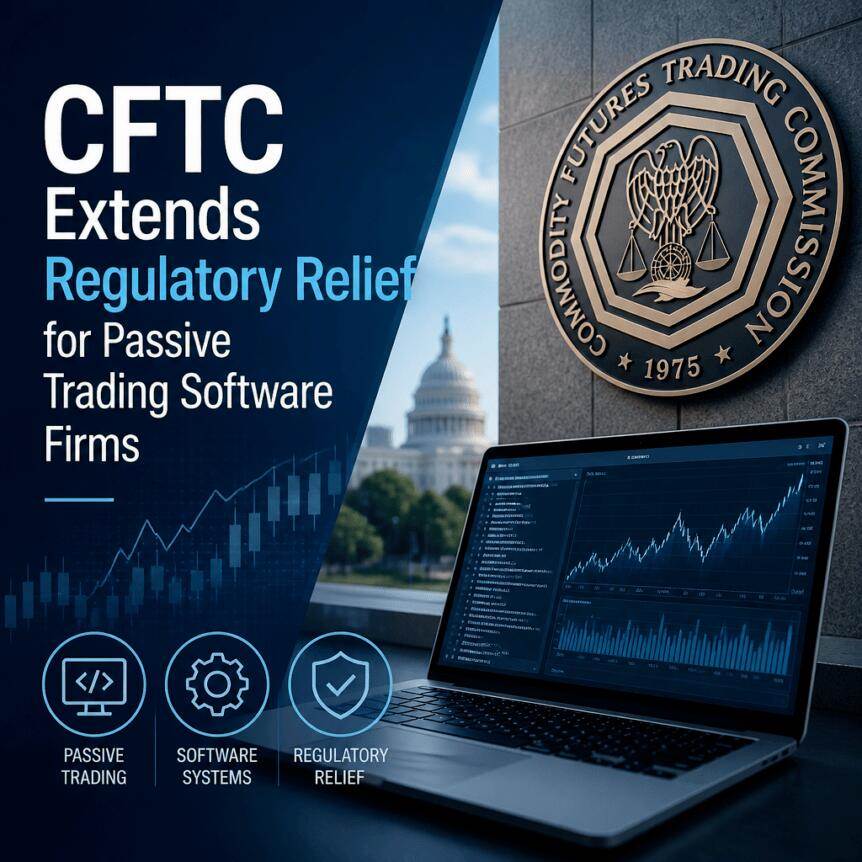
The U.S. Commodity Futures Trading Commission (CFTC) has issued a non-enforcement position statement, further expanding regulatory relief for so-called "passive software" providers. Such entities only serve as bridges between users and CFTC-registered derivatives companies and exchanges, and do not assume the role of regulated intermediaries.
In a non-enforcement letter issued on Thursday, the agency's Market Participants Division stated that as long as eligible providers and their personnel meet certain conditions-that is, limit their discretion over users 'trading decisions-the agency will not recommend enforcement action for not registering as an introducing broker or associated person. The move is expected to reduce the compliance friction costs of crypto wallets and other applications that want to link users to regulated venues, including derivatives such as perpetual contracts and predictive markets.
Key Points
- The CFTC's non-enforcement position covers "passive software" that facilitates transactions with CFTC registered companies and exchanges but does not trigger registration requirements for introducing brokers or related persons, provided that relevant conditions are met.
- The core of qualification recognition is to limit the provider's discretion, including prohibiting it from exercising judgment on user orders.
- The guidelines build on previously issued relief letters for Phantom Technologies 'self-managed wallet software, extending the framework to a wider range of passive software use scenarios.
- 该公告紧随《CLARITY法案》在美国参议院未能推进之后发布,同时CFTC和SEC领导人重申将在现有监管权限下继续推进相关工作。
CFTC授予何种豁免,以及适用对象
周四发布的不执行立场旨在面向那些充当最终用户与受监管衍生品基础设施之间技术桥梁的软件提供商。根据CFTC的说法,如果合格提供商或其人员在促进与CFTC注册实体及交易所的交易时,未涉足需要注册为介绍经纪商或关联人士的中介职能,市场参与者部门将不会建议对其进行执法行动。
豁免的核心在于软件必须保持“被动性”。CFTC的信函指出,资格认定需要满足旨在限制提供商角色的条件——例如,限制软件提供商对用户订单所能施加的自由裁量程度。
这一区分对加密货币产品设计至关重要。许多钱包、链上应用和交易界面都可以配置为将用户路由至受监管的市场平台。如果没有此豁免,提供商可能会面临被认定为实质上从事经纪或咨询活动的风险,即使它们并未保管资产或未手动下达交易指令。
从Phantom钱包软件到更广泛的被动软件规则
The new position continues a similar approach previously taken by the CFTC. In March this year, the agency issued a non-enforcement letter to Phantom Technologies covering its self-hosted crypto-wallet software, with relevant conditions attached. In a previous letter, Phantom was allowed, subject to established constraints, to provide and promote software that connects users with registered futures brokers and exchanges without registering as an introducing broker.
In July, Phantom and the Hyperliquid Policy Center jointly called on the CFTC to provide broader protection. Their request focuses on protecting unmanaged wallet providers from introducing broker requirements and clarifying how existing rules apply when blockchain developers use on-chain infrastructure with regulated derivatives companies. Thursday's move suggests that at least part of the reasoning has been adopted: the CFTC treats certain connections to regulated trading venues through software intermediaries as distinct from regulated brokerage activity.
While these non-enforcement letters are not a comprehensive license for all conceivable integration methods, the pattern is clear: regulators seem willing to leave compliance room for interfaces that limit discretion and do not act as intermediaries in the traditional sense.
Regulatory momentum after the setback of the CLARITY Act
The CFTC's decision comes two days after the CLARITY Act failed to advance in the U.S. Senate. According to the original report, the cloture motion received 49 votes in support-11 votes short of the 60 votes needed to advance the debate.
投票结束后,CFTC主席Michael Selig和证券交易委员会(SEC)主席Paul Atkins均表示,其机构将继续利用现有权力开展与加密货币相关的监管工作。Selig在X平台上发帖称,CFTC“已锁定目标并准备好推出金融新前沿的规则”。Atkins也表示,SEC将“无论有无立法”采取行动,为数字资产提供监管确定性,相关信息亦通过X平台引用。
周四的行动反映了这种既定的决心。除了CFTC的不执行立场外,据引用的报道,SEC还批准了一项临时豁免,允许符合条件的平台通过获批准的自动做市商和流动性池,促进代币化美股的有限链上交易。
这对加密钱包和衍生品访问意味着什么
对于开发者和运营商而言,操作层面的启示是:如果软件设计使提供商远离自由裁量的交易决策,合规负担可能会减轻。在实际操作中,CFTC的豁免信号表明,只要遵守不执行框架中规定的条件,开发者可以构建面向用户的路由或连接层——可能包括钱包功能或其他应用程序界面——而无需自动承担介绍经纪商的注册义务。
For traders and users, the downstream impact may be smoother access to regulated derivatives products through a familiar interface. If software providers can more easily integrate with CFTC regulated companies and exchanges, users will encounter fewer points of friction when seeking to enter compliance venues-whether those venues involve perpetual derivatives or other CFTC regulated market structures, such as forecasting markets.
Still, this immunity is not without limits. The CFTC letter makes it clear that eligibility depends on meeting "passive" requirements, including restrictions on order discretion. Observers are likely to pay close attention to the scope of interpretation of the word "passive" in future guidance and how regulators assess actual products where user interactions blur the line between simple routing and proactive brokerage decision-making.
Next, the industry will look to further clarify how these "passive software" principles apply to different architectures-especially as more encryption applications seek to integrate with regulated derivatives platforms-while monitoring whether lawmakers 'failure to push the CLARITY Act changes the pace and direction of agency rulemaking.