Exchange Ranking
 Top Exchanges
 24h Volume Ranking
 Popularity Ranking
 Exchange BTC Balance
 Proof of Reserves
 Decentralized Exchanges
 Funding Rate
 Funding Heatmap
 Liquidation Data
 Max Pain
 Long/Short Ratio
 Whale L/S Ratio
 Binance/Okex/Huobi L/S
 Bitfinex Margin L/S
 ETF Tracker
 Solana ETF
 XRP ETF
 Hong Kong ETF
 Bitcoin Treasuries
 Crypto Reversal
 Ethereum Reserves
 HyperLiquid Wallet Analysis
 Hyperliquid Whale Watch
 Large Transactions
 On-chain Movement
 Bitcoin ROI
 Stablecoin Market Cap
 Options Analysis
 News
News Articles
 Economic Calendar
 Features
 Wallet
 Contract Calculator


 Security
 Collections
 Watchlist
 Following
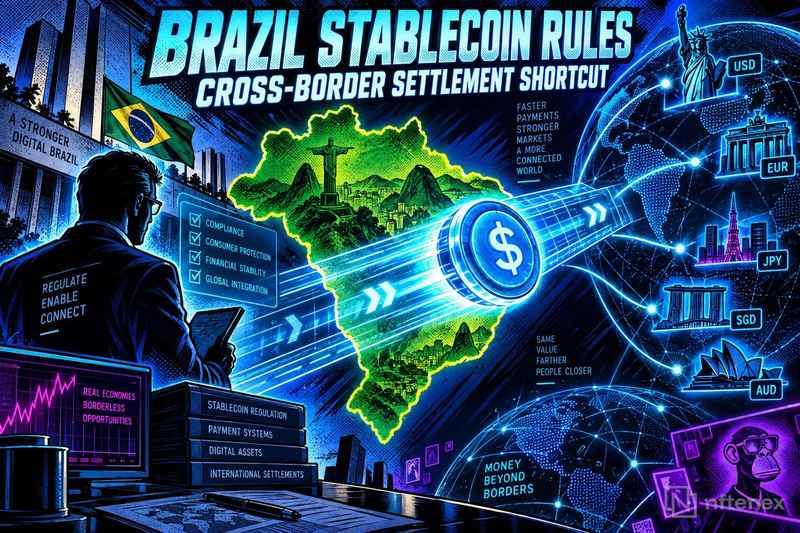
Brazil does not ban stablecoin payments: Regulation focuses on in-depth analysis of cross-border settlement channels
The Brazilian government has not completely banned stablecoin payments. The country's regulators are targeting stablecoins used in key cross-border payment channels, a targeted measure designed to influence the way value flows across borders, rather than restricting the holding or consumption of stablecoins domestically.
Specific boundaries of the policy: Do something and not do something
This policy only targets specific settlement channels used in cross-border transactions and does not involve the ownership or domestic payment use of stablecoins. For example, companies that use stablecoins to make payments to local suppliers are not affected; while financial operations departments that conduct international settlements through restricted channels may face compliance gaps.
More and more jurisdictions are beginning to distinguish "payment-based" stablecoins from "settlement-level infrastructure," a trend that is also reflected in North Carolina's Digital Assets and stablecoins Act. For related reports, please refer to the release of North Carolina Digital Assets and stablecoins Act.
The Central Bank of Brazil has previously marked stablecoins as the dominant tool in crypto-related foreign exchange activities. In the first quarter alone, the bank recorded $6.9 billion in stableco-linked cryptocurrency purchases. This suggests that the settlement restriction is a structural intervention on high-traffic channels rather than a ban on consumers. For relevant market developments, please refer to "Bitcoin looks at US$82,000 after the Federal Reserve and CLARITY Act impact."
Why this distinction is crucial for companies and market participants
Cross-border settlement shortcuts allow institutions to more quickly transfer value between jurisdictions beyond the cumbersome intermediary checks of traditional correspondent banks. Closing this channel does not eliminate access to assets, but rather removes a routing efficiency. While alternatives such as regulated payment providers or traditional channels are still available, they are more costly and frictional.
Consumer-facing stablecoin payments-including retail purchases, peer-to-peer transfers, and non-homogeneous token (NFT) transactions settled in USDT or USDC-operate at a different level than the institutional settlement channel that Brazil appears to be targeting. Readers, creators and collectors who use stablecoins for digital asset purchases should not interpret this policy as a freeze on their activities.
The significance of cross-border settlement shortcuts
Cross-border shortcuts based on stablecoins replace the agent banking link in international transfers with linked digital assets. Instead of routing through multiple banks in multiple jurisdictions, the sender converts it into stablecoins, which are transmitted on-chain, and the recipient converts it on the other end. This speed and cost advantage is real, but it also reduces the visibility regulators use to monitor capital flows, which is exactly the problem Brazil is trying to solve, according to CryptoSlate reports on the policy.
同一报道指出,受影响的部分处于一个规模达1.1万亿美元的稳定币市场中,面临着新的限制。这进一步印证了该措施的针对性极强,相对于整体稳定币活动而言范围有限。限制单一通道并不会消除需求,而是将活动引导至合规的许可走廊或较慢的SWIFT路径。更广泛的稳定币监管势头,包括美国各州层面的数字资产立法,表明此类针对特定通道的限制正成为一种标准的监管工具,而非例外情况。
随着实施细节浮现,应关注什么
核心要点:
- 无全面禁令:巴西未禁止稳定币支付。
- 针对性捷径限制:特定的跨境结算通道被阻断,影响机构路由,但不影响国内使用。
- 观察实施情况:实际影响取决于哪些实体受覆盖、生效日期以及执法指南的撰写方式。
该政策的实际效果取决于尚未完全公开的细节:哪些实体受覆盖(交易所、支付处理商、企业财务部)、哪些稳定币在范围内、生效日期以及是否存在过渡性条款。在这些细节得到确认之前,推测市场后果为时过早。
A more relevant question for the creator economy and digital asset markets is whether Brazil's practices will spread to other Latin American markets. In these regions, stablecoins fill the gap left by local currency fluctuations and limited bank access. Implementing targeted settlement restrictions in a jurisdiction is manageable; but if the region coordinates similar rules, it will reshape the structure of cross-border NFT royalty flows and market capital allocation across the continent, affecting how platforms settle cross-border inflows through compliance corridors.