Exchange Ranking
 Top Exchanges
 24h Volume Ranking
 Popularity Ranking
 Exchange BTC Balance
 Proof of Reserves
 Decentralized Exchanges
 Funding Rate
 Funding Heatmap
 Liquidation Data
 Max Pain
 Long/Short Ratio
 Whale L/S Ratio
 Binance/Okex/Huobi L/S
 Bitfinex Margin L/S
 ETF Tracker
 Solana ETF
 XRP ETF
 Hong Kong ETF
 Bitcoin Treasuries
 Crypto Reversal
 Ethereum Reserves
 HyperLiquid Wallet Analysis
 Hyperliquid Whale Watch
 Large Transactions
 On-chain Movement
 Bitcoin ROI
 Stablecoin Market Cap
 Options Analysis
 News
 Articles
 Economic Calendar
 Features
 Wallet
 Contract Calculator


 Security
 Collections
 Watchlist
 Following
 BTC
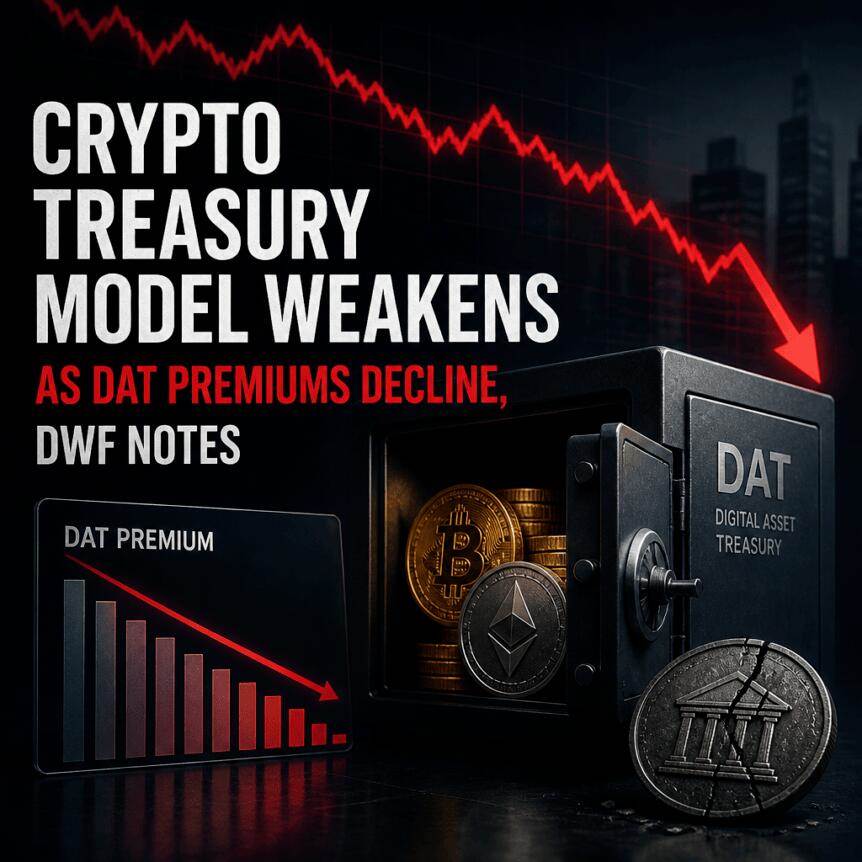
Digital Asset Treasury (DAT) companies 'early advantages fade, and premium models face structural challenges
According to a report released this week by DWG Ventures, Digital Asset Treasury (DAT) companies, a public vehicle that aims to finance growth by holding cryptocurrencies and relying on their trading premiums, is losing most of its early advantages.
In its analysis of the top 20 DAT companies with the largest assets under management, SDL found that only four companies were trading at prices above their adjusted net worth (mNAV). This indicator is used to compare a company's market value with the value of its underlying cryptocurrency holdings. The implications are obvious: Investors seem increasingly reluctant to pay extra fees for cryptocurrency exposure gained through listed balance sheets, weakening one of the model's key financing mechanisms.
Core Points
- Among the top 20 digital asset vaults, only four companies trade at prices above mNAV, which means that most companies trade at discounts below the value of their cryptocurrency positions.
- DWG attributed this shift to investors no longer paying a sustained premium for cryptocurrency exposure in DAT shares.
- The performance of DAT stocks is often difficult to outperform direct holding of the underlying cryptocurrency, and even if there are advantages, Reported's advantages are often limited.
- External warnings about the "mNAV collapse" precede recent market weakness, including concerns previously raised by Standard Chartered Bank and Galaxy Digital.
The vast majority of DAT companies now trade at discounts below the value of their cryptocurrency positions
A report released on Thursday looked at the largest DAT companies ranked by size of assets under management and found that only four companies had mNAV above 1, which means that the market value is higher than the value of the cryptocurrency they hold. The four companies are Bit Digital, Strike, Hyperliquid Strategies and BitMine.
Such discounts are significant to investors because DAT's growth strategy often relies on issuing shares at a price higher than the value of existing positions. When shares are traded at a premium, companies can raise capital and increase their exposure to cryptocurrencies without diluting the effective value of existing shareholders. When this premium disappears or turns into a discount, new issues become less attractive and may instead dilute shareholders rather than strengthen the treasury.
DWG describes this widespread discount phenomenon as a signal that the market is no longer willing to pay the same premium for publicly traded cryptocurrency exposure.
The "treasury premium" seems to have peaked
DWG points out that "Strategy"(formerly MicroStrategy), a pioneer of the Bitcoin treasury model, was a benchmark for how early premiums operated. According to the report, DAT's overall model shows that mNAV premiums peak when the strategy is novel and demand for the structure is strongest.
DWG highlighted Strategy's peak mNAV during the Bitcoin rally in late 2024, when demand for leveraged BTC exposure was reported to be particularly strong. The overall view of DWG is that as the novelty and momentum surrounding the structure of BTC's treasury wanes, so does the premium investors are willing to pay.
DWF还注意到,虽然某些DAT公司在某些时候的表现优于基础加密货币,但与投资者直接持有加密货币所能实现的收益相比,这种超额表现通常很小。
此前的报道描述了Michael Saylor的Strategy如何从2020年开始普及比特币财库方法,并为后来DAT公司试图遵循的模式设定了模板。
现实案例:Sequans退出其BTC财库
DWF的发现与一家公司远离财库模式的实际例子同时出现。法国半导体公司Sequans Communications去年推出了比特币财库策略,但披露已出售其剩余的314枚BTC,完成了退出程序。
据报道,退出过程始于5月赎回其可转换债务,并以出售剩余比特币告终。交易完成后,Sequans表示其资产负债表上不再持有任何加密货币。
虽然单次退出并不能决定DAT类别是否会失败,但它凸显了依赖持续投资者支持的结构所带来的实际后果。如果股价无法维持相对于净值的溢价,通过股权筹集和维持敞口的成本将更难证明其合理性。
关于mNAV崩溃的警告早于最新的市场压力
The NFS report is not the first to question whether the DAT model can continue to operate without a sustained equity premium. Standard Chartered Bank reportedly raised concerns during the September 2025 boom in Bitcoin and the broader crypto markets. The bank warned that the "mNAV collapse" could trigger the consolidation of digital asset treasuries.
Galaxy Digital makes a similar argument, pointing out that the model "relies heavily on persistent equity premiums relative to net worth." In Galaxy's view, it is this premium that allows the company to issue shares and buy more cryptocurrencies while avoiding diluting the interests of existing holders. If shares are traded below net value, raising new equity may have a diluting effect, undermining the financing logic of the strategy.
Galaxy analyst Will Owens wrote in research: "If premiums collapse, or worse, turn into discounts, the model starts to break down."
These concerns are consistent with the timing and direction of market movements. Data showed that Bitcoin fell below $60,000 from a historical high of more than $126,000 set in October, and then recovered to about $86,000, creating conditions for a treasury premium and a possible weakening in demand for leverage.
In other words, the problem raised by early institutional warnings has not disappeared: this appears to be a structural reliance on investors 'willingness to pay above net worth, rather than just a temporary valuation adjustment.
Why current discount trends matter
For traders and long-term investors, the shift to broad DAT discounts has changed the way the category is evaluated. If most treasuries are trading at a price lower than their underlying positions, the "equity as growth capital" argument becomes unreliable and performance may converge to that of the cryptocurrency market itself-minus any inefficiencies created by stock packaging.
This also raises the question of what happens when the premium cannot be restored quickly. DWG's findings suggest that the model's early advantage-accessibility of funds driven by investor enthusiasm-has faded, resulting in fewer companies able to accumulate positions through share issuance without eroding shareholder value.
Investors focusing on DAT should next focus on whether any remaining premiums can stabilize and how the company will respond when the share price does not justify continuing equity-funded purchases-especially as market volatility continues to put pressure on cryptocurrency-related balance sheets.