Exchange Ranking
 Top Exchanges
 24h Volume Ranking
 Popularity Ranking
 Exchange BTC Balance
 Proof of Reserves
 Decentralized Exchanges
 Funding Rate
 Funding Heatmap
 Liquidation Data
 Max Pain
 Long/Short Ratio
 Whale L/S Ratio
 Binance/Okex/Huobi L/S
 Bitfinex Margin L/S
 ETF Tracker
 Solana ETF
 XRP ETF
 Hong Kong ETF
 Bitcoin Treasuries
 Crypto Reversal
 Ethereum Reserves
 HyperLiquid Wallet Analysis
 Hyperliquid Whale Watch
 Large Transactions
 On-chain Movement
 Bitcoin ROI
 Stablecoin Market Cap
 Options Analysis
 News
 Articles
 Economic Calendar
 Features
 Wallet
 Contract Calculator


 Security
 Collections
 Watchlist
 Following
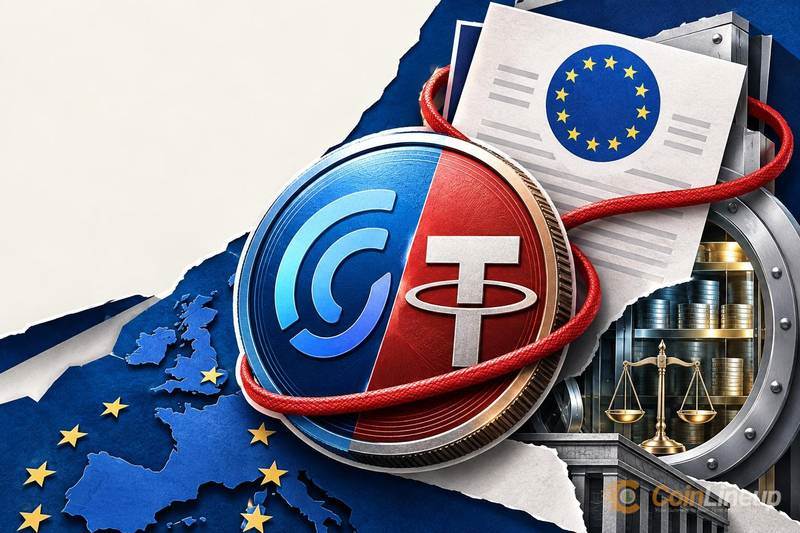
Circle and Tether, two major stablecoin issuers, have joined forces to boycott the core provisions of the EU MiCA regulation
Circle and Tether, the world's two largest stablecoin issuers, are raising strong objections to key parts of Europe's cryptocurrency regulatory framework. Both companies have called on regulators to revise the provisions of the Cryptocurrency Markets Regulations (MiCA) on stablecoin reserve requirements.
Rare consensus: Opponents agree on specific issues
According to reports, Circle and Tether have reached a rare consensus in opposing MiCA's bank-centered reserve rules. Although the two companies are usually competitors, they both believe this particular clause poses a common challenge.
MiCA requirements and issuer concerns
As the EU framework for regulating crypto assets, MiCA includes a regulation requiring issuers of major stablecoins to place part of their reserves in regulated bank accounts. The purpose is to protect consumers by ensuring that issuers can meet redemption obligations.
The main concern for issuers is that concentrating large amounts of reserves in bank accounts increases risk concentration rather than spreads risk. If the bank holding these reserves fails, stablecoin issuers and their users could face serious problems. From a mechanism point of view, issuers must be able to convert each stablecoin token into their base currency at any time upon request, so reserve management and redemption mechanisms are crucial.
In addition, the European Securities and Markets Authority (ESMA) has issued guidelines under MiCA, establishing a framework for the application of these requirements in practice. Circle and Tether want to revise the requirement before it creates a compliance bottleneck or a barrier to market access.
Potential impact of rule changes on European markets
If regulators adopt the issuer's arguments, the result could lead to greater flexibility in the stablecoin reserve structure, possibly allowing a greater proportion of reserves to be held in the form of government bonds or other low-risk instruments rather than bank deposits. This would bring European regulatory rules closer to the way Circle and Tether currently manage reserves globally.
If regulators stick to their current stance, issuers operating in Europe will face the choice of restructuring reserves to meet MiCA's specific requirements, restricting their European operations, or withdrawing from the market. For example, with the tightening of MiCA rules, OKX decided to open a USDT-to-USDC conversion channel in Europe, indicating that exchanges have begun to adjust their product supply to respond to regulatory pressure.
The outcome of this lobbying campaign has not yet been determined. While Circle and Tether are advocating for changes, European regulators have not yet indicated whether they will revise reserve terms. The key question for anyone holding or considering holding stablecoins in Europe is whether the two largest issuers can enter the market on terms they see feasible. This question is likely to be answered in the next few months as MiCA's stablecoin provisions are fully implemented and tested.