Exchange Ranking
 Top Exchanges
 24h Volume Ranking
 Popularity Ranking
 Exchange BTC Balance
 Proof of Reserves
 Decentralized Exchanges
 Funding Rate
 Funding Heatmap
 Liquidation Data
 Max Pain
 Long/Short Ratio
 Whale L/S Ratio
 Binance/Okex/Huobi L/S
 Bitfinex Margin L/S
 ETF Tracker
 Solana ETF
 XRP ETF
 Hong Kong ETF
 Bitcoin Treasuries
 Crypto Reversal
 Ethereum Reserves
 HyperLiquid Wallet Analysis
 Hyperliquid Whale Watch
 Large Transactions
 On-chain Movement
 Bitcoin ROI
 Stablecoin Market Cap
 Options Analysis
 News
 Articles
 Economic Calendar
 Features
 Wallet
 Contract Calculator


 Security
 Collections
 Watchlist
 Following
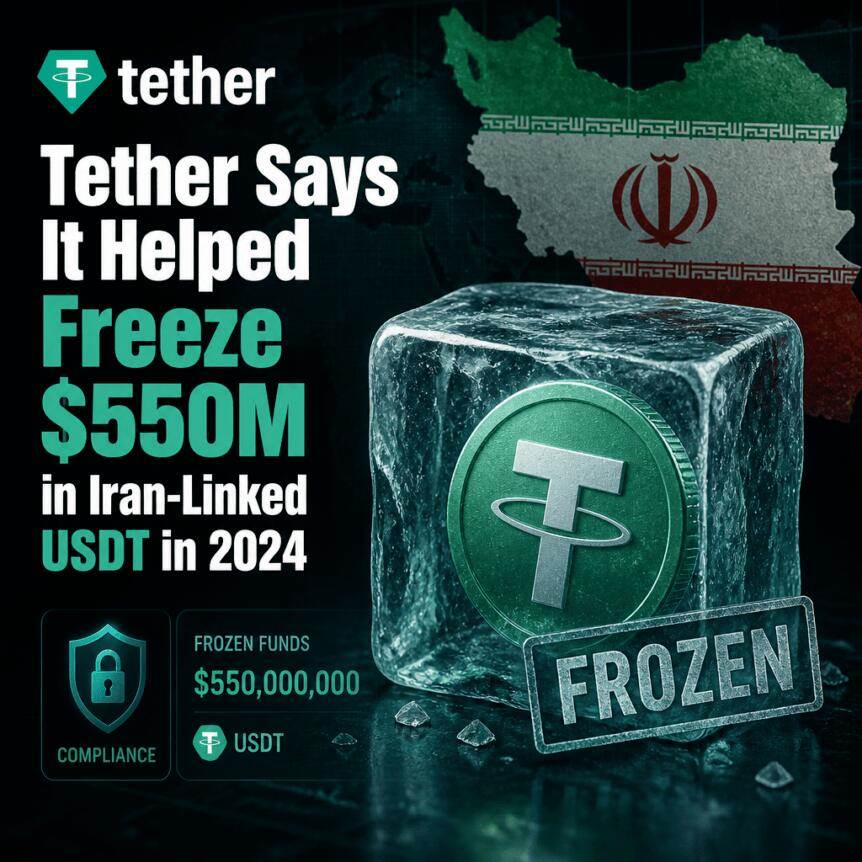
TEDA helped freeze nearly US$550 million in Iran-related USDTs, sparking controversy over stablecoin sanctions circumvention.
Tether announced in 2026 that it assisted law enforcement agencies in freezing USDTs worth nearly US$550 million in Iran-related activities. The move has intensified widespread public debate over whether stablecoins are being used to circumvent sanctions. The update comes as a Democrat-led U.S. Senate investigation is urging federal agencies to review potential sanctions violations involving stablecoins.
In a statement issued on Monday, TEDA said it has been working with international law enforcement for years to identify and freeze illicit funds. The company said the cooperation has resulted in the freezing of more than $4.9 billion in assets worldwide. The company cited multiple freezing actions in 2026, including freezing more than $130 million in USDT at four wallet addresses this year, and a larger operation in April targeting funds linked to the Central Bank of Iran involving more than $344 million.
Core Points
- TEDA expressed support for the freezing of nearly US$550 million in Iran-related USDT in 2026, including more than US$344 million in April related to the Central Bank of Iran.
- According to the company's statement on Monday, the company attributed the actions to ongoing coordination with international law enforcement agencies and law enforcement agencies.
- A report released jointly by the Senate Permanent Investigation Subcommittee and Democratic investigators stated that the USDT is often used in Iran-related sanctions evasion networks.
- The investigation showed that most of the sanctioned wallets reviewed used USDT almost exclusively or entirely for transactions, prompting calls for review by the Treasury and Justice Departments.
- CEO Paolo Ardoino said TEDA has assisted agencies including the U.S. Department of Justice, the Federal Bureau of Investigation (FBI), the Secret Service, Customs and Border Protection, Immigration and Customs Enforcement (HSI), and the Office of Foreign Assets Control (OFAC) in tracking, freezing and recovering funds.
Details of funds Tedar claims to be frozen in 2026
Tedar's statement on Monday that the nearly US$550 million data framework is the result of continued law enforcement cooperation rather than isolated compliance incidents. The company said it froze more than $130 million in USDT in four wallet addresses during 2026; and in April, it froze more than $344 million associated with the Central Bank of Iran.
CEO Paul Aldoino emphasized that TEDA believes that USDT is not a "safe haven" for sanctioned entities or criminal networks. "TEDA has consistently proved that USDT is not a safe haven for sanctioned persons, terrorist organizations or criminal networks," the company statement quoted Aldoino as saying.
In addition to the Iran-related freeze, TEDA also cited its broader law enforcement record. The company noted that its global cooperation resulted in "more than $4.9 billion in assets being frozen," including more than $2.4 billion linked to U.S. authorities.
Senate probe accuses USDT of playing a key role
就在上述评论发布的同时,参议院永久调查小组委员会的民主党调查员发布了一份报告,指控USDT已成为伊朗规避制裁的主要渠道。根据周一报道中引用的报告摘要,调查人员分析了与伊朗相关的制裁活动,发现与伊朗相关的钱包强烈偏好使用USDT。
参议院调查员报告称,在被制裁的846个与伊朗有关联的加密钱包中,有84%的交易 exclusively 或几乎 exclusively 使用USDT。这一发现促使美国参议员理查德·布鲁门撒尔(Richard Blumenthal)呼吁财政部和司法部调查是否存在违反制裁的行为。
泰达币并未否认USDT被广泛使用的事实,而是强调其与执法部门采取的行动。然而,参议院关于被制裁钱包中USDT使用近乎主导地位的主张与泰达币的冻结数据形成了鲜明对比,突显了辩论中的一个关键张力:即在识别后的合规行动, versus 系统设计和生态系统使用是否在执法触发之前便促进了制裁规避的问题。
为何这场争议对稳定币监管至关重要
稳定币处于日常加密货币结算的中心,特别是在跨境转账中,速度和流动性往往胜过透明度。因此,指控特定稳定币被被制裁方不成比例地使用的说法,引发了超越单个发行人的更广泛的监管问题。
泰达币的数据——2026年冻结的近5.5亿美元与伊朗相关的资金,加上长期宣称的全球冻结超过49亿美元——提供了一个侧重于合规的反论点。但是,参议院调查中关于钱包层面的发现,如报告摘要所示,突出了实际担忧:即使最终发生冻结,USDT的稳定性和可访问性可能允许被制裁方在当局干预之前转移价值。
对于投资者和市场参与者而言,影响是双重的。首先,日益增加的审查可能会影响交易所、托管机构和合规工具如何处理与被制裁司法管辖区相关的稳定币流量。其次,对潜在制裁违规行为的调查呼吁可能会加速围绕稳定币治理、监控义务以及平台应采取以防止非法路由的标准等政策辩论。
泰达币指向执法协调
阿尔多伊诺的声明旨在强化泰达币并非孤立运作。他表示,“记录是公开的”,美国机构——包括司法部、FBI、特勤局、HSI和OFAC——已与泰达币合作追踪、冻结和追回资产。他补充说,泰达币将继续向针对恐怖主义、制裁规避、欺诈和其他严重犯罪的当局提供其追踪和冻结能力。
For readers following the compliance debate, a key observation point is how to evaluate these "freeze and recover" claims against Senate investigators 'conclusions that USDT is often used in Iran-related sanctions circumvention. The results may depend on whether investigators can demonstrate the point in time of illegal activity, whether issuers or intermediaries fail to act on warning signs, and how consistently sanctioned traffic is detected across the ecosystem.
As the investigation progresses, market participants are likely to pay close attention to more details on whether federal agencies will initiate formal investigations, as well as any further guidance on compliance expectations for stablecoin issuers and service providers.
Currently, the core issue remains unresolved: TEDA claims it actively helps freeze illegal USDTs, while the Senate report believes USDTs dominate sanctioned wallet activity related to Iran-so the next development is likely to depend on investigators being able to determine the timing of prevention, detection and enforcement in the stablecoin network.