Exchange Ranking
 Top Exchanges
 24h Volume Ranking
 Popularity Ranking
 Exchange BTC Balance
 Proof of Reserves
 Decentralized Exchanges
 Funding Rate
 Funding Heatmap
 Liquidation Data
 Max Pain
 Long/Short Ratio
 Whale L/S Ratio
 Binance/Okex/Huobi L/S
 Bitfinex Margin L/S
 ETF Tracker
 Solana ETF
 XRP ETF
 Hong Kong ETF
 Bitcoin Treasuries
 Crypto Reversal
 Ethereum Reserves
 HyperLiquid Wallet Analysis
 Hyperliquid Whale Watch
 Large Transactions
 On-chain Movement
 Bitcoin ROI
 Stablecoin Market Cap
 Options Analysis
 News
News Articles
 Economic Calendar
 Features
 Wallet
 Contract Calculator


 Security
 Collections
 Watchlist
 Following
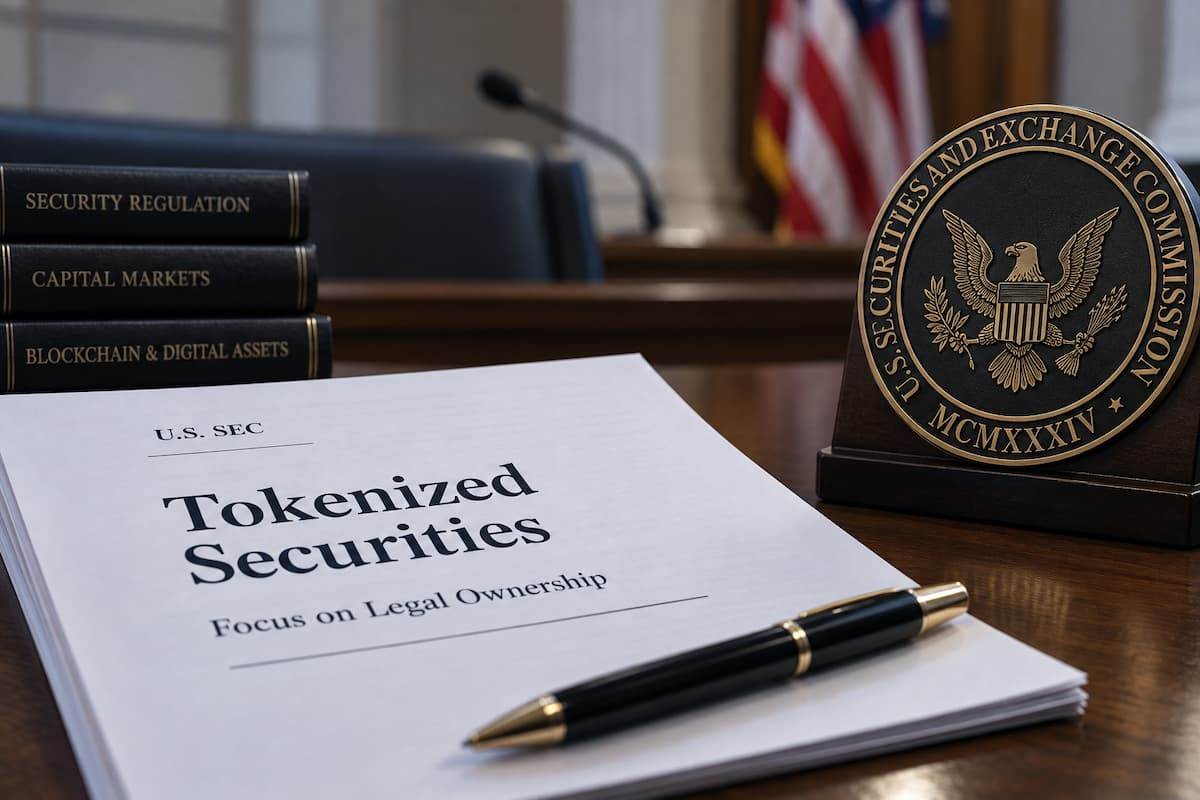
SEC statement on tokenized securities: Focus on legal ownership records, not underlying blockchain
The U.S. Securities and Exchange Commission (SEC) Cryptographic Assets Working Group has collected written opinions on how current securities laws apply to tokenized stocks. This framework shifts the most thorny legal issue from "whether a token is a security" to "who is officially registered as the actual owner."
The SEC's public statements on tokenized securities, including those from its corporate finance department, point to a core point that is easily ignored: the focus of regulation is not blockchain technology itself, but the shareholder register-that is, the legal record that determines ownership of shares, rather than the tokens that represent that ownership to wallet holders.
Why the register of shareholders is more critical than a token
From a legal perspective, a stock is not a paper certificate or a line of code that represents it. It is a record on the company's official register of shareholders and is maintained by the company or its transfer agent. This register determines who is entitled to dividends, who has voting rights, and who has legal claims if problems arise.
Tokenization of shares makes sense only if contemporary coins are truly linked to the underlying register entries, making holding coins legally equivalent to becoming a registered owner. If the tokens issued by the platform only track stock prices without any registered ownership backing them, then this is a synthetic exposure rather than a true tokenized equity. No matter how the product is marketed and packaged, buyers will face a fundamentally different and much less protective legal status.
The SEC's Investor Advisory Committee made this distinction directly in its recommendations on tokenization of equity securities. This also explains why regulators have repeatedly returned to the roster mechanism rather than focusing mainly on the technical issues of blockchain architecture. Technical issues (such as which chain to use and which token standard) are relatively simple. The real legal difficulty is: Is the token holder really a registered owner with enforceable rights? This element determines whether tokenized equity is a true innovation in settlement methods or a product that appears to have stock ownership but lacks corresponding legal protection.
Outlook for the Committee's Follow-up Process
The SEC's Cryptographic Asset Working Group has been soliciting public comments on the above issues, including detailed written submissions on tokenization of U.S. stocks and discussions on the Committee's immunity powers. The latter advocated seeking specific remedies to allow tokenized transactions to operate under the revised rules, rather than requiring comprehensive exemptions from securities laws.
This process is not yet over. The practical impact is that any platform promoting tokenized stock trading in the United States is in a gray area. The legal protection behind it depends entirely on whether the platform carefully constructs connections to the real shareholder register, a detail that is difficult for most retail users to verify for themselves.