Exchange Ranking
 Top Exchanges
 24h Volume Ranking
 Popularity Ranking
 Exchange BTC Balance
 Proof of Reserves
 Decentralized Exchanges
 Funding Rate
 Funding Heatmap
 Liquidation Data
 Max Pain
 Long/Short Ratio
 Whale L/S Ratio
 Binance/Okex/Huobi L/S
 Bitfinex Margin L/S
 ETF Tracker
 Solana ETF
 XRP ETF
 Hong Kong ETF
 Bitcoin Treasuries
 Crypto Reversal
 Ethereum Reserves
 HyperLiquid Wallet Analysis
 Hyperliquid Whale Watch
 Large Transactions
 On-chain Movement
 Bitcoin ROI
 Stablecoin Market Cap
 Options Analysis
 News
 Articles
 Economic Calendar
 Features
 Wallet
 Contract Calculator


 Security
 Collections
 Watchlist
 Following
 BTC
 ETH
Key insights
Bitcoin funds had a net inflow of US$241.1 million this week, while Ethereum products had a net outflow of approximately US$138 million. The crypto ETF market showed a divided trend. The spot Bitcoin ETF extended its gains, recording positive inflows for three consecutive weeks. In contrast, the Ethereum Fund posted net redemptions over the next four trading days after a good start on Monday.
In the week ending October 2, U.S. crypto ETFs performed differently. Spot Bitcoin funds attracted approximately $241.1 million in funds, while spot Ethereum products recorded net redemptions of approximately $138 million. This divergence occurred as Bitcoin rebounded to around $86,000 on October 5. Capital flow data shows that there is strong demand for Bitcoin exposure, while Ethereum products face continued selling pressure later this week.
Crypto ETF tracks Bitcoin price recovery
CoinMarketCap data shows that Bitcoin trading prices were close to US$86,300 on October 5. Previously, Bitcoin traded around $83,600 on September 30 and closed at approximately $84,512 on October 2. This price puts Bitcoin above the middle and lower end of the recent consolidation range. 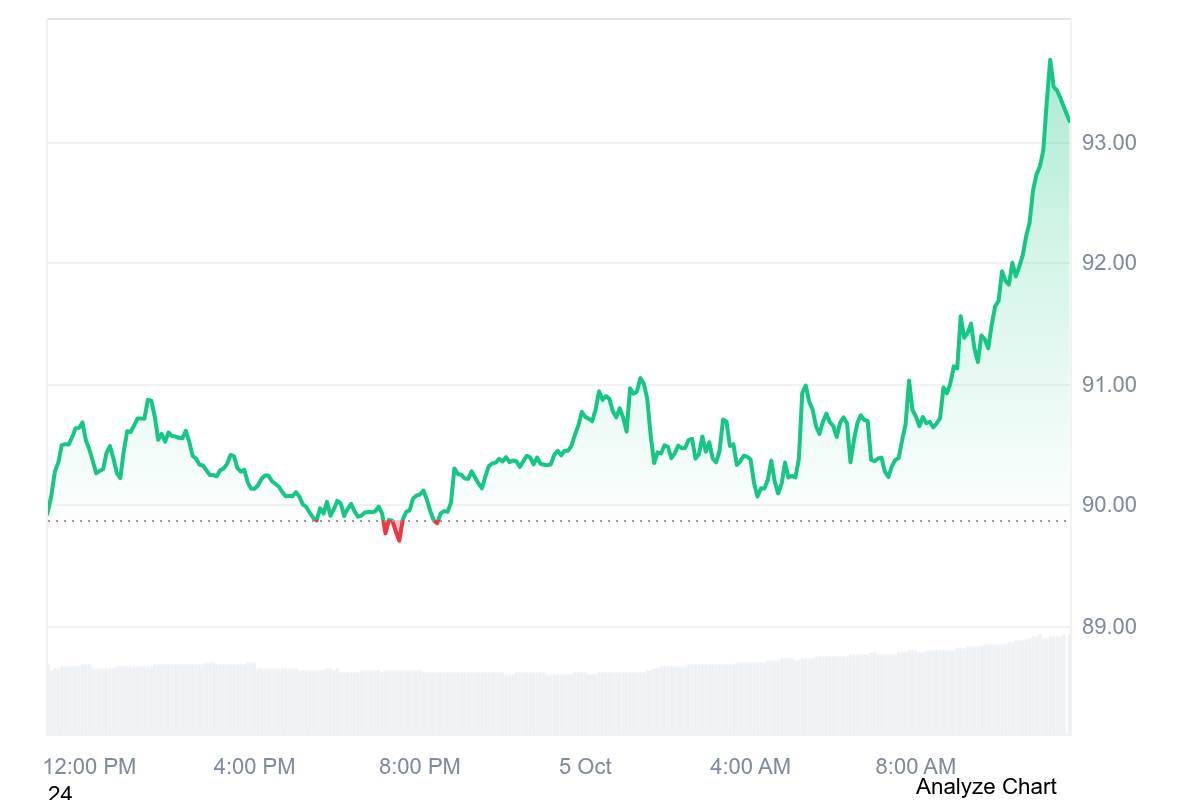
Bitcoin/U.S. dollar price chart. Source: CoinMarketCap
The recovery in prices is basically consistent with the increased demand for crypto ETFs linked to bitcoin. BlackRock's iShares Bitcoin Trust led the way with weekly net inflows of approximately $450 million, SoSoValue data shows. Ark and 21Shares 'ARKB also recorded positive weekly demand, while Fidelity's FBTC recorded the largest weekly outflow. However, different data providers do not fully agree on the statistics of total weekly outflows. Farside Investors 'daily Bitcoin ETF form shows net inflows into Bitcoin ETFs of approximately US$82.9 million for the period from September 28 to October 2. This difference means that readers should avoid treating a particular summary data as an absolute standard because each provider uses different methodologies and updates them regularly. Despite the differences, the overall direction has not changed, with both sets of data showing a net positive inflow of Bitcoin funds at the end of the period. For crypto ETFs, differences in methodology may change the total number of headlines, but will not reverse the weekly trend.
Bitcoin ETF traffic encounters key technical resistance
比特币的反弹将市场注意力引向了87,000至87,500美元区域。Delta Exchange的研究分析师Riya Sehgal在10月5日表示,该区域为短期阻力位。她将支撑位设在85,000至85,500美元之间,并指出若价格能持续突破上方阻力,90,000美元将成为下一个关注目标。这一技术形态为加密ETF带来了另一次短期测试。强劲的比特币ETF需求可以支持现货流动性,但价格仍需在阻力位上方实现有效突破。CoinMarketCap数据显示,在10月5日早盘交易中,比特币仍处于该区域下方。
周度结构依然不均衡。Farside数据显示,比特币基金在多个交易日录得增长,但在9月30日出现了1.487亿美元的流出。这种波动性表明,正向的周度余额源于集中买入,而非稳定的每日积累。
加密ETF显示以太坊需求疲软
与以太坊挂钩的产品讲述了截然不同的故事。Farside Investors记录到9月28日以太坊ETF流入1,710万美元,随后连续四个交易日出现流出,金额分别为280万美元、5,960万美元、5,540万美元和1,730万美元。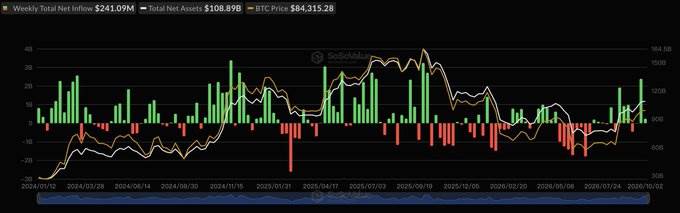
比特币ETF流入情况。来源:SoSoValue
These daily figures resulted in a net outflow of approximately $118 million. Reports based on SoSoValue showed weekly losses of $138.02 million. This gap once again explains why the total number of crypto ETF headlines varies among different data providers. The weakness of the Ethereum ETF contrasts with positive weekly readings for Bitcoin, which also limits evidence of broader institutional rotation among major digital assets. Investors seem more willing to increase their exposure to bitcoin while reducing their holdings in Ethereum funds.
Crypto ETFs face new leveraged products
The U.S. Securities and Exchange Commission (SEC) approved a proposed rule by Cboe BZX on October 2 to cover six commodity-based leveraged funds. The approved product lines include VS Trust's 3x Bitcoin ETF and 3x Ethereum ETF. 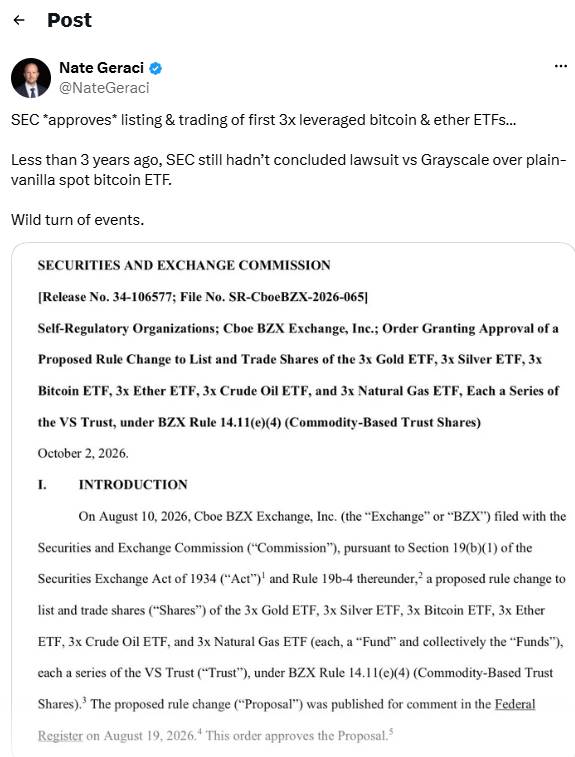
Cboe submitted the proposal under BZX Rule 14.11(e)(4) on August 10, seeking approval to list the six leveraged funds as commodity-based trust shares. The SEC order states that Bitcoin products are designed to track three times the daily performance of the Bitcoin futures benchmark, while Ethereum products are designed to track three times the daily performance of the Ethereum futures benchmark. Neither fund represents direct spot ownership of the underlying cryptocurrency.
This approval expands the product structure available to crypto ETFs, but also introduces higher daily leverage risks. Leveraged funds reset exposure every day, so returns over long-term holding periods may deviate from a simple triple return calculation.
The next test remains Bitcoin's response in the $87,000 to $87,500 region. If this range can continue to break through, demand may be further consolidated; if it is rejected, the market's attention will return to the support level of US$85,000. ETF investors will also be watching whether next week's data can narrow the gap between Bitcoin and Ethereum demand.