Exchange Ranking
 Top Exchanges
 24h Volume Ranking
 Popularity Ranking
 Exchange BTC Balance
 Proof of Reserves
 Decentralized Exchanges
 Funding Rate
 Funding Heatmap
 Liquidation Data
 Max Pain
 Long/Short Ratio
 Whale L/S Ratio
 Binance/Okex/Huobi L/S
 Bitfinex Margin L/S
 ETF Tracker
 Solana ETF
 XRP ETF
 Hong Kong ETF
 Bitcoin Treasuries
 Crypto Reversal
 Ethereum Reserves
 HyperLiquid Wallet Analysis
 Hyperliquid Whale Watch
 Large Transactions
 On-chain Movement
 Bitcoin ROI
 Stablecoin Market Cap
 Options Analysis
 News
 Articles
 Economic Calendar
 Features
 Wallet
 Contract Calculator


 Security
 Collections
 Watchlist
 Following
民主党推动商品期货交易委员会伦理办公室关注预测市场交易问题
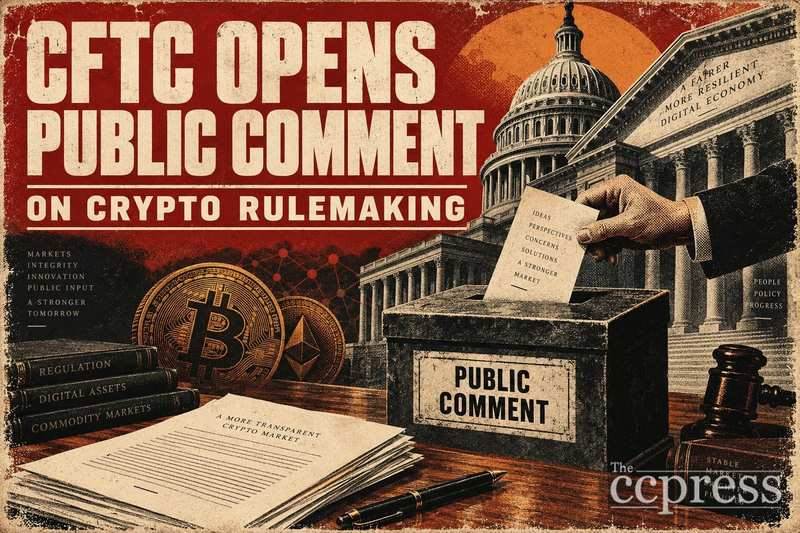
商品期货交易委员会(CFTC)已启动一项规则制定程序,该程序可能为加密货币交易所提供一条联邦途径,向零售客户提供杠杆、保证金和融资支持的加密资产交易。在国会未能推进更广泛的市场结构立法后,该机构依据现有权限继续前行。周一,该机构发布了关于“加密资产交易监管”(Regulation CTX)和“加密资产市场监管”(Regulation CAM)的拟议规则制定预先通知。
这一举措旨在为《商品交易法》第2(c)(2)(D)条所涵盖的零售加密商品交易建立定制化的规则,并可能专门为加密交易所创建一个新的指定合约市场(DCM)注册子类别。此行动推进了一项于9月提交白宫进行监管审查的流程,此前两天参议院未能通过《数字资产市场明晰法案》。
“加密资产交易监管”与“加密资产市场监管”究竟会带来哪些改变?
该框架针对的是以杠杆、保证金或融资方式提供的零售加密商品交易,而非普通的完全支付现货交易。现有的指定合约市场可以根据针对该产品定制的规则提供这些加密资产交易。专注于此类交易的交易所可以寻求注册为新的“加密资产市场”(CAM),这将作为指定合约市场的专门子类别运作。
CFTC Chairman Michael Selig described the structure as a federal option rather than a mandatory alternative to state licensing. Ordinary spot exchanges can continue to operate mainly under the state funds transfer framework, while platforms seeking to provide retail leveraged trading can enter the CFTC regulatory system. This distinction is crucial because the CFTC currently lacks congressional authority to require all spot crypto exchanges to register with the agency. The abandoned CLARITY Act would have gone further by establishing a statutory federal market structure and expanding the CFTC's jurisdiction over the spot market for digital goods.
Back in August, the agency had outlined three possible ways to bring leveraged crypto-trading to U.S. exchanges, including rules for existing registered markets and specially constructed crypto registration categories.
Investor revelation
This move does not issue a federal license for every U.S. crypto exchange. Its immediate significance is limited: it could provide a regulated U.S. domestic market for leveraged retail crypto products that have historically been concentrated mainly on offshore platforms.
What protection mechanisms may federal crypto exchanges face?
The CFTC is seeking public opinion on how the new system should deal with manipulation, customer protection, custody, market surveillance and other risks specific to crypto assets. Selig said that potential CAMs will still be bound by core principles that apply to designated contract markets, with specific rules for crypto assets superimposed on them. These rules may require exchanges to evaluate token distribution, ownership concentration, attribution schedules, programmatic issuance and repurchase to determine whether an asset is vulnerable to manipulation.
The agency is also considering implementing reserve certification requirements for integrated account platforms that hold client assets. Another proposal would require futures commission brokers (FCM) intermediaries to process retail crypto transactions, subject client funds to capital, isolation, disclosure and anti-money laundering controls. The CFTC is also separately reviewing the applicability of the "actual delivery" exception in the Commodity Exchange Act. Selig said that under future explanations, transferring assets to a customer's external unmanaged wallet within 28 days would usually satisfy this exception.
Investor revelation
The proposed structure may narrow the regulatory gap between offshore crypto leverage and traditional U.S. derivatives markets. Key details will cover leverage limits, custody requirements, FCM participation and what assets can be listed at registration sites.
Why would the CFTC take action in the absence of Congress?
The move follows the Senate's failure to pass the CLARITY Act on September 15, which failed to meet the required 60-vote threshold with a vote of 49 to 50. Previous reports pointed out that the vote turned attention to what the SEC and CFTC could do under current laws. The CFTC has been preparing for this result for months. Selig has repeatedly stated that the agency can use its existing powers to develop part of the crypto market structure, while acknowledging that only Congress can implement a comprehensive registration system for the spot crypto market.
The Securities and Exchange Commission (SEC) has adopted a similar institution-led approach, including a five-year innovation exemption for certain tokenized U.S. stocks. Together, these two measures demonstrate that regulators are advancing the framework on a narrower scale while comprehensive legislation is pending.
What will happen before exchanges use the new framework?
The CFTC has not formally adopted "Regulation of Cryptographic Asset Trading" or "Regulation of Cryptographic Asset Markets." Monday's action was advance notice of the development of the proposed rule, an early stage designed to gather information so the agency can decide how to write formal regulations. Public comment will be accepted within 60 days of the notice being published in the Federal Register. Agencies can then use these responses to develop proposed rules, which typically require another round of public comment processes before any final requirements take effect.
Investor Enlightenment
The announcement creates a regulatory path rather than an immediately available exchange license. For U.S. crypto platforms, the next substantive questions include: what are the requirements of the formal proposal, how expensive will CAM registration be, and whether the framework is competitive enough to bring leveraged trading back from offshore locations.