Exchange Ranking
 Top Exchanges
 24h Volume Ranking
 Popularity Ranking
 Exchange BTC Balance
 Proof of Reserves
 Decentralized Exchanges
 Funding Rate
 Funding Heatmap
 Liquidation Data
 Max Pain
 Long/Short Ratio
 Whale L/S Ratio
 Binance/Okex/Huobi L/S
 Bitfinex Margin L/S
 ETF Tracker
 Solana ETF
 XRP ETF
 Hong Kong ETF
 Bitcoin Treasuries
 Crypto Reversal
 Ethereum Reserves
 HyperLiquid Wallet Analysis
 Hyperliquid Whale Watch
 Large Transactions
 On-chain Movement
 Bitcoin ROI
 Stablecoin Market Cap
 Options Analysis
 News
 Articles
 Economic Calendar
 Features
 Wallet
 Contract Calculator


 Security
 Collections
 Watchlist
 Following
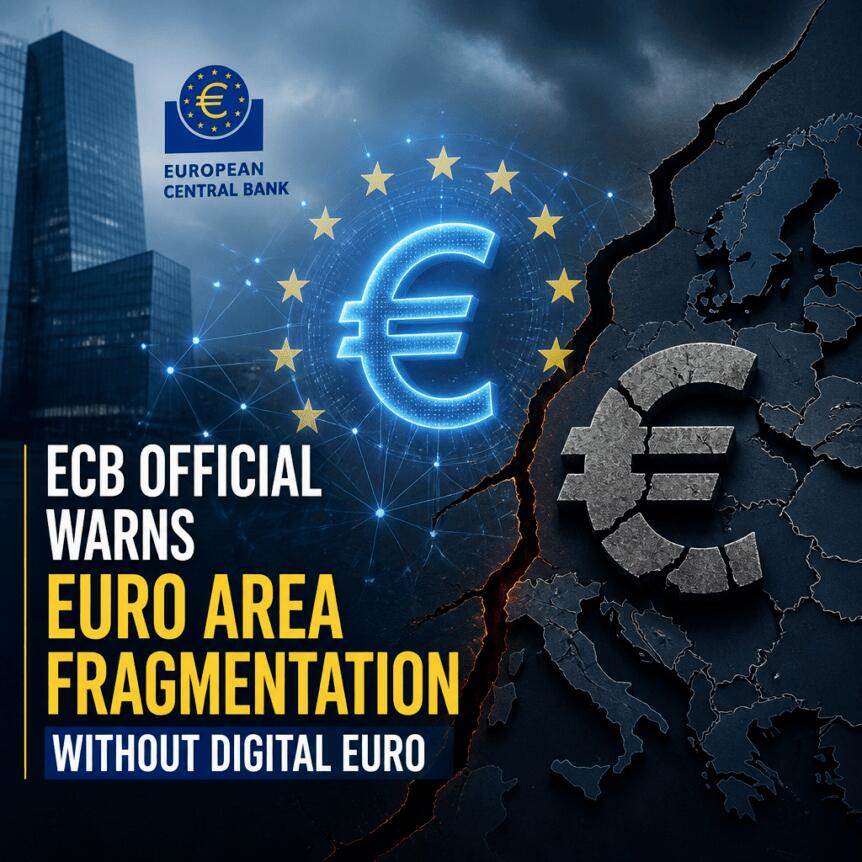
ECB executives warn: Without a pan-European digital euro, the tokenized payment system could intensify fragmentation.
A senior European Central Bank (ECB) executive warned that the digital euro project could be damaged if other payment providers establish competing tokenized payment channels before the central bank launches its pan-European solution. In a speech at the MNI Connect webinar, ECB Executive Council member Piero Cipollone pointed out that a lack of broad interoperability of the digital euro could exacerbate fragmentation among various tokenization platforms, weakening Europe's "resilience and monetary sovereignty."
Although the European Central Bank has not yet decided whether to issue digital euros, Cipolone said that the central bank plans to complete the legislative process by the end of 2026. He also described a possible timetable: a 12-month pilot starting in the second half of 2027 and expected to be officially released in 2029.
Core Points
- Fragmentation Risk: Chipolone warned that without pan-European digital payment options, tokenized payment systems could fragment across platforms.
- Legislative progress: The European Central Bank has not confirmed whether it will issue digital euros, but plans to complete the legislative process by the end of 2026.
- Potential timeline: Based on the current roadmap, the 12-month pilot may start in the second half of 2027 and be considered for release in 2029.
- Strategic goals: The ECB's clear goal is not to replace banks, but to provide infrastructure to help banks and other providers compete in the digital space.
- Privacy controversy: Previous ECB proposals have positioned the digital euro as a digital payment supplement to cash, but critics have raised privacy and surveillance concerns.
Why the ECB is worried about "fragmentation"
Speaking at the MNI Connect webinar on Monday, Chipolone highlighted a specific risk: If there is no pan-European digital payment solution capable of handling day-to-day transactions, alternatives may emerge outside the ECB's framework. In his view, these decentralized methods may lead to deeper fragmentation among tokenization platforms.
This concern is not just about isolated technologies, but also about interoperability and coordination. Without a universally accepted central-bank-issued option designed to operate across the banking system, the market could end up with multiple tokenized ecosystems that cannot be seamlessly exchanged for regular payments.
This framework is critical to both users and organizations. For consumers and merchants, fragmentation can lead to inconsistent payment availability, differences in user experience, or increased friction costs when used across providers. For banks and payment companies, this means that integration and compliance costs will be higher if they have to support multiple competing tokenization systems rather than standardizing around a shared benchmark.
ECB's stated goal: achieve digital euro convertible between banks
Despite criticism of sovereignty and resilience, Chipolone emphasized that the ECB's goal is not to replace banks. "Our goal is not to take over bank functions," he said, adding that the digital euro will "equip banks with the competitive infrastructure they need in the digital age" and help them expand the coverage and usage scenarios of their own solutions.
This approach positions the digital euro as an infrastructure layer rather than a retail payment provider. In practice, this means that the focus is on making the digital euro available for daily payments while maintaining its convertibility among banking institutions.
This also clarifies the ECB's political and market stance: rather than replacing private payments with central-bank monopolies, the ECB appears to aim to establish a basic payment capability on which private participants can build services.
Timetable: Legislative process, pilot window and possible issuance
Chipolone said that the European Central Bank has not yet decided whether to issue digital euros. However, he hinted that the agency has a willingness to complete the legislative process by the end of 2026, which will determine whether the project moves from the planning stage to the implementation stage.
If lawmakers and the ECB continue to move forward, Chipolone describes a possible implementation path, which includes a 12-month pilot project starting in the second half of 2027. He further pointed out that the release may come in 2029, but this depends on the pilot results and subsequent steps.
These dates are important not only for policy observers, but also for market participants who need planning integration, governance and operational readiness. Even if the ECB has not yet made a final decision, the existence of the roadmap means that the timeline risk-that is, private alternatives accelerate while central bank plans remain pending-could still become a real competitive issue.
Background: Digital euro proposal and ongoing debate
The European Central Bank first proposed the introduction of digital euros in October 2020, initially positioning it as a central bank digital currency (CBDC), intended to serve as a digital payment supplement to cash.
Critics argue that such systems could allow EU authorities to monitor or potentially control residents 'spending, raising concerns that go beyond technical levels and extend into areas of privacy, oversight and governance.
In another speech in September 2025 at an event hosted by the Bank for International Settlements (BIS), Chipolone said: "The digital euro will ensure that all Europeans can make payments at any time using free, universally accepted digital payment methods, even in the event of major interruptions." The statement connects the plan to contingency planning, designed to maintain paid access and prevent interruptions during times when private systems are under pressure or uneven availability.
Taken together, these two arguments-Cipolone's warnings about fragmentation and his previous emphasis on universal availability-outline a consistent policy narrative: the ECB seems focused on maintaining durable and interoperable payment options in the euro area while ensuring that banks 'role in competitive services is not undermined.
Future Concerns
For investors and practitioners, the key observation is not only whether the ECB will ultimately choose to issue digital euros, but also whether its legislative process and pilot timetable can keep up with private tokenization efforts, lest these alternatives solidify into fragmented standards. The ECB's legislative goals for the end of 2026 and the proposed pilot window for the second half of 2027 could shape the speed at which banks and payment providers plan around potential interoperability benchmarks or multiple competing channels.