Exchange Ranking
 Top Exchanges
 24h Volume Ranking
 Popularity Ranking
 Exchange BTC Balance
 Proof of Reserves
 Decentralized Exchanges
 Funding Rate
 Funding Heatmap
 Liquidation Data
 Max Pain
 Long/Short Ratio
 Whale L/S Ratio
 Binance/Okex/Huobi L/S
 Bitfinex Margin L/S
 ETF Tracker
 Solana ETF
 XRP ETF
 Hong Kong ETF
 Bitcoin Treasuries
 Crypto Reversal
 Ethereum Reserves
 HyperLiquid Wallet Analysis
 Hyperliquid Whale Watch
 Large Transactions
 On-chain Movement
 Bitcoin ROI
 Stablecoin Market Cap
 Options Analysis
 News
News Articles
 Economic Calendar
 Features
 Wallet
 Contract Calculator


 Security
 Collections
 Watchlist
 Following
Rumors of Robinhood Chain shutdown gradually subsided after the Arbitrum update
Today, rumors about "Robinhood Chain may be shutdown" quickly circulated on the Internet, triggering a wave of concerns. People searched for answers, trying to confirm whether the Ethereum Layer 2 network was really down. However, Arbitrum, the technical team supporting the network, acted quickly and clarified the situation directly from its official account, confirming that the network remained online throughout the incident, although some temporary exceptions did occur in the background.
What actually happened to the Arbitrum?
According to an official statement from Arbitrum, there were no outages today. 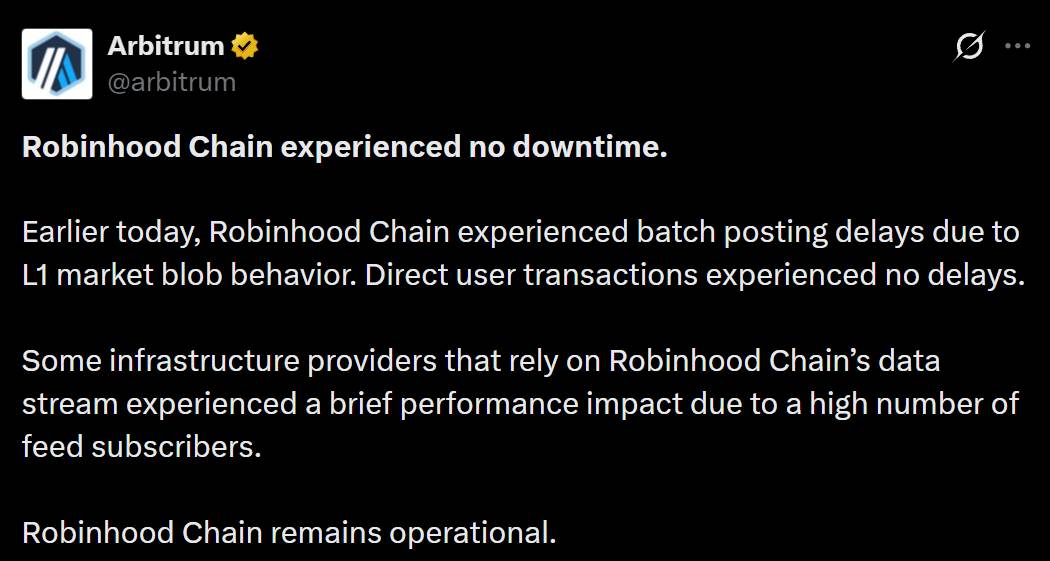
The network experienced delays in publishing transaction batches due to behavior in the Ethereum Layer 1 (L1) Blob market, but the chain itself remained fully functional throughout the process. The following is a breakdown of the key points of the statement:
- Status: No network downtime reported
- Batch release: Delay due to L1 Blob market behavior
- Direct user transactions: No delays were experienced
- Infrastructure data sources: Some provider performance was temporarily affected
- Overall network status: Stay operational throughout
This difference is critical. "Batch release delay" and "comprehensive network shutdown" are two different things. Arbitrum made it clear that the former occurred, while the latter did not occur.
Why does it seem more serious than it actually is?
This confusion is understandable given the internal workings of these systems. The network is built as Ethereum Layer 2, which means it processes transactions quickly locally, while regularly publishing batches of transaction data back to Ethereum's base layer to ensure security and final certainty. When this particular release step is delayed due to congestion in the Ethereum Blob Market, external observation may give the impression that something is a bigger problem, especially for someone monitoring the data source rather than the actual transaction processing. 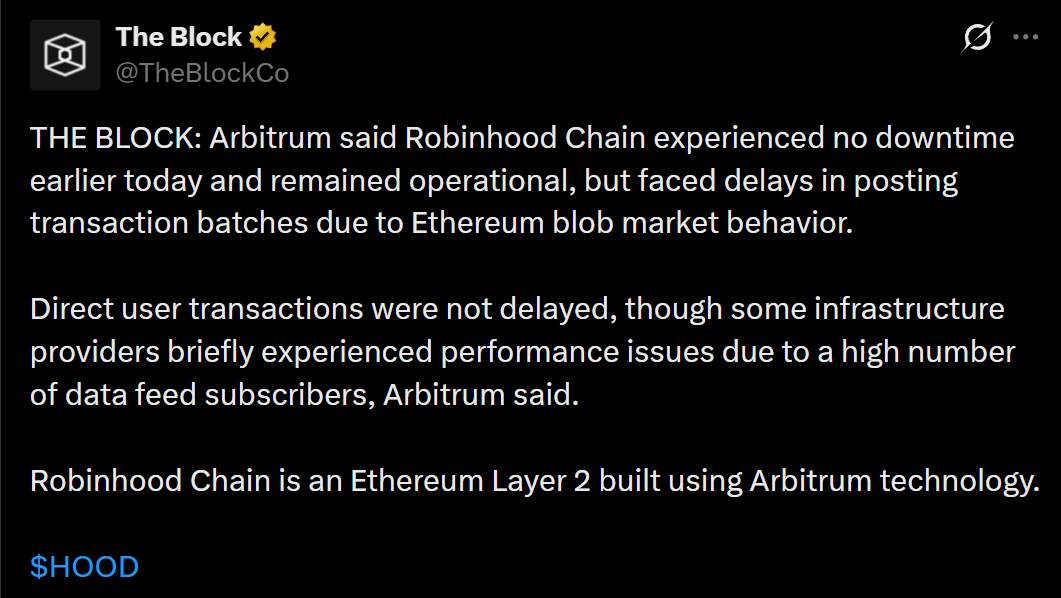
Source: The Block
This is basically what happens here. A follow-up report on the incident also confirmed this explanation, pointing out that some infrastructure providers experienced temporary performance problems simply because a large number of subscribers were pulling data from the same data source at the same time, rather than because any feature stopped working.
An in-depth analysis of the technical reasons
To understand how today's Robinhood Chain outage panic occurs, it is helpful to understand what the Blob market is. Ethereum's Blob Space is a dedicated, lower-cost data channel that the Layer 2 network uses to publish transaction batches back to the main Ethereum chain. When there is abnormal demand or congestion in this Blob market, batch releases for any Layer 2 networks that rely on it may be delayed. Here are some points worth understanding:
- Blob market delays affect the speed at which batches are confirmed on Ethereum, not whether Layer 2 is processing transactions.
- During this period, users interacting directly with the network were not affected.
- Infrastructure providers that rely on real-time data sources have noticed a brief pause due to a surge in data source subscribers, Instead of a failure on the chain
Is this a real failure or just an episode?
Based on official statements, the situation is clear: this is not a shutdown in the traditional sense. The network has never stopped operating, and users who send transactions on a daily basis have not experienced any interruptions. What really happened was a temporary delay in the batch release process, coupled with a temporary strain on some third-party infrastructure that relied on chain data flows. Even if the initial rhetoric online makes it sound more serious than it actually is, describing it as a real Robinhood Chain outage would exaggerate what actually happened.
This difference deserves wider attention. The Layer 2 network has multiple components, including its own transaction processing, publishing data to Ethereum, and the third-party infrastructure built around them. Stacking in one part does not necessarily mean that the entire system is compromised, and today's events are a perfect example of this nuance.
What does this mean for the future
For all daily activities and online users related to $HOOD, the practical conclusion is simple: transactions were conducted normally throughout the incident. For infrastructure providers and anyone building tools on top of chain data sources, this incident is more of a reminder that Blob market conditions on Ethereum can have downstream ripple effects, even if the underlying Layer 2 itself is operating as expected.
Conclusion
Despite the rapid spread of alerts online, both Arbitrum and The Block confirmed that the network remains operational throughout, and that the real problems are temporary batch release delays (related to the Ethereum Blob market) and temporary stress on certain data source infrastructure. Direct user transactions are never interrupted, making this more like a behind-the-scenes incident than a real failure of the system itself.
Disclaimer
This content covers financial markets and is for general information only. Does not constitute financial, investment, trading or legal advice. Cryptocurrency assets are highly volatile and may fall rapidly in value. Please be sure to study it yourself. Consult a licensed financial adviser before making an investment decision.