Exchange Ranking
 Top Exchanges
 24h Volume Ranking
 Popularity Ranking
 Exchange BTC Balance
 Proof of Reserves
 Decentralized Exchanges
 Funding Rate
 Funding Heatmap
 Liquidation Data
 Max Pain
 Long/Short Ratio
 Whale L/S Ratio
 Binance/Okex/Huobi L/S
 Bitfinex Margin L/S
 ETF Tracker
 Solana ETF
 XRP ETF
 Hong Kong ETF
 Bitcoin Treasuries
 Crypto Reversal
 Ethereum Reserves
 HyperLiquid Wallet Analysis
 Hyperliquid Whale Watch
 Large Transactions
 On-chain Movement
 Bitcoin ROI
 Stablecoin Market Cap
 Options Analysis
 News
News Articles
 Economic Calendar
 Features
 Wallet
 Contract Calculator


 Security
 Collections
 Watchlist
 Following
 AVAX
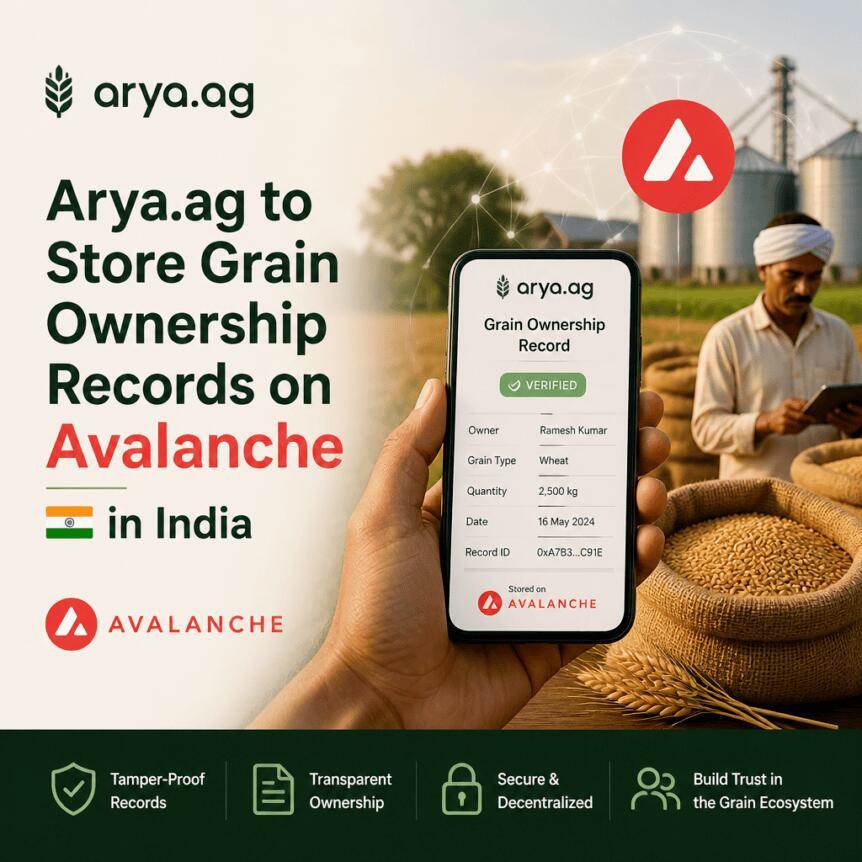
AVAX India's agricultural warehousing and lending platform Arya.ag pilots the tokenization of grain warehouse receipts on the Avalanche chain
Indian agricultural warehousing and lending service provider Arya.ag is testing a tokenization system that aims to convert electronic warehouse receipts stored in grain into tokens that can be transmitted along the chain. The pilot project is built on a dedicated Avalanche Layer-1 network and is originally designed to connect digital records with real-world lending processes. According to Arya.ag and its partners, the approach closely correlates grain deposits, warehouse receipts, mortgage commitments and loan status through Finternet's infrastructure.
Devika Mittal, head of Ava Labs India, told the media that testing is currently underway and that each tokenized warehouse receipt will represent ownership of the stored goods.
Core Points
- Connection of off-chain objects to on-chain records: Arya.ag is testing tokenized warehouse receipts for grain storage on the Avalanche dedicated Layer-1 network, aiming to strengthen the link between physical collateral and on-chain lending records.
- Finternet's data integration: Finternet integrates farmer, commodity, warehouse and insurance data into a "composite token" designed to help banks assess mortgage risk.
- Transparency rather than scale expansion: The focus of the pilot is on improving sharing transparency among lenders (such as banks)-such as confirming whether grain has been pledged and outstanding debt status-rather than immediately expanding the existing loan size at Arya.ag
- Physical verification is crucial: The effectiveness of the system still depends on the accurate confirmation of the underlying physical grains, and operational control still occupies the core position in the model.
- Regulatory background: The concept of "Finternet" can be traced back to a paper published by the Bank for International Settlements (BIS) in 2024 that called for the establishment of a unified ledger for tokenized assets, supported by legal and supporting frameworks.
Tokenization of grain collateral on Avalanche
Arya.ag's system is designed to solve a long-standing bottleneck in commodity-backed lending: Lenders need reliable and up-to-date information about the existence of collateral, ownership, and whether it has been pledged elsewhere. Electronic warehouse receipts can help by allowing goods to be stored as financing guarantees without having to be sold immediately after harvest. However, converting these warehouse receipts into shared and verifiable digital records becomes the next obstacle.
Based on tests described by Arya.ag and Ava Labs, tokenized warehouse receipts will become a digital expression of ownership of stored grains. Mittal pointed out that each warehouse receipt token corresponds to the goods stored in the warehouse network. The intention is for the ledger to serve as a shared reference point for lenders, borrowers and relevant stakeholders.
Finternet does more than just connect ownership records. Sanmesh Kalyanpur, director of Finternet Labs, said Arya.ag's sampling and verification process collects information about stored grains and enters it into the company portal. Finternet then aggregated multiple types of data-including farmer, commodity, warehouse and insurance data-into what Kalyanpur describes as a "composite token" that banks can use to assess mortgage risk.
Pilot how to link warehouse receipts and commitments to loan status
This announcement describes the system as an end-to-end link from deposits, mortgage commitments to loan results. Arya.ag and Finternet said their networks connect grain deposits, warehouse receipts, commitments as collateral and the changing loan status associated with those warehouse receipts.
This design is important because mortgage risk is not only about the existence of collateral, but also about exclusivity and exposure. Lenders need to know whether the grain behind a particular warehouse receipt has been pledged and whether the associated debt already exists. The company said its system is designed to provide lenders with a shared record of what is stored, owners, whether it has been pledged and the remaining debt.
However, the company also emphasized that the effectiveness of the system still depends on accurate verification of the physical goods represented by the digital records. In practice, this means that operational inspections and sampling procedures remain crucial. Tokenization can improve the traceability of collateral and the speed of information sharing, but it cannot replace basic verification of the existence of stored grains and consistency with warehouse receipt statements.
Arya.ag reports that its warehouse network stores approximately US$2 billion worth of agricultural products and supports approximately Indian rupees (approximately US$1.26 billion) in loans every year. Its lending arm, Arya Dhan, issues approximately $230 million in loans every year. The announcement clarified that these data describe the existing business of Arya.ag and do not represent assets or loans that have been linked.
Deep architectural and regulatory issues for Finternet
The Finternet framework behind this pilot is not an entirely new concept. The concept can be traced back to a paper published by the Bank for International Settlements (BIS) in 2024 co-authored by Infosys co-founder Nandan Nilekani and former BIS general manager Agustín Carstens. The paper proposes establishing a unified interconnected ledger for tokenized assets, while emphasizing the need for legal and regulatory frameworks to support such systems.
According to BIS, the model aims to enable tokenized assets to flow in connected systems of record rather than in isolated databases. The paper also emphasized that technical alignment alone is not enough; arrangements for legal recognition, operational responsibilities and supervision are critical to adoption.
This focus on governance is particularly important for mortgages because institutions need to have a clear understanding of custody, ownership, enforcement and dispute resolution. In the context of warehouse receipts, if physical commodity verification is needed, the "only source of truth" cannot be purely software.
Finternet's background is consistent with the broader tokenization activity on Avalanche. Previous reports have shown that as of the end of 2025, the value of tokenized real-world assets on Avalanche has exceeded US$1.3 billion, mainly driven by loans and tokenized money market funds, indicating that tokenization has been used in some areas of the on-chain financial stack.
Momentum of warehouse-backed lending in India
India is building momentum in warehouse-based agricultural financing. The core mechanism-electronic warehouse receipts-allows farmers and businesses to store goods as collateral for borrowing rather than sell them immediately after harvest. This helps stabilize income and improves access to capital during periods of seasonal price fluctuations.
The policy environment is also crucial. In 2024, the Indian government launched a credit guarantee scheme worth Rs 10 billion to encourage financing for electronic transferable warehouse receipts, especially for small and marginal farmers. Such projects aim to reduce risk for lenders and make warehouse receipt financing more popular.
Arya.ag's testing can be seen as an effort to modernize how these electronic warehouse receipts are represented and shared when collateral enters the digital lending workflow. If tokenized warehouse receipts and compound mortgage records function as expected, banks will gain a more synchronized view of pledged assets and associated exposures.
Still, the companies have not disclosed an expected release date or the size of the initial deployment (such as how much grain or loan volume is covered), so investors and builders may need to closely monitor pilot performance to understand its performance, verification reliability, and how it integrates with existing lending businesses.
At present, the most important question is whether the tokenized warehouse receipt model can provide faster and more reliable collateral evaluations without weakening control over physical verification and pledge status; the next public update from Arya.ag, Finternet and Ava Labs may determine whether this is just a technical test or whether it evolves into a product path for warehouse-backed lending.