Exchange Ranking
 Top Exchanges
 24h Volume Ranking
 Popularity Ranking
 Exchange BTC Balance
 Proof of Reserves
 Decentralized Exchanges
 Funding Rate
 Funding Heatmap
 Liquidation Data
 Max Pain
 Long/Short Ratio
 Whale L/S Ratio
 Binance/Okex/Huobi L/S
 Bitfinex Margin L/S
 ETF Tracker
 Solana ETF
 XRP ETF
 Hong Kong ETF
 Bitcoin Treasuries
 Crypto Reversal
 Ethereum Reserves
 HyperLiquid Wallet Analysis
 Hyperliquid Whale Watch
 Large Transactions
 On-chain Movement
 Bitcoin ROI
 Stablecoin Market Cap
 Options Analysis
 News
News Articles
 Economic Calendar
 Features
 Wallet
 Contract Calculator


 Security
 Collections
 Watchlist
 Following
BRICS 2026 Summit News: Is BRICS Pay finally ready to go global?
If you continue to follow this week's headlines, you may have seen a lot of news released from New Delhi about the BRICS 2026 Summit. In today's cryptocurrency news, leaders of the group's 11 member states held the 18th BRICS Summit from September 12 to 13, 2026, and the outcome was much more than just a regular group photo. A detailed joint declaration, a substantial push for payment infrastructure, and some compelling economic data are circulating. Let us use plain language to break down what actually happened and trace each claim back to its source.
New Delhi Declaration: What consensus did leaders reach?
The core of this year's summit is the New Delhi Declaration, which was unanimously adopted by all BRICS leaders. According to a summary shared by Sputnik India, the declaration identified the "Global South" as a driver of global change and noted the growing role of the New Development Bank. The declaration also calls for the establishment of fair supply chains for key minerals, which is crucial given the huge reliance of modern technology on rare earth metals and specialty minerals.
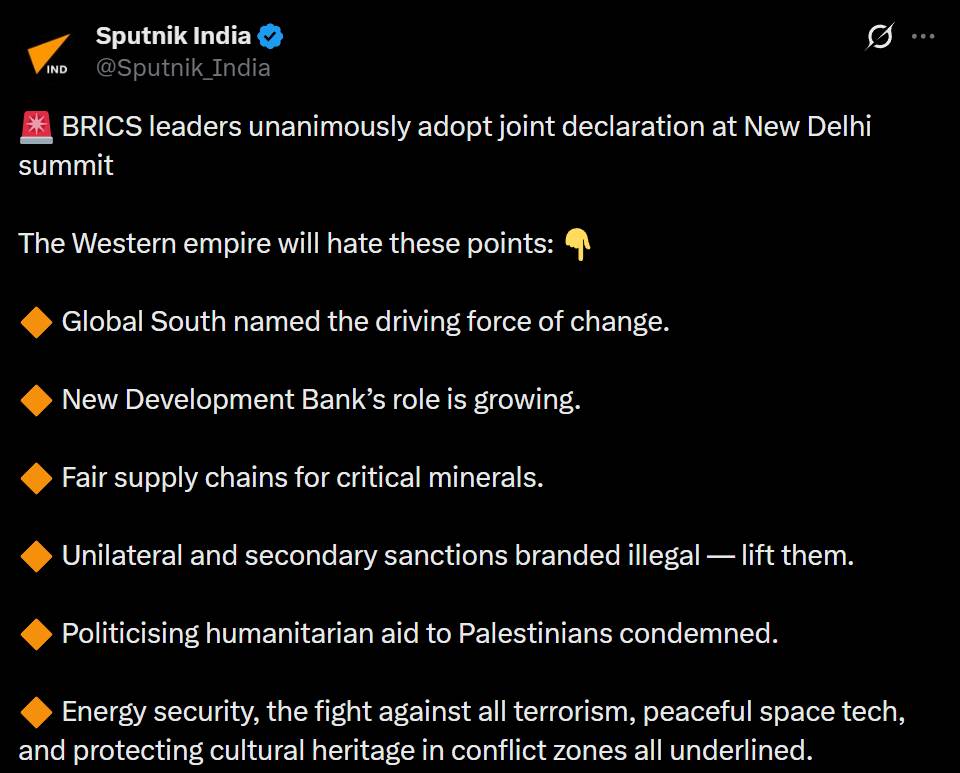 Source: Sputnik India's post on the X platform
Based on the same source, the following are other elements covered by the declaration:
- Unilateral and secondary sanctions are characterized as illegal and there is a direct call for their lifting.
- Clearly condemn the politicization of humanitarian assistance to Palestinians.
- specifically mentions energy security issues.
- emphasizes combating all forms of terrorism, not just terrorism targeting certain groups or regions.
- Contains peaceful uses of space technology.
- Include the protection of cultural heritage in conflict areas into the text.
Indian Prime Minister Narendra Modi personally confirmed the adoption of the declaration and posted a post saying that it reflected "the confidence of a BRICS country with broader coverage and firmer goals." The group's focus now shifts to innovation, sustainability, people-to-people exchanges and making cooperation more pragmatic and development-oriented. He particularly thanked all BRICS countries and their leaders for making this happen.
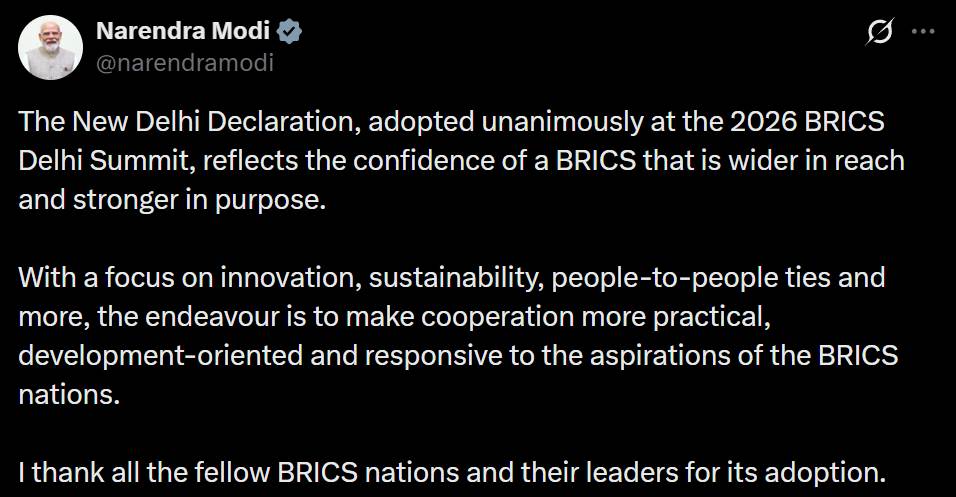 Source: Narendra Modi's post on platform X
BRICS Pay: Alternative to SWIFT is being advanced
This may be the most specific part of the news of this round of BRICS 2026 Summit and deserves a slow and careful review. According to a post from Stellar Rippler, China , Russia and India announced the upcoming launch of BRICS Pay, and the group is actively working towards interoperability by connecting central bank digital currencies (CBDC) to local currencies.
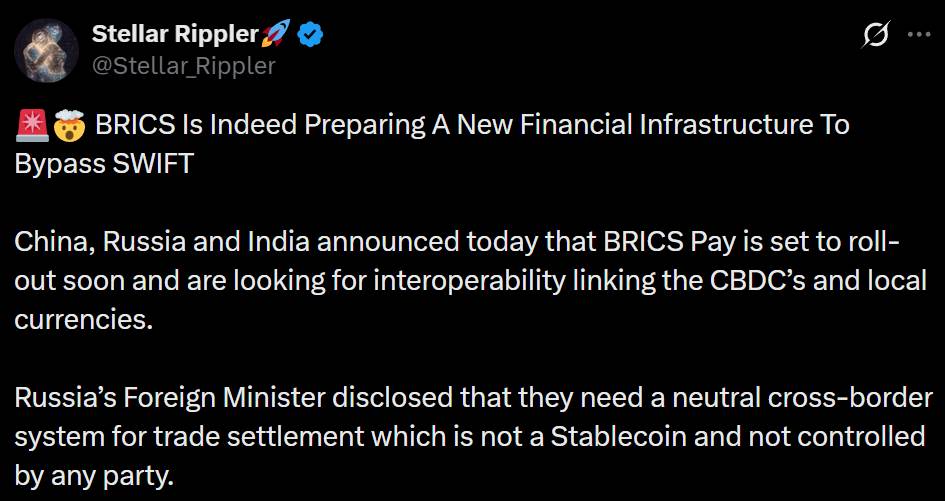 Source: Stellar Rippler's post on the X platform
The same source reported, Russia The foreign minister explained the reason behind the move: They wanted to create a neutral cross-border trade settlement system that was neither a stablecoin nor controlled by any single party. The post also mentioned that Russian President Vladimir Putin signed the Russian version of the "Clarity Act" and said the Western financial system was outdated, arguing that advanced blockchain solutions could help other countries avoid the weaponization of the US dollar and SWIFT. The wording used is to build "a new globally neutral asset connecting each currency." It is worth noting that the specific claim that Putin signed domestic laws comes from this single source and has not been independently confirmed elsewhere, so this detail should be cautious.
BRICS vs G7: Who is actually bigger?
Another circulated news thread of the BRICS 2026 Summit compares the economic sizes of the two groups, and the data is indeed thought-provoking. Based on an analysis of account sharing that tracks changes in the global economy, the situation is as follows:
G7-totaling approximately US$55.3 trillion:
- United States: US$32.38 trillion
- Germany: US$5.45 trillion
- Japan : US$4.38 trillion
- UK: US$4.26 trillion
- France: US$3.60 trillion
- Italy: US$2.74 trillion
- Canada: US$2.51 trillion
BRICS countries (11 member states)-total approximately US$35.2 trillion:
- China : US$20.85 trillion
- India: US$4.15 trillion
- Russia : US$2.66 trillion
- Brazil: US$2.64 trillion
- Indonesia : US$1.54 trillion
- Saudi Arabia: US$1.39 trillion
- United Arab Emirates: About US$0.62 trillion
- South Africa: About US$0.48 trillion
- Egypt: About US$0.43 trillion
- Iran: About US$0.30 trillion
- Ethiopia: About US$0.20 trillion
According to the same post, since the early comparison point in October 2023, the G7's nominal gross domestic product (GDP) has increased from US$45.9 trillion to approximately US$55.3 trillion, while the BRICS countries have expanded from US$30.8 trillion to approximately US$35.2 trillion. As a result, the gap between the two groups actually widened in raw dollar terms, thanks largely to the strong growth of the U.S. economy itself. But there is a turning point: in the terminology of purchasing power parity (PPP), which is adjusted for the cost of living and the real purchasing power of the currency in each country, the situation is completely reversed. Data from the International Monetary Fund (IMF) for 2025 shows that BRICS countries account for about 40.5% of world output, while the G7 accounts for only 28.3%.
Why is it all important together
Reading these three aspects of BRICS 2026 Summit news side by side, a pattern begins to emerge. You have a political declaration firmly opposed to sanctions and Western-dominated institutions, a real technical effort to build payment infrastructure that does not go through dollars or SWIFT, and economic data that shows that the group is already a huge force-when measuring what people can actually buy with money, even if it still lags behind the G7 in raw dollar GDP. It is no accident that these three events occurred in the same week; they are clearly part of the group's coordinated effort to position itself as a serious counterweight in the world.
What to focus on next
Given that BRICS Pay is still in its early stages, the next real signal will be to see whether to launch an actual pilot and which countries will participate first. The language in the New Delhi Declaration on sanctions and Palestinian aid may also shape the way BRICS countries vote and speak at the United Nations and other international forums in the months ahead. As GDP data continues to be updated, it is worth paying attention to whether the gap in terms of purchasing power parity between the BRICS countries and the G7 will continue to widen in a way that benefits the BRICS countries.
Conclusion
This round of BRICS 2026 summit news shows a group that apparently no longer meets just for group photos. Direct targeting of unilateral sanctions in a declaration containing 140 points of detail, and in China , Russia With India's support to truly promote BRICS Pay and CBDC interoperability, as well as the economic numbers that put the group ahead of the G7 in terms of purchasing power, this year's summit in New Delhi looks like one of the more substantive meetings the group has held. Whether payment infrastructure is truly built and used on a large scale will be the real test of how much content can be transformed from declaration to practice.
Disclaimer : This article is for educational and informational purposes only and should not be regarded as financial or investment advice. Be sure to conduct your own research before making an investment decision.