Exchange Ranking
 Top Exchanges
 24h Volume Ranking
 Popularity Ranking
 Exchange BTC Balance
 Proof of Reserves
 Decentralized Exchanges
 Funding Rate
 Funding Heatmap
 Liquidation Data
 Max Pain
 Long/Short Ratio
 Whale L/S Ratio
 Binance/Okex/Huobi L/S
 Bitfinex Margin L/S
 ETF Tracker
 Solana ETF
 XRP ETF
 Hong Kong ETF
 Bitcoin Treasuries
 Crypto Reversal
 Ethereum Reserves
 HyperLiquid Wallet Analysis
 Hyperliquid Whale Watch
 Large Transactions
 On-chain Movement
 Bitcoin ROI
 Stablecoin Market Cap
 Options Analysis
 News
News Articles
 Economic Calendar
 Features
 Wallet
 Contract Calculator


 Security
 Collections
 Watchlist
 Following
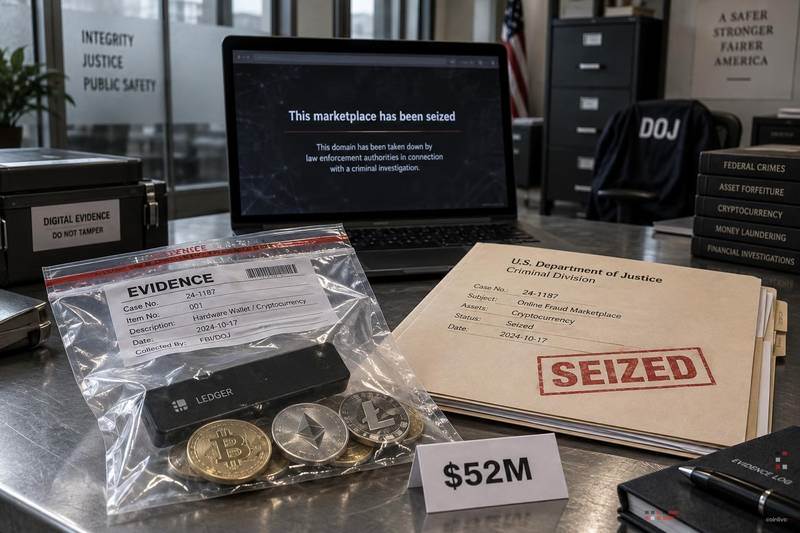
The U.S. Department of Justice crackdown seized fraud markets and froze approximately US$52 million in cryptocurrency
According to relevant law enforcement actions, a special strike team of the U.S. Department of Justice (DOJ) has seized a suspected fraudulent crypto-asset trading market and frozen approximately US$52 million worth of cryptocurrency. The title describes "market seizure" and "cryptocurrency freeze" as two separate enforcement actions.
Summary of core points
- The U.S. Department of Justice's Special Strike Team has seized a market platform suspected of fraud.
- About US$52 million in cryptocurrency was frozen in accordance with the law.
- News headlines clearly distinguish between two separate actions: market seizures and cryptocurrency freezes.
Details on market seizure
The core of this enforcement action is the special strike team run by the U.S. Department of Justice, which seized a platform described as a "fraudulent market." However, current public reports do not mention the specific name of the platform, the name of the special strike group and the exact date when the seizure occurred.
Range of facts established by the title
Available records only confirm that the U.S. Department of Justice's Special Strike Team carried out one market seizure and was linked to another market seizure in the same enforcement effort. The report did not indicate whether there were any arrests, specific charges, locations of operations, the number of victims or the specific fraud patterns involved. Although similar cross-border seizures have been similar to cases such as Interpol's crypto-crime crackdown, no such connection has been confirmed in this incident.
US$52 million in cryptocurrency was frozen
The second reported action was to freeze US$52 million in cryptocurrency. This figure is for reported amounts only and does not include valuation dates or asset details. It is worth noting that "restrained" is a legal state that is different from "recovered","confiscated" or "returned to victims." The current reporting background does not specify the type of token, blockchain network, wallet address or custodian involved, nor does it establish evidence that the frozen assets belong to the market. Previous law enforcement cases, such as the Royal Canadian Mounted Police (RCMP) cryptocurrency seizure case and the U.S. seizure of bitcoins from a Cambodia fraud case, have shown that "freezing" and "confiscation" may be separate stages in the handling of the case.
What is unclear about this Justice Department action
Against the background of the information provided, many details were not recognized as confidential by the authorities, but were not provided at all. The market name, the date of the case, the legal basis for the freezing and the final asset disposal method all need to be verified through the original source. Current information fails to establish a case timeline, list defendants 'names, clarify the legal status of assets or any victim compensation process. Due to the lack of verifiable data to confirm the scale of the operation, querying Ministry of Justice records has now become the main source of information.
Disclaimer : This article is for reference only and does not constitute financial or investment advice. There are significant risks in the cryptocurrency and digital asset markets. Before making a decision, be sure to study it yourself.