Exchange Ranking
 Top Exchanges
 24h Volume Ranking
 Popularity Ranking
 Exchange BTC Balance
 Proof of Reserves
 Decentralized Exchanges
 Funding Rate
 Funding Heatmap
 Liquidation Data
 Max Pain
 Long/Short Ratio
 Whale L/S Ratio
 Binance/Okex/Huobi L/S
 Bitfinex Margin L/S
 ETF Tracker
 Solana ETF
 XRP ETF
 Hong Kong ETF
 Bitcoin Treasuries
 Crypto Reversal
 Ethereum Reserves
 HyperLiquid Wallet Analysis
 Hyperliquid Whale Watch
 Large Transactions
 On-chain Movement
 Bitcoin ROI
 Stablecoin Market Cap
 Options Analysis
 News
News Articles
 Economic Calendar
 Features
 Wallet
 Contract Calculator


 Security
 Collections
 Watchlist
 Following
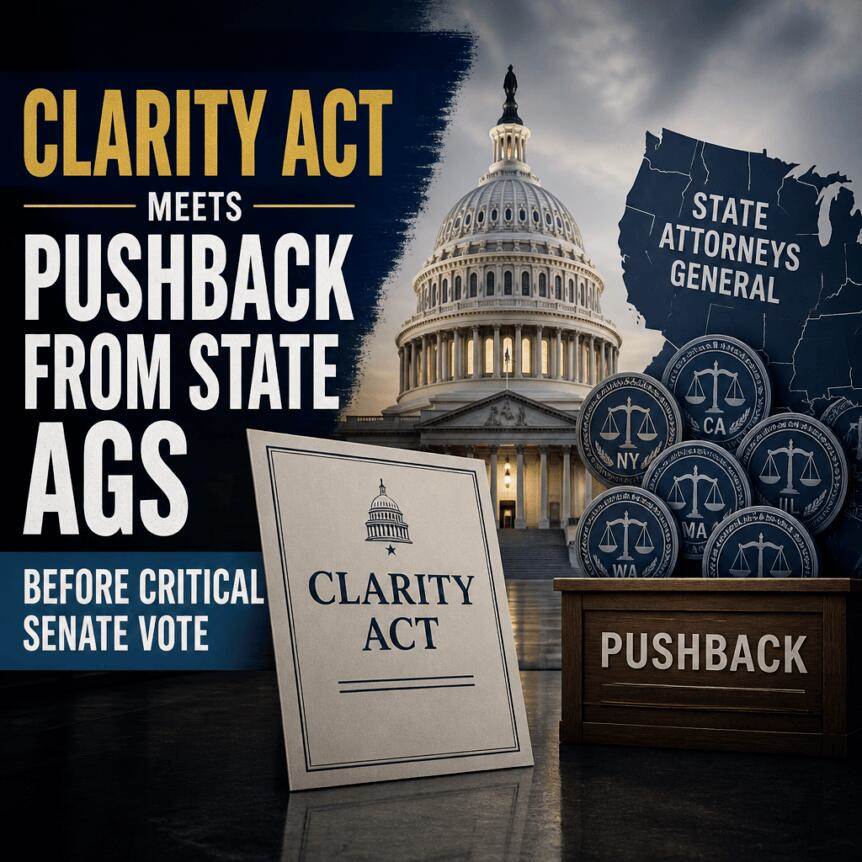
CLARITY Bill faces a key procedural vote in the Senate, and state attorneys general jointly oppose
According to multiple reports, the CLARITY Bill will face a key procedural vote in the Senate on Tuesday. Previously, President Donald Trump had agreed to most of a bipartisan proposal to tighten ethical rules for federal officials holding crypto-asset-related interests.
The bill aims to establish a federal framework for the regulation of digital asset markets, including clarifying jurisdictional boundaries between the Securities and Exchange Commission (SEC) and the Commodity Futures Trading Commission (CFTC). However, the latest compromise did not eliminate all opposition. A bipartisan group of 18 state attorneys general urged senators to veto the legislation, arguing that changes could weaken states 'powers to investigate and prosecute crypto companies suspected of fraud or other misconduct.
Core Points
- Procedural vote: The CLARITY bill is moving towards a key procedural vote in the Senate that will determine whether it enters full debate.
- Ethics guidelines adjustments: President Trump has reportedly agreed to most provisions of a bipartisan ethics proposal that would strengthen conflict of interest rules for specific federal officials.
- State Enforcement Concerns: Eighteen state attorneys general, led by New York Attorney General Letitia James, said the bill's language could weaken states 'enforcement efforts to combat alleged encryption fraud.
- Market restructuring: This bill remains a major effort to establish federal market structure rules aimed at clarifying whether crypto assets are considered securities or commodities.
State attorneys general raise concerns about enforcement powers
In a letter to the leadership of the Senate Banking Committee, 18 state attorneys general, led by New York Attorney General Letitia James, pointed out that the CLARITY Act could limit states 'ability to combat illegal activities in the area of encryption.
They argued that while the "current draft" retains certain powers of states to prosecute fraud, the provisions are "vague, unclear or restricted" in some respects, which could lead to challenges to states 'law enforcement powers or limit how hard states can continue to respond to what they call the "proliferation of fraud." The letter did not imply that states would be completely excluded from law enforcement, but emphasized that such ambiguity could lead to legal disputes and limit actual supervision.
An important point for observers concerned about the balance of power between federal and state regulators: While the revised bill gives state attorneys general a role in enforcing new federal ethics restrictions, other provisions will still weaken their ability to hold crypto company cases more broadly accountable.
The controversy highlights recurring tensions in U.S. crypto policy: Even if lawmakers agree on market structures and ethical guidelines, the details of the division of enforcement responsibilities among agencies and federal and state authorities often determine whether regulators can act quickly and effectively.
Tuesday's Senate procedural vote after Thun pushed for end debate
As previously noted, Senate Majority Leader John Thune submitted a closure motion last month before legislation failed to advance to recess. A procedural vote on Tuesday will determine whether the bill can move to Senate debate.
Motions to close debate are often used to limit debate time and overcome procedural obstacles. For supporters and opponents, Tuesday's vote is a mandatory node: It determines whether the CLARITY Act can leapfrog the next step of the legislative process, regardless of remaining differences over its content.
Trump Reported moral concessions reshape key conflict of interest rules
In addition to state attorneys general concerns, weekend reports noted that the White House had agreed to "about 80%" of the proposals proposed by Republican Sen. Thom Tillis and Democratic Senator Ruben Gallego, reported by The Associated Press. The Associated Press said the agreement came from a senior Republican aide.
The ethics section of the CLARITY Act will expand on existing rules that prohibit federal elected officials, their spouses, and federal judges from issuing digital assets. According to the Associated Press, the latest compromise will also require officials who have "significant" financial interests in crypto issuers to divest that interest or place it in invisible trusts. In addition, the measure would give the state attorney general a role in enforcing the restrictions.
Lawmakers described the adjustment as a response to concerns from Democrats and Tillis, who previously believed existing ethics provisions were insufficient to resolve potential conflicts, including conflicts involving President Trump's own crypto assets and business interests.
The cryptocurrency industry's response to this has been described as cautiously optimistic. "Crypto in America," a publication co-chaired by Eleanor Terrett, said the weekend's development triggered a "renewed sense of optimism" across the industry. According to Crypto in America, Republicans called the revised plan the "last, best and final recommendation" they made to Democrats before Tuesday's vote.
Still, the state attorneys general's letter suggests that tightening ethical guidelines for federal officials does not automatically address broader concerns about the bill's impact on state enforcement powers involving encryption fraud and misconduct.
Why the CLARITY Act goes beyond the ethics clause
While ethical disputes dominate the current political narrative, the larger purpose of the CLARITY Act is to reshape the regulatory landscape of digital assets in the United States. The bill is widely regarded as a landmark effort that would establish a federal market structure for digital assets, clarify when crypto assets fall within the securities or commodity framework, and define supervisory responsibilities between the SEC and the CFTC.
These jurisdictional clarifications have practical consequences for market participants. When the role of regulators is less controversial or more clearly defined, uncertainty in compliance decisions-such as how new products should be built and monitored-is reduced. If this is not the case, companies may face overlapping or conflicting expectations, and regulators may pursue different authoritative theories.
This round of opposition emphasizes that even large bipartisan bills are politically fragile if key stakeholders believe that enforcement powers will shift in the wrong direction. So Tuesday's procedural vote reflects not only whether lawmakers accept moral adjustments, but also whether they are willing to move forward even as state leaders raise positive legal and federalist concerns.
Next, readers should focus on how senators respond to state attorneys general's letters after the Senate moves to further debate-particularly whether the amendment addresses issues of ambiguity that may limit states 'ability to investigate alleged encryption fraud, or whether the bill enters the full legislative process largely unchanged.