Exchange Ranking
 Top Exchanges
 24h Volume Ranking
 Popularity Ranking
 Exchange BTC Balance
 Proof of Reserves
 Decentralized Exchanges
 Funding Rate
 Funding Heatmap
 Liquidation Data
 Max Pain
 Long/Short Ratio
 Whale L/S Ratio
 Binance/Okex/Huobi L/S
 Bitfinex Margin L/S
 ETF Tracker
 Solana ETF
 XRP ETF
 Hong Kong ETF
 Bitcoin Treasuries
 Crypto Reversal
 Ethereum Reserves
 HyperLiquid Wallet Analysis
 Hyperliquid Whale Watch
 Large Transactions
 On-chain Movement
 Bitcoin ROI
 Stablecoin Market Cap
 Options Analysis
 News
 Articles
 Economic Calendar
 Features
 Wallet
 Contract Calculator


 Security
 Collections
 Watchlist
 Following
 BTC
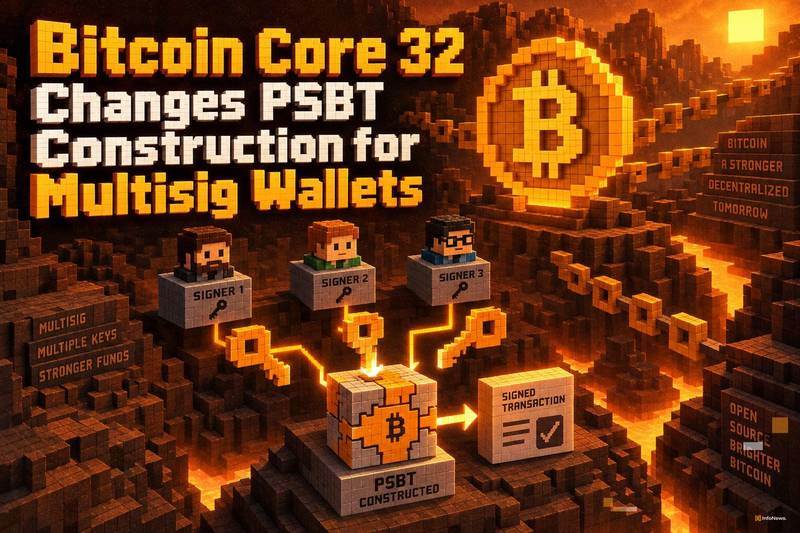
Bitcoin Core 32's analysis of changes to the construction method of PSBT for multi-signature wallets
According to the official release document, Bitcoin Core 32 has introduced changes to the construction method of partially signed Bitcoin transactions (PSBT) in multi-signature (Multisig) wallets. This update mainly affects the transaction preparation phase, which is the step before any co-signer adds a signature. This change makes more practical sense for operators running multi-signature settings between multiple signature devices or wallet applications.
Key points about changes to Bitcoin Core 32 PSBT
Partially Signed Bitcoin Transactions (PSBT) are a standardized data format that packages all the information needed to authorize a Bitcoin transaction, without all participants being online at the same time. PSBT is passed between signers or devices, and each participant in turn adds its signature until the required threshold is met before the transaction can be finalized and broadcast to the network.
- PSBT Build : refers to the transaction preparation stage, which is different from the transaction signing stage where the co-signer approves the input.
- Changes to Bitcoin Core 32 : Changes the way the multi-signature wallet works in this build step; before upgrading the multi-signature workflow in the production environment, please check the official release notes for implementation details.
Changes to Bitcoin Core 32 affect the build phase, which assembles inputs, outputs, and required metadata before starting signing. The way data is organized in PSBT at build time determines whether downstream signers, coordinators, and hardware devices can consistently interpret the transaction, especially in multi-signature configurations that require multiple authorization key contributions.
Where PSBT builds in the multi-signature wallet workflow
Standard multi-signature transactions follow five sequential stages: build, distribute, sign, combine, and broadcast. The build phase is the process of wallet assembling the UTXO inputs to be spent, target outputs, cost parameters, and script data that describes the signature policy (such as 2-of-3 requirements). Operators who have gone through relevant scenarios will realize that each stage relies closely on consistent data coding among all participants.
Once the build is complete, PSBT will be distributed to each co-signer. Each participant (whether it is a hardware wallet, air-gap device or a separate software instance) reads the PSBT, verifies the transaction details, and appends a partial signature. The coordinator then combines the signed PSBT into a single complete transaction, finalized and broadcast.
The consistency of transaction data during the build phase allows each signer to independently verify that they are signing the same transaction. If the PSBT built encodes input or script metadata that does not match expectations from the co-signer's device, the device may reject the signature or generate an incompatible signature. This is particularly important for multi-signature settings involving hardware wallets, as the firmware on the signing device often enforces strict parsing rules.
The combination and finalization steps after signing are only reliable if each participant's software correctly interprets the same build PSBT. As a result, changes in the build phase are propagated through the entire workflow, from the initial coordinator application to the broadcast.
Things to check for multi-signature wallet users and developers
The most immediate consideration is compatibility between the various components in the entire signature workflow. A multi-signature setup typically involves a coordinator application, one or more hardware signature devices, and possibly read-only wallet software. Each of these components may have its own PSBT parser, and changes to Bitcoin Core 32 at the build level may manifest themselves as parsing errors or silent behavioral differences in older implementations.
Before relying on a new transaction build path in a real-time environment, use TestNet Funds to test the complete workflow from build to broadcast in a non-production environment. Verify that each hardware device and coordinator application can correctly read, sign, and combine PSBT generated under the updated build logic. Bitcoin Core 32.0 Release Notes Authoritative descriptions of the changes are provided; please cross-reference these descriptions against the supporting documentation for each signature device and coordinator in the stack.
Not all multi-sign wallets will be affected in the same way. The extent of impact depends on the wallet configuration, the PSBT version used, and whether the software on each signing participant has been updated synchronously with Bitcoin Core. Avoid generalizing the change as universally damaging or universally harmless until the compatibility of all tools in a specific setting is confirmed.
Developers maintaining coordinator software or hardware wallet firmware should review the release notes and test its implementation directly against Bitcoin Core 32 's PSBT output. The transaction validity rules for the Bitcoin network have not changed; this is a build level update, not a consensus change, so transactions finalized and broadcast are still subject to the same script and signature verification as before.