Exchange Ranking
 Top Exchanges
 24h Volume Ranking
 Popularity Ranking
 Exchange BTC Balance
 Proof of Reserves
 Decentralized Exchanges
 Funding Rate
 Funding Heatmap
 Liquidation Data
 Max Pain
 Long/Short Ratio
 Whale L/S Ratio
 Binance/Okex/Huobi L/S
 Bitfinex Margin L/S
 ETF Tracker
 Solana ETF
 XRP ETF
 Hong Kong ETF
 Bitcoin Treasuries
 Crypto Reversal
 Ethereum Reserves
 HyperLiquid Wallet Analysis
 Hyperliquid Whale Watch
 Large Transactions
 On-chain Movement
 Bitcoin ROI
 Stablecoin Market Cap
 Options Analysis
 News
 Articles
 Economic Calendar
 Features
 Wallet
 Contract Calculator


 Security
 Collections
 Watchlist
 Following
Core Points
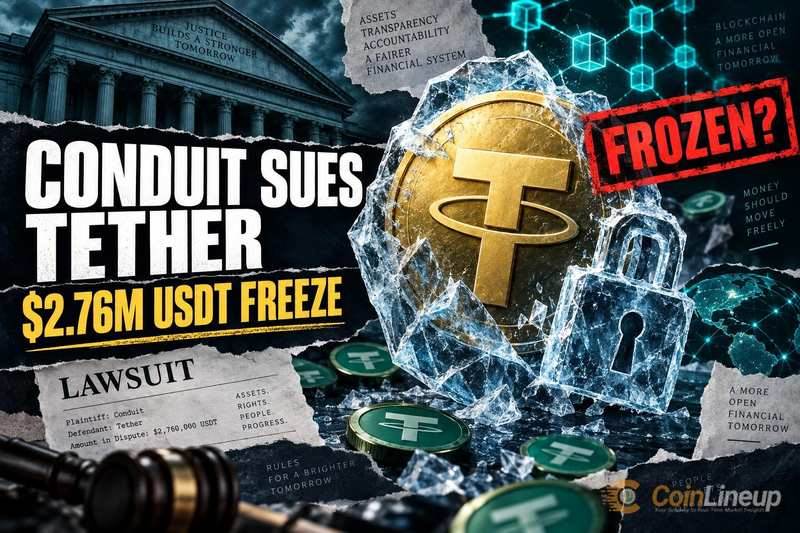
Conduit accused Tether of freezing USDT worth US$2.76 million. Even if the balance is visible on the books, it may not be available. According to Tether's terms of service, it has the right to freeze tokens and blacklist addresses. This case reveals the risks faced by stablecin users in treasury fund management.
$2.76 million USDT becomes unavailable
Cross-border payments company Conduit Technology has filed a lawsuit against USDT issuer Tether in the U.S. District Court for the Southern District of New York. The company accuses Tether of freezing approximately $2.76 million in USDT in its treasury management wallet, making funds needed to operate the business impossible to mobilize.
According to the complaint, Conduit said that Brazilian police did not list his treasury wallet as an object that should be frozen. Conduit seeks to restore access to the funds, asking the court to declare Tether has no right to withhold the funds and claim at least $2.76 million. It should be emphasized that the above are all allegations in Conduit's lawsuit; the court has not yet ruled whether the freeze is reasonable and legal.
The importance of this controversy is that stablecoins are increasingly being used for commercial payments, not just transactions. A company may keep dollar-linked tokens in its wallet, but lose the ability to send them at critical moments when it needs to settle invoices, pay suppliers, or allocate working capital.
Visible balances may still not be available
USDT can be stored in a self-managed wallet, with the holder controlling the private key needed to sign a transaction. This private key gives access to the wallet address. However, if Tether blacklists the address, the USDT token contract can refuse the transfer request before the network completes the transfer.
Although the balance may be visible on the blockchain browser, the holder may not be able to send, redeem, or redeem these tokens in fiat form through regular channels. For payment companies, even if the token price remains close to a dollar, this creates a cash management dilemma.
The key point is that private keys control the wallet address, but issuer rules may still limit how centrally issued stablecoins flow from that address.
Conduit challenges "wallet freeze," not "government seizure." This distinction determines the status of the assets in the wallet and the specific claims the company makes to the court.
Tether's terms of service demonstrate its claimed rights
Tether 发布的法律条款规定了其在网站、钱包和服务方面对用户可行使的权力。这些条款允许 Tether 在法律要求、认为行动审慎或面临法律及合规风险时,暂停访问、冻结代币或将地址列入黑名单。
条款还提及制裁、反洗钱义务、疑似违规使用行为以及政府诉讼程序。此类管控措施有助于发行方应对盗窃、欺诈、违反制裁规定或官方请求等情况。同时,当钱包内的资金发生争议时,这也赋予了发行方重要的角色。
这些条款是否适用于 Conduit 的钱包,以及它们是否支持此次特定的冻结行为,是本案的核心问题。法院还可能审查 Tether 所依赖的信息、公司与 Tether 之间的关系,以及 Conduit 声称因限制措施而遭受的损失。
对支付公司而言,风险在于访问权限,而非汇率锚定
许多企业选择 USDT 是因为它比传统银行转账能更快速地跨境移动,且旨在保持美元价值。Conduit 的案例表明,维持汇率锚定只是计算的一部分。当资金用于日常运营时,代币的可访问性同样重要。
这提出了一个不同于常见的代币贬值风险的国库管理问题。公司可能需要考虑发行方的合规规则、自身的客户尽职调查、对受限交易对手的敞口,以及在钱包被封锁时是否有替代支付渠道。
The same gap exists in corporate accounting. Wallets can show that a company holds stablecoins, but the legal path to convert them into cash may depend on an agreement between the company and the issuer or intermediary. Companies need to review these terms rather than relying solely on the dollar-anchored nature of the token.
Conduit has not proved that the freeze lacks legal basis, and Tether may contest its allegations. Even before the case was resolved, the case provided a useful warning to stablecoin users: A token may still be worth a dollar, but it cannot be used for its intended payment purpose.
This article is for reference only and does not constitute legal, financial or investment advice. The allegations have not been confirmed and still need to await the final decision of the court.