Exchange Ranking
 Top Exchanges
 24h Volume Ranking
 Popularity Ranking
 Exchange BTC Balance
 Proof of Reserves
 Decentralized Exchanges
 Funding Rate
 Funding Heatmap
 Liquidation Data
 Max Pain
 Long/Short Ratio
 Whale L/S Ratio
 Binance/Okex/Huobi L/S
 Bitfinex Margin L/S
 ETF Tracker
 Solana ETF
 XRP ETF
 Hong Kong ETF
 Bitcoin Treasuries
 Crypto Reversal
 Ethereum Reserves
 HyperLiquid Wallet Analysis
 Hyperliquid Whale Watch
 Large Transactions
 On-chain Movement
 Bitcoin ROI
 Stablecoin Market Cap
 Options Analysis
 News
 Articles
 Economic Calendar
 Features
 Wallet
 Contract Calculator


 Security
 Collections
 Watchlist
 Following
 HYPE
Wall Street's richest moments usually occur before listings
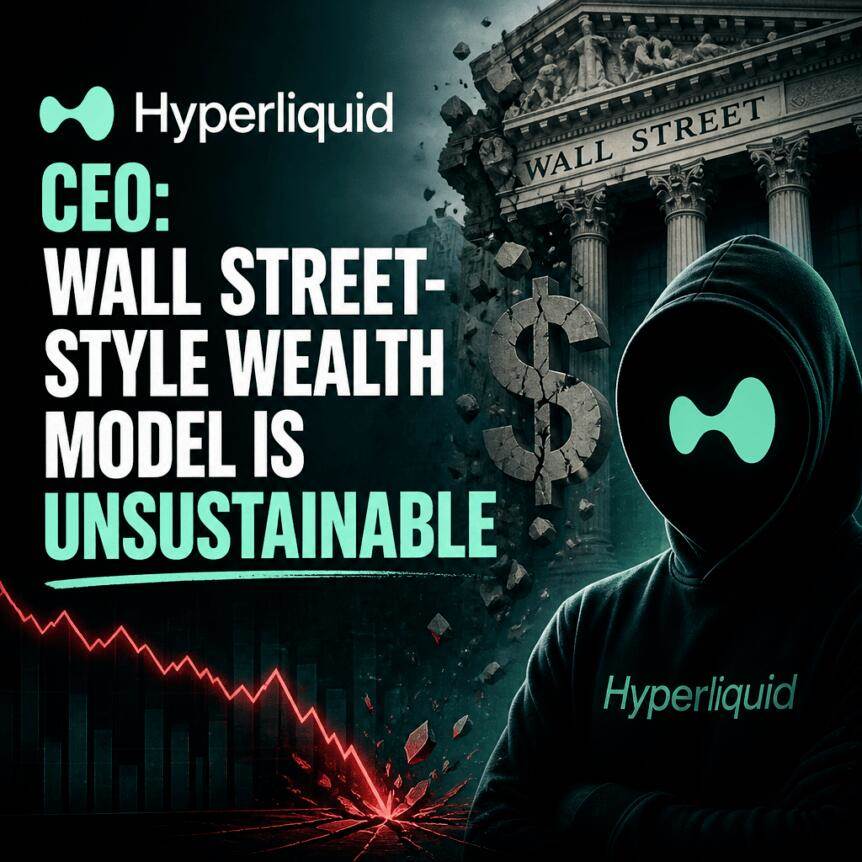
Wall Street's most profitable moments of wealth creation often occur before stocks enter the public market-when the company is still private and the earnings are largely owned by insiders. Jeff Yan, CEO and co-founder of Hyperliquid, believes that this "pre-IPO" model excludes retail investors from early rising dividends and that the current system is ultimately unsustainable.
In a fireside conversation at the Token2049 conference in Singapore on Tuesday, Yan emphasized that the appeal of on-chain perpetual contracts and decentralized transactions lies in providing a wider audience with the opportunity to participate in blockchain-based wealth creation, rather than aiming to maximize short-term agreement revenue.
Core Points
- Jeff Yan pointed out that traditional markets concentrate early growth in the hands of a few privileged participants, while public investors often enter after most of the upside has been realized.
- Hyperliquid's CEO described its revenue growth as a result of expanded user engagement rather than its ultimate goal.
- Yan said that perpetual futures with no expiration date can reduce traders 'decision-making friction and help avoid fragmentation of liquidity.
- DefiLlama data cited in the discussion showed that Hyperliquid was one of the main fee-generating DeFi protocols in the past 30 days.
- Wall Street institutions have begun to focus on on-chain derivatives that operate around the clock and promote regulatory fairness to allow them to conduct business.
Why Yan believes that there are structural barriers to retail investors 'access
Yan compares the blockchain market with traditional public equity channels. In the traditional model, assets usually become widely tradable after they are listed on an exchange. He believes that under this model, early growth is often "traded" by only a small number of participants, sometimes after orders of magnitude growth before the general public is accessible.
Although he described this concentration as a by-product of the broader way the economy is run, Yan said the arrangement cannot be sustained indefinitely. In his view, on-chain infrastructure has changed the landscape of accessibility by allowing people to trade and participate in tokenized economic instruments without having to wait for a centralized listing cycle.
Hyperliquid's strategy: access first, revenue second
Yan said that Hyperliquid's mission is to achieve financial openness-making it easier for more people to participate in wealth creation opportunities-and that revenue is a "by-product" of user value. In his words, Hyperliquid "doesn't really focus on maximizing revenue." That is a by-product of providing value to users."
He linked the momentum of the agreement to product design options aimed at improving the trading experience of participants. A core example is Hyperliquid's use of perpetual futures contracts with no expiration date. Yan believes that removing contract expiration dates can reduce the number of decisions traders need to manage, while also limiting liquidity fragmentation-two issues that often affect the market structure around time-limited instruments.
In other words, Yan's argument is not just that perpetual contracts are faster or more convenient, but that structural design can affect market depth and how liquidity is aggregated in DeFi.
Revenue momentum highlighted by DefiLlama data
Discussions also pointed out that expense generation is a quantifiable signal for measuring user activity. According to DefiLlama, Hyperliquid generated approximately $72 million in revenue in the past 30 days, making it the third-largest revenue generation agreement in the DeFi space by this metric.
Although CEOs prioritize revenue after access and availability, the reported fee numbers are important because they show that design tradeoffs, such as perpetual contracts with no expiration time, have translated into meaningful user engagement. For traders, this means that markets behave more closely when liquidity is spread across multiple contract timelines; for developers and investors, it suggests that the DeFi model can attract continued inflows of funds even without imitating traditional listing schedules.
The challenge of on-chain perpetual contracts to traditional market structures
Yan's remarks fit into the debate about whether blockchain-based derivatives can structurally compete with traditional financial components-especially those designed to support continuous participation. The article also cited Pantera's July assessment that perpetual futures could become the dominant tool in global finance due to underlying advantages, and Hyperliquid demonstrated how blockchain infrastructure can put pressure on existing market designs.
The traditional financial community is also paying increasing attention to regulatory issues, that is, whether on-chain markets can operate on a truly comparable basis with existing platforms. The article pointed out that ICE CEO Jeffrey Sprecher urged regulators to establish a "level playing field" for launching on-chain sustainable futures that operate around the clock. Previous reports have also discussed this driving force in the context of the expansion of chain derivatives from crypto-native venues into broader areas.
Competition in regulation and infrastructure is not limited to derivatives. The article mentioned a development in March when the New York Stock Exchange (NYSE) partnered with Securitize as part of an effort to build a blockchain-based stock trading infrastructure that supports Wall Street round-the-clock trading and settlements.
Taken together, the message to market participants is that "24/7" is becoming a key battlefield issue: it is not only a marketing slogan, but also a structural capability that affects how liquidity, settlement and trading strategies work over different time periods and market hours.
Future concerns
Yan's core proposition-that access to wealth creation should not rely on traditional listing gatekeeping mechanisms-is likely to continue to be closely linked to product and regulatory progress. Traders should pay attention to whether the on-chain sustainable market continues to integrate liquidity as more institutions and liquidity providers participate, and whether regulators move towards clearer rules that allow 24/7 crypto-native products to operate under rules that match the size and risk of traditional derivatives.