Exchange Ranking
 Top Exchanges
 24h Volume Ranking
 Popularity Ranking
 Exchange BTC Balance
 Proof of Reserves
 Decentralized Exchanges
 Funding Rate
 Funding Heatmap
 Liquidation Data
 Max Pain
 Long/Short Ratio
 Whale L/S Ratio
 Binance/Okex/Huobi L/S
 Bitfinex Margin L/S
 ETF Tracker
 Solana ETF
 XRP ETF
 Hong Kong ETF
 Bitcoin Treasuries
 Crypto Reversal
 Ethereum Reserves
 HyperLiquid Wallet Analysis
 Hyperliquid Whale Watch
 Large Transactions
 On-chain Movement
 Bitcoin ROI
 Stablecoin Market Cap
 Options Analysis
 News
 Articles
 Economic Calendar
 Features
 Wallet
 Contract Calculator


 Security
 Collections
 Watchlist
 Following
 BTC
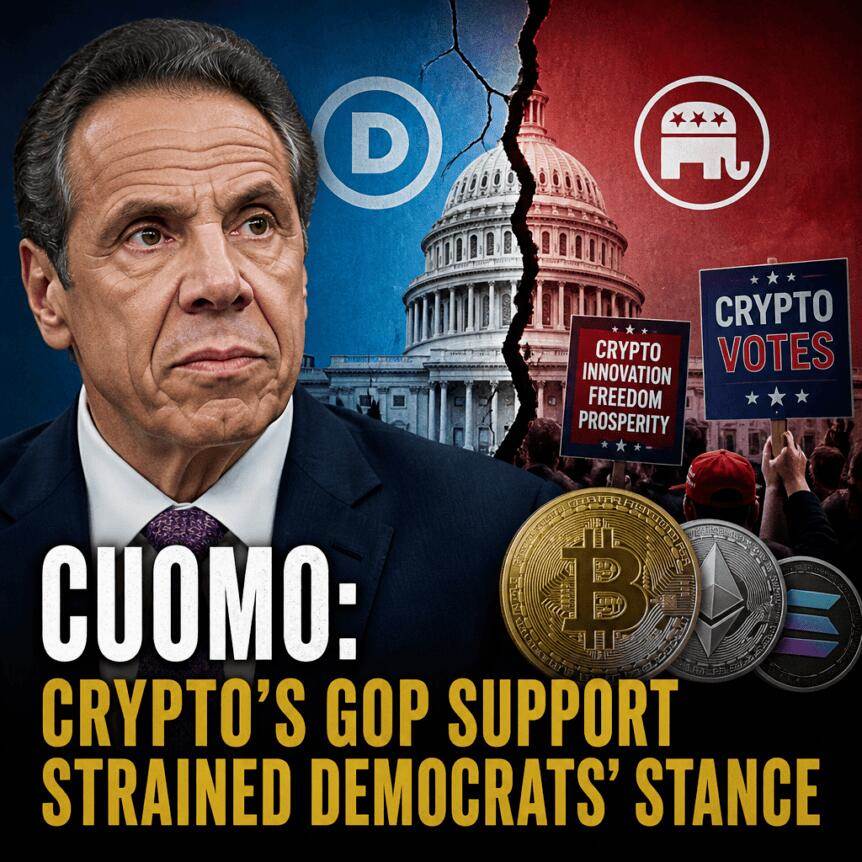
Cuomo: The cryptocurrency industry's excessive support for Republicans is hampering the federal legislative process
Former New York Gov. Andrew Cuomo pointed out this week that U.S. efforts to promote federal cryptocurrency legislation are facing a "political pairing" problem. Speaking on the same stage as OKX CEO Xu Huijun at the Token2049 conference, he said that the industry's funding and organizational support are heavily biased towards the Republican Party, and this strategy is weakening Democratic support for major bills, endangering the possibility of legislative passage.
Cuomo linked this strategy to current political realities. He pointed out that even though Democrats now seem likely to regain control of Congress, lawmakers still need to work across parties to move the bill forward. At the same time, he refuted the view that "Democrats are generally anti-crypto", arguing that the Democratic Party's policy priorities are consistent with cryptocurrency technology's commitment to expanding access to financial products.
Core Points
- Political alienation from risk: Cuomo said that the cryptocurrency industry's massive injection of capital into Republicans could alienate Democrats and complicate efforts to pass a federal cryptocurrency bill.
- Money flow data: Tech Influence Watch tracking data shows that in the 2026 election cycle, funding spending by cryptocurrency-focused Political Action Committees (PACs) is significantly leaning towards Republicans over Democrats.
- Congressional control forecast: Based on Kalshi's latest market forecast data (as of Thursday), the probability of Democrats winning control of both houses of Congress is about 61%.
- Conceptual fit: Cuomo argued that Democrats are not inherently opposed to cryptocurrencies, and he framed cryptocurrency technology as a means consistent with the Democratic Party's goals of financial inclusion.
- Historical voting record: Although procedural attempts have encountered resistance, historical voting has shown some bipartisan participation in major legislation.
Why Cuomo believes that the industry's Republican strategy may backfire
Cuomo's core argument lies in political arithmetic: If the cryptocurrency industry bets heavily on a single party, it will reduce the incentives for another party to support legislation. He said that belief has caused friction in the fight for enough votes for the CLARITY Act, the Clarification Act.
"When you invest heavily in the Republican Party, by definition, you inevitably make Democrats feel excluded," Cuomo said during a panel discussion.
This claim is consistent with spending data cited by Tech Influence Watch. According to the latest data from the tracker as of Thursday, during the 2026 election cycle, cryptocurrency-focused political action committees spent $54.3 million supporting Republicans and $26.2 million supporting Democrats. The same tracker reported that another $23.2 million was spent against Democratic candidates.
Although these data describe political activity rather than direct legislative action, they help explain why lawmakers who feel marginalized may be reluctant to compromise-especially on bills that require inter-house cooperation.
If Democrats control Congress, the fate of the CLARITY Act may be reshaped.
Cuomo pointed out that the possibility of Democrats controlling Congress is a key variable in the next stage of cryptocurrency legislation. As of Thursday, Kalshi predicted that the market would put the Democratic Party's probability of winning both houses of Congress at about 61%.
In this scenario, Cuomo said Democrats could take a different path: either try to withdraw institutional initiatives related to cryptocurrencies, or work with the Trump administration to pass the full CLARITY Act.
His advice to investors and policy observers is that the legislative timetable may no longer depend on widespread "approval" of cryptocurrencies, but more on coalition building-especially the balance of priorities between parties and the willingness to negotiate specific details.
Cuomo summed up the practical requirements: "You need Democrats to pass the bill, and you need Republicans. You have to be more balanced."
Cuomo refutes the "Democratic anti-crypto" narrative
Cuomo also challenges what he calls the broad assumption that Democrats oppose cryptocurrency technology. He believes this view is inaccurate and argues that cryptocurrencies are in line with the Democratic Party's goal of expanding financial services coverage.
"There is a feeling that Democrats are anti-crypto," he said. "In fact, I think cryptocurrency technology is exactly the right thing for Democrats," Cuomo added. He portrayed cryptocurrencies as empowering people who otherwise would not have access to financial products, and said Democrats have long pursued this goal.
The legislative record presented during the group discussion suggests that the situation is not purely partisan. Cryptocurrency legislation has enjoyed bipartisan support, although Republicans tend to show stronger alignment on major measures.
For example, the article cited a House vote in July 2025, when 78 Democrats joined 216 Republicans to pass the CLARITY Act, while 134 Democrats voted against it. In addition, the GENIUS Act was supported by 18 Democratic senators and passed the Senate in June 2025.
At the same time, procedural and factional dynamics pose obstacles. The article cited a procedural vote in September, when all Democratic senators and four Republican senators voted against advancing the CLARITY Act. The article pointed out that some concerns at the time involved potential conflicts of interest with Trump's crypto companies.
Later, seven Democratic senators issued a joint statement reiterating their commitment to passing the CLARITY Act, indicating that despite objections, they were not unanimously ignored.
The signaling significance of political activity for future electoral cycles
In addition to Cuomo's arguments, the political landscape itself is also constantly evolving. The article also quoted a statement from Fairshake, a political action committee that focuses on cryptocurrencies, saying it would support 32 House candidates-19 Republicans and 13 Democrats-in November's midterm elections.
For readers concerned about policy risks, the participation of this candidate category is crucial because it shapes which legislators feel pressured to deliver legislative results and who may calculate that supporting cryptocurrency initiatives is politically costly.
Given that at least one prediction market believes the Democratic majority is probable, and recent legislative history shows cooperation and resistance, the next stage may depend on whether cryptocurrency advocates recalibrate their outreach strategies-and whether Democrats can be included in a stable coalition rather than seen as obstacles to overcome.
Looking ahead, the most noteworthy major developments are: whether spending and coalition signals have changed ahead of major votes; and whether despite internal doubts in previous procedural efforts, Democrats can move from conditional support to the kind of lasting bipartisan agreement needed to pass a full CLARITY Act.