Exchange Ranking
 Top Exchanges
 24h Volume Ranking
 Popularity Ranking
 Exchange BTC Balance
 Proof of Reserves
 Decentralized Exchanges
 Funding Rate
 Funding Heatmap
 Liquidation Data
 Max Pain
 Long/Short Ratio
 Whale L/S Ratio
 Binance/Okex/Huobi L/S
 Bitfinex Margin L/S
 ETF Tracker
 Solana ETF
 XRP ETF
 Hong Kong ETF
 Bitcoin Treasuries
 Crypto Reversal
 Ethereum Reserves
 HyperLiquid Wallet Analysis
 Hyperliquid Whale Watch
 Large Transactions
 On-chain Movement
 Bitcoin ROI
 Stablecoin Market Cap
 Options Analysis
 News
 Articles
 Economic Calendar
 Features
 Wallet
 Contract Calculator


 Security
 Collections
 Watchlist
 Following
 BTC
 ETH
Tokenization is moving from edge experiments to mainstream infrastructure
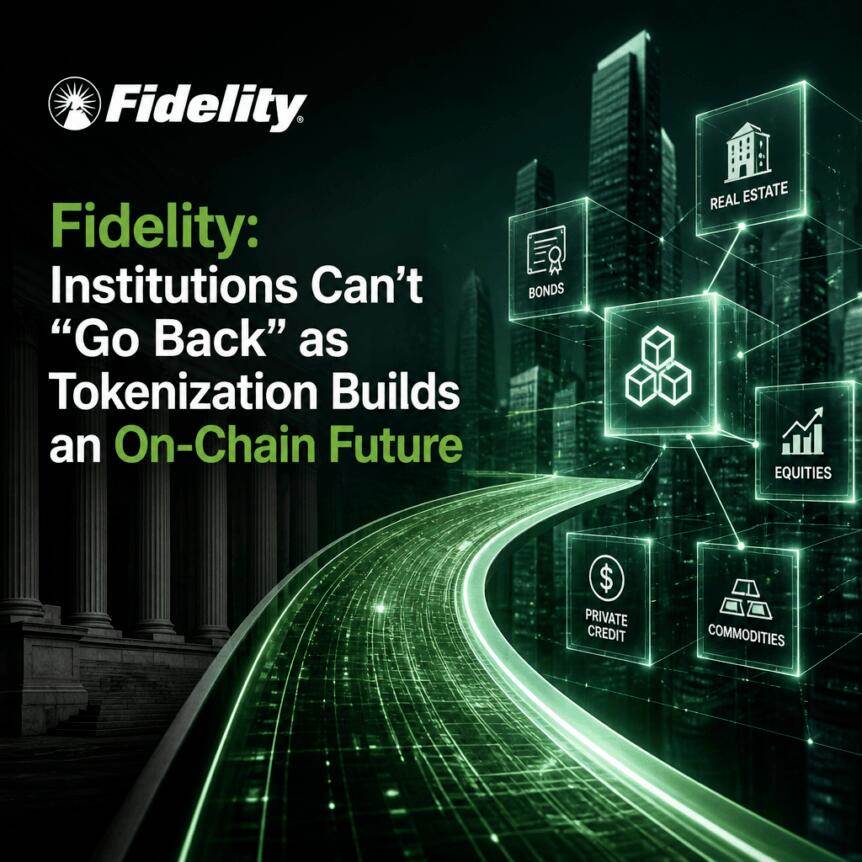
Tokenization is transforming from a niche experiment to a core issue about mainstream infrastructure. Leading financial institutions believe that the next wave of growth will be driven by on-chain market infrastructure-including custody, clearing and distribution-rather than relying solely on retail speculation.
During a panel discussion at the Longitude event held in Singapore on Thursday, Matthew Horne, head of digital asset strategy at Fidelity Investments, said institutions are moving towards a "future on the chain" that is irreversible. He sees tokenization as an important way to expand investor access and expand channels for new markets.
Summary of Core Views
- Matthew Horn of Fidelity Investment pointed out that the trend of institutions driving the transition to the future on the chain is becoming irreversible, and tokenization helps asset management companies reach new groups of investors.
- RWA.xyz data shows that demand for tokenized real-world assets has increased by 41% in the past 30 days, with the number of holder addresses reaching 493,000 (excluding stablecoins).
- Ka Yan Chan of UBS said that if regulators and market infrastructure providers modernize custody services and transform them into tokenized platforms, the treasury bonds and equity sector is expected to unleash "hundreds of billions to trillions of dollars" in value.
- Recent regulatory initiatives mentioned in the panel discussion included: a "no action" letter from the U.S. Securities and Exchange Commission (SEC) to subsidiaries of the Depository Trust and Clearing Corporation (DTCC) allowing them to provide tokenization services; and a temporary exemption to allow limited trading of tokenized U.S. stocks on certain chains.
- OnchainBenchmark reported that more than US$1.2 billion of funds have been moved onto the chain in the past 30 days, bringing the total on-chain capital in stablecoins and tokenized assets to more than US$323 billion.
Institutional momentum and driving force for broader access
Horn's core view is that in the eyes of large institutions, tokenization is increasingly seen as a structural shift rather than a temporary trend. He pointed out that significant progress and activity results have been achieved in the past 18 months, and believes that once true institutional investors commit to migrating assets and processes onto the chain, the direction of the industry will be more difficult to reverse.
For U.S. asset managers, Horn said that the incentives provided by tokenization go beyond mere custody experiments. Tokenized products make it easier to reach different investor segments and have the potential to expand distribution networks through channels that are difficult to serve in traditional formats.
This demand signal is clearly visible in the growth at the address level. According to RWA.xyz, demand for tokenized assets has increased by 41% in the past 30 days. The platform reported that the total number of addresses holding tokenized real-world assets (excluding stablecoins) has reached 493,000.
While the number of holders and addresses does not automatically translate into long-term profitability, they can serve as useful early indicators of product occupancy-especially in tokenized funds and instruments where distribution and access are major bottlenecks.
Why treasury bonds and stocks are the targets of "the next phase of scale expansion"
UBS's Ka Yan Chan expanded the discussion beyond asset management companies to market structures, arguing that some of the biggest on-chain opportunities exist in building the core assets of investment portfolios-namely treasury bonds and stocks. In Chan's view, the biggest leap in adoption depends on whether the core infrastructure layer takes the lead.
"What really drives funding from tens of billions to trillions of dollars is when market infrastructure participants such as the Federal Reserve or DTCC are the first to transform the custody layer into a tokenized platform."
Chan suggested that once custody and settlement systems are specifically designed for tokenized tools, other industry participants can "free ride" by building distribution and related services for tokenized assets. This shifts the focus of competition to areas such as product access, onboarding workflows, and transaction/transfer experiences, where issuers and platforms can create differentiated advantages.
This is crucial because the friction of tokenization is often concentrated at the infrastructure level. Without extensive and compliant ways to hold and transfer securities-like instruments, new products may face bottlenecks in scalability. The implicit meaning of Chan's remarks is that the next step in market expansion may no longer be about just the issuance of new tokens, but more about establishing channels that allow more issuers to reach more investors.
Regulatory milestone shaping on-chain securities trading
Infrastructure theory in the panel discussion complemented references to U.S. regulatory trends, which participants saw as a practical catalyst for tokenization market activity.
In December 2025, the U.S. Securities and Exchange Commission (SEC) issued a "no action" letter to a subsidiary of the Depository Trust and Clearing Corporation (DTCC), allowing it to provide tokenization services. In discussions earlier this week, progress in tokenized stocks was also mentioned, noting that the SEC approved a temporary exemption in September to allow limited trading of tokenized U.S. stocks on specific chain-based exchanges.
It has been previously reported that the exemption is intended to support restricted trading activities, rather than providing full and unconditional approval for all tokenized securities use cases. During the same period, Securitize announced the launch of Trading of tokenized shares linked to U.S. stocks that dozens only widely held, with securities interests.
For investors and developers, the key question is not only whether tokenization is allowed, but also what forms of transactions and custody are considered acceptable under the current regulatory framework. These differences affect everything from compliance workflows to cross-site mobility structures.
Capital flows indicate increased on-chain activity-mainly supported by stablecoins
In addition to tokenizing real-world assets, on-chain activity is also rising across the ecosystem. According to OnchainBenchmark, more than $1.2 billion of funds have been moved onto the chain in the past 30 days. The same dataset shows that the cumulative total of stablecoins and tokenized assets has exceeded US$323 billion.
This broader measure is important because stablecoins currently represent most of the liquidity used for on-chain settlements. While tokenized real-world assets are growing faster in certain segments, stablecoins often provide an instant track that makes on-chain transfers efficient and liquid.
The panel discussion also mentioned industry forecasts for the real-world asset (RWA) sector. Geoff Kendrick, global head of digital asset research at Standard Chartered Bank, predicted in August that tokenized real-world assets could reach US$4 trillion by the end of 2028. Such forecasts typically depend on whether infrastructure and regulatory paths are mature enough to support large-scale offerings and promote easier transfers and settlements of funds between institutions.
For market participants, the focus of recent observations is clear: whether tokenized treasury bonds and stocks can move beyond the limited pilot trading stage, how custody and settlement standards will evolve, and whether the number of holders continues to grow as platform data tracking the number of tokenized asset addresses is updated.
As regulatory clarity gradually expands and infrastructure providers position tokenization custody as the next competitive battlefield, the next stage of tokenization adoption may rely less on the release of new tokens, and more on the ability of institutions to scale distribution, compliance and settlement capabilities without sacrificing operational reliability.