
 Exchange Ranking
 Top Exchanges
 24h Volume Ranking
 Popularity Ranking
 Exchange BTC Balance
 Proof of Reserves
 Decentralized Exchanges
 Funding Rate
 Funding Heatmap
 Liquidation Data
 Max Pain
 Long/Short Ratio
 Whale L/S Ratio
 Binance/Okex/Huobi L/S
 Bitfinex Margin L/S
 ETF Tracker
 Solana ETF
 XRP ETF
 Hong Kong ETF
 Bitcoin Treasuries
 Crypto Reversal
 Ethereum Reserves
 HyperLiquid Wallet Analysis
 Hyperliquid Whale Watch
 Large Transactions
 On-chain Movement
 Bitcoin ROI
 Stablecoin Market Cap
 Options Analysis
 News
News Articles
 Economic Calendar
 Features
 Wallet
 Contract Calculator


 Security
 Collections
 Watchlist
 Following
 ADA
ADA  DOT
DOT Cardano governance flaws may limit ADA price growth, analysts warn
Cardano has been trying for years to solve one of the most thorny issues in the cryptocurrency space: How can blockchain distribute power without allowing wealthy token holders or unelected development teams to gain control?
Its governance system provides one of the most detailed answers in the industry. However, the system may also introduce a weakness that limits confidence in Cardano and complicates ambitious ADA price targets, including the widely discussed $5 level.
Cheeky Crypto Unfiltered recently reviewed Cardano governance and praised multiple parts of its design. The analyst also identified a deeper concern. Cardano may have strong rules for decision-making, but those rules do not guarantee that decisions will be made by qualified people.
This distinction may become increasingly important as ADA prices remain more than 90% below their all-time highs in 2021.
The governance paradox forces blockchain to choose between two risks
Blockchain governance often faces two difficult choices. Giving each token equal voting rights may sound democratic, but wealthy holders, exchanges and investment companies can accumulate huge control.
Cheeky Crypto Unfiltered explained that a simple "one-coin-one-vote" structure could allow large households to influence treasury expenditures or change network rules for their own benefit. Lightning lending may pose another risk because attackers can temporarily borrow large amounts of tokens and use them to control voting.
Canceling token holder voting will not solve the problem. This option may hand control over to a small development team or a centralized foundation. Such an arrangement may make technical decisions faster, but it also creates reliance on a limited group.
The channel described this conflict as a governance paradox. Networks must strike a balance between decentralization, technical capabilities, financial protection, and the ability to avoid long-term gridlock to reach decisions.
Cardano attempts to solve this problem with a system that includes multiple checking mechanisms. The framework is more complex than basic token voting, although human judgment is still part of every important decision.
Cardano governance decentralizes control to three independent groups
Cardano launched the Chang hard fork in 2024, entering the Voltaire era. Control shifted to the on-chain governance structure introduced through CIP 1694.
The system allocates responsibilities to three groups:
Governance groups and main responsibilities are as follows:
Delegated Representatives: Vote on economic and general governance proposals.
Stake Pool Operators: Evaluate major technology changes and network upgrades.
Constitutional Committee: Checks whether the proposal is consistent with the Cardano Constitution.
ADA holders can delegate their voting rights to a delegated representative, commonly known as a DRep. Their ADA remains in their wallets, and if they disagree with a decision, they can change representatives.
Equity pool operators maintain network infrastructure and evaluate technical proposals. This role helps prevent voters lacking sufficient technical knowledge from approving changes that could harm network operations.
The Constitutional Council serves as the ultimate guarantee. Its members determine whether governance actions are consistent with Cardano's written constitution.
Cheeky Crypto Unfiltered views these independent groups as an important defense against unrestricted voting rights. Major decisions require approval from different parts of Cardano's governance system.
Automated rules protect Cardano's treasury from specific governance attacks
Cardano also uses code-based protection measures known as "guardrails." These controls can reject proposals that violate established financial or technical restrictions before voting begins.
For example, treasury withdrawals that exceed Cardano's approved spending limits can automatically fail. Dangerous changes to network parameters may face similar limitations.
Serious governance proposals also require a deposit of 100,000 ADA. Legal sponsors can recover the deposit regardless of whether their proposal is approved or not. Malicious or incomplete submissions risk losing deposited funds.
Cheeky Crypto Unfiltered believes that these protections can help Cardano avoid the treasury problems faced by other decentralized networks. The analyst cited Polkadot as an example to criticize past treasury payments to content creators.
Cardano's hard fork combiner provides another technical advantage. Approved upgrades can connect old protocol rules with new rules without stopping the blockchain. Node operators have time to update their software before the network moves to the next phase.
These mechanisms provide strong technical protection. However, they cannot determine whether a representative has sufficient knowledge, independence or business judgment.
DRep centralization may become Cardano's most important governance flaw
Cheeky Crypto Unfiltered identified DRep centralization as the biggest threat. Popular influencers, large funds or major organizations can persuade many ADA holders to delegate voting rights to them.
A small coalition that controls enough active voting power may block proposals or support decisions that are in its own interest. Centralized exchanges have raised greater concerns because they hold large customer ADAs.
An exchange may register a DRep and use client-controlled voting rights without explicit approval from each holder. This result will undermine the decentralization that Cardano governance is designed to protect.
The analyst also questioned whether some DReps had the technical and business knowledge needed for major blockchain decisions. He included himself in this criticism and argued that understanding cryptocurrencies does not automatically qualify one to guide the global financial network.
Another concern involves third parties operating equity pools for multiple public figures. ADA holders may think they are supporting different operators, but behind-the-scenes infrastructure may rely on one provider.
Therefore, Cardano governance risks include:
Concentration of voting power in the hands of popular DRep.
Exchanges use client ADA to gain political control.
Multiple equity pools rely on one infrastructure provider.
Committee controversy caused delays in necessary network upgrades.
Representatives approve decisions that exceed their expertise.
These results are not inevitable. However, the structure relies heavily on ADA holders selecting competent and independent representatives.
Weak governance may make it more difficult to defend the $5 ADA price
Cheeky Crypto Unfiltered analysis does not set a direct mathematical upper limit on ADA prices. The argument involves the assumptions behind the bullish target.
The $5 ADA price requires Cardano to rebound significantly from its current level of close to $0.17. Such a trend also requires stronger demand, broader network use, deeper liquidity, and renewed confidence in Cardano's future.
Governance has become relevant because large institutions need predictable rules and trusted decision makers. Cardano's automated protections may support this requirement, but concentrated voting rights or unqualified representatives may weaken its case.
Recurrent governance disputes may also delay escalation, undermine treasury discipline, or create uncertainty for Cardano's development. These issues could reduce demand for ADA and make it more difficult to maintain higher valuations.
Governance flaws do not prove that ADA cannot reach $5. It explains why multiplying previous prices by an optimistic growth assumption ignores how the quality of governance affects adoption and market confidence.
ADA prices must recover US$0.22 before a credible larger rally
Cardano prices are currently trading around US$0.17, down more than 90% from their 2021 all-time high of around US$3.10. ADA is also trading below most of the 2021 price range, putting the asset at risk of further weakness.
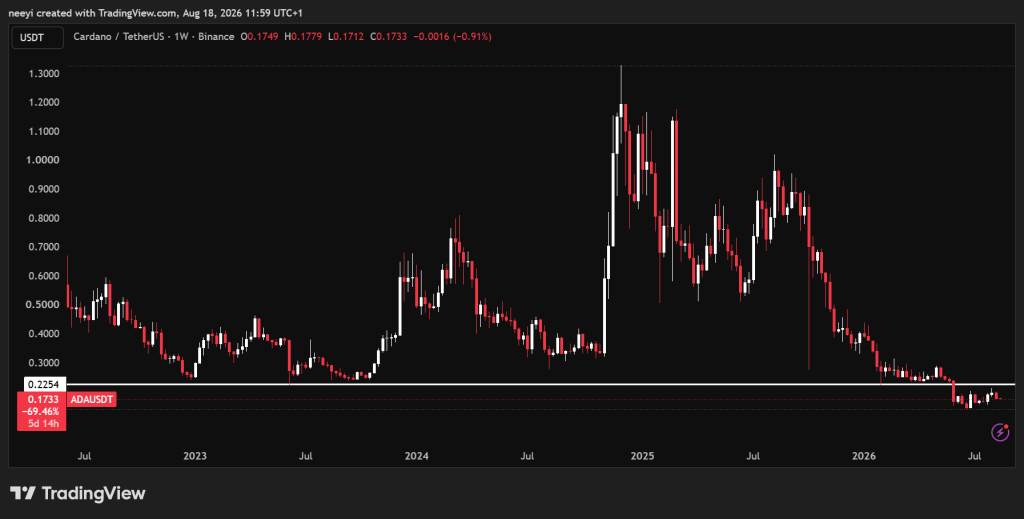
Looking at the ADA chart, the previous support level of around US$0.22 has turned into resistance. ADA bulls need to regain that level before the market structure can begin to stabilize.
Continued breakthroughs above $0.22 may boost confidence and create room for a broader Cardano price recovery. Failure to regain the area will focus attention on lower support at around $0.139.
Worse market conditions could push ADA prices below that bottom. So reaching $5 requires much more than a short-term recovery. ADA must first regain $0.22, rebuild its broader market structure, and demonstrate that Cardano governance can operate effectively under real pressure.
























