Exchange Ranking
 Top Exchanges
 24h Volume Ranking
 Popularity Ranking
 Exchange BTC Balance
 Proof of Reserves
 Decentralized Exchanges
 Funding Rate
 Funding Heatmap
 Liquidation Data
 Max Pain
 Long/Short Ratio
 Whale L/S Ratio
 Binance/Okex/Huobi L/S
 Bitfinex Margin L/S
 ETF Tracker
 Solana ETF
 XRP ETF
 Hong Kong ETF
 Bitcoin Treasuries
 Crypto Reversal
 Ethereum Reserves
 HyperLiquid Wallet Analysis
 Hyperliquid Whale Watch
 Large Transactions
 On-chain Movement
 Bitcoin ROI
 Stablecoin Market Cap
 Options Analysis
 News
News Articles
 Economic Calendar
 Features
 Wallet
 Contract Calculator


 Security
 Collections
 Watchlist
 Following
 ETH
ETH Ethereum once again faces controversy over core incentive design
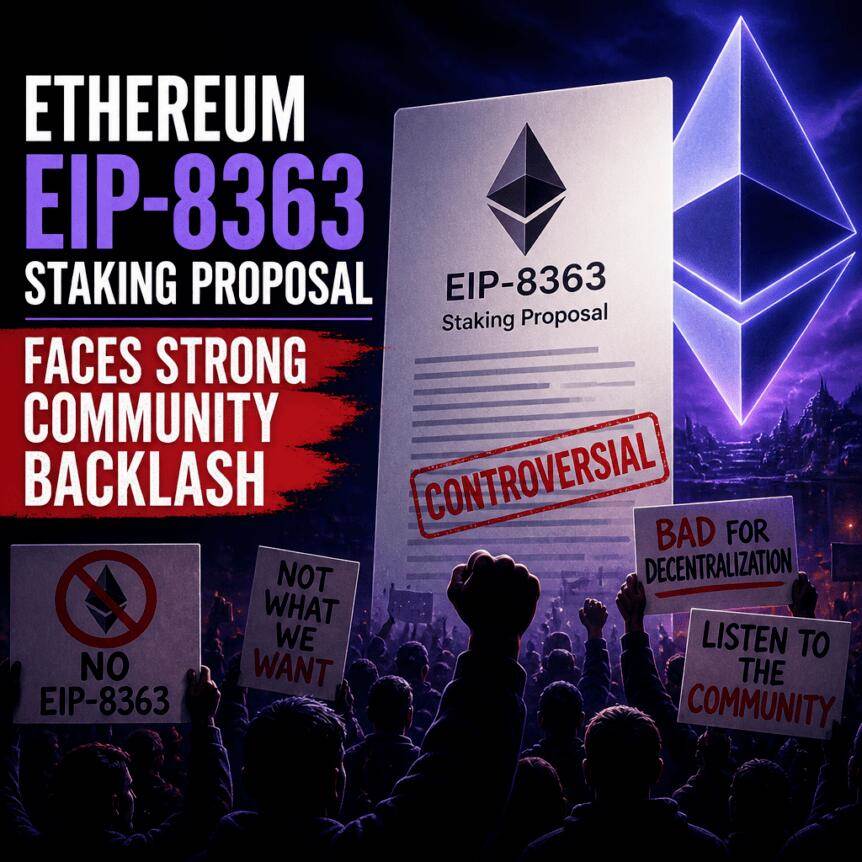
Ethereum is once again caught in controversy over core incentive design. An upgrade proposal called EIP-8363 ("Decreasing Issue Destruction") proposes that pledge rewards will gradually decrease as more ether is locked in, with the goal of reducing new issues of the agreement after the pledge amount reaches a certain threshold. The amount dropped to zero.
This controversy is not an empty theoretical discussion: Ethereum's pledge rate, DeFi's reliance on pledged derivatives, and institutional investors 'need for predictable monetary policy all collide fiercely in the debate. Proponents believe that when the amount of pledge exceeds a certain point, the margin of safety will diminish; while critics warn that reducing issuance may undermine the stability of Ethereum's financial system and undermine the market's ability to govern its currency. Trust.
Core Points
The EIP-8363 proposal plans to decrease the verifier reward as the pledge participation rate increases, with the ultimate goal of stopping the issuance of new coins when the target pledge level is reached.
Proponents believe that Ethereum has entered a stage where additional pledges are less valuable to security and more detrimental to non-pledges.
Critics-including DeFi and institutions-believe the change could weaken decentralization, disrupt lending markets, and introduce "earnings governance risks."
Opponents also point out that Ethereum's inflation rate is already very low, and market forces themselves may slow down pledge growth without changing the issuance policy.
The timing of the proposal has also been questioned, with critics questioning its release before the August 6 deadline for the next Ethereum upgrade proposal.
The content of the EIP-8363 proposal and the backlash it caused
The EIP-8363 proposal aims to control pledge rewards when more ether is locked out to ensure network security. According to the proposed framework, the policy will eventually reduce the issuance of new coins to zero, provided that the pledged supply of Ethereum reaches 50%.
Proposal authors include Ethereum Foundation researcher Justin Drake and ETHCC co-founder Jerome de Tychey. They believe that Ethereum has reached a tipping point where the safety margin from additional pledges is no longer proportional to the issuance allocated to verifiers. In their view, paying a price that "exceeds network security needs" is actually subsidizing existing pledge participants and harming the interests of non-pledge holders.
However, many people within the ecosystem do not agree with this potential shift that could change the logic of Ethereum's currency. Ether.fi founder Mike Silagadze criticized the idea on social media, arguing that it would undermine decentralization, popularity and the credibility of the network.
"This is disappointing at all levels... it's bad for decentralization, it's bad for the popularity of Ethereum, and it's bad for the credibility of the network."
Dr. Steve Berryman, head of Ethereum customer collaboration at Bitwise, agrees that institutional adoption relies on certainty, and adjusting circulation will introduce uncertainty, which is difficult for institutions to tolerate.
"Institutional adoption requires certainty. Testing at the edge of circulation creates uncertainty, and institutions hate uncertainty."
Has Ethereum been "over-pledged"? The debate behind the data
Current network participation data is the background to this divergence. According to validator queue data, Ethereum currently has approximately 41.5 million Ethereum pledged, producing a yield of approximately 2.67%, accounting for approximately 34.07% of the total supply.
Supporters of EIP-8363 believe that while more pledged ether usually makes attacks more difficult, there is a point where the additional security benefits beyond it become increasingly insignificant. In this sense, the proposal targets incentives: the goal is to stop rewarding additional pledges once Ethereum is safe enough.
However, opponents question the premise that "issuance is an effective 'hidden tax' on non-pledgers." Berryman believes that as yields fall, the market itself may naturally approach the upper limit of pledge participation rates without changing Ethereum's issuance policy. He also pointed out that participation rate growth is influenced by institutional entrants-mentioning participants such as Bitmine and BlackRock-and that pledge rates may level off again after these entities complete their pledge allocations.
Another objection came from commentator Leo Lanza, who opposed the proposal and questioned the view that "inflation in Ethereum causes substantial harm to non-pledgers." Lanza pointed out that Ethereum's annual inflation rate is below 1%, and compared it to gold's annual supply growth rate of about 1 to 2%, arguing that the market can solve the problem without agreement level adjustments.
"The free market has solved this problem... let the market adjust itself."
DeFi and decentralization concerns: Critics highlight risks
Even if regressive issuance can curb unnecessary rewards, critics believe it may introduce secondary effects. A core concern is that pledge has become deeply embedded in Ethereum's decentralized financial ecosystem through the use of pledged derivatives and related collateral. Silagadze believes policies like EIP-8363 will "kill most of the DeFi built around the pledge ecosystem."
Aave founder Stani Kulechov raised additional concerns. In his view, reducing pledge rewards could encourage investors who view Ethereum as an interest-bearing asset (or "Ethereum beta") to switch to other income strategies-effectively punishing Ethereum's growth. Kulechov is concerned that the network may lose the liquidity and composability linked to pledge related gains.
"My concern is... those who are satisfied with the beta and earnings of Ethereum may also sell Ethereum to buy other earnings assets... Ethereum should not be punished for its growth."
Technology stakeholders also warn against simple safety arithmetic. Greg Koumoutsos, head of technical research at the Lido Labs Foundation, said that the pledge rate, which accounts for about one-third of total supply, does not look healthy, and he believes it is reasonable to consider excessive pledge in advance. More importantly, he believes the proposal oversimplifies the price paid for issuance-implying broader system benefits including decentralization, operator diversity, censorship resistance and network resilience.
"Ethereum pays more than just forfeitable ether; it pays for decentralization, operator diversity, censorship resistance and network resilience."
In other words: Unless these pros and cons are clearly weighed, lower circulation does not automatically equate to a better security policy.
If rewards fall, who will pay the price? Critics of decentralization
also believe that reducing rewards may affect validator participation patterns, leading to increased concentration. Koumoutsos pointed out that independent verifiers cannot enjoy the same economies of scale as large pledge businesses, exchanges or institutional operators. He said if agreement rewards decline, marginal independent validators may withdraw, leaving the independent operator's base even weaker.
"An independent verifier has real costs: some ideal independent pledgers may stay, but many marginal independent verifiers will not, and if there are new entrants, there will be very few."
He added that large centralized platforms can be driven by factors other than revenue-such as customer retention, regulatory positioning and product integration-making them less likely to reduce pledges even when rewards decline. In entrusted pledges, the same dynamics may tilt incentives towards custody products rather than on-chain pledge agreements, which typically face higher responsibilities for ongoing maintenance, governance, and upgrades.
Predictability vs. Adaptability: The battle for managing risk
Proponents of EIP-8363 argue that bringing stronger long-term monetary characteristics to Ethereum is worth adjusting, while opponents counter that constantly adjusting Ethereum's monetary policy will weaken one of its biggest selling points: predictability.
Berryman said that institutions are more concerned about certainty than marginal changes in pledge earnings, and he described adjustments to the issuance curve as an "earnings governance risk." His argument is more about whether the network's monetary rules can be trusted than absolute reward levels.
"It's not broken, why try to fix it?"
Silagadze echoed this view from a popularity perspective, arguing that any change with far-reaching implications-especially changes affecting DeFi-could undermine the confidence of large institutions or national actors who view Ethereum as a stable governance environment.
In addition to the substance of the proposal itself, its release process also triggered procedural criticism. According to reports, EIP-8363 was released two days before August 6, the deadline for considering proposals for inclusion in the next Ethereum network upgrade. Silagadze believes a wide-ranging change should not be proposed in such a short period of time.
This pressure highlights a broader tension in Ethereum governance: monetary and security incentives are interconnected, so every adjustment inevitably creates winners and losers in pledge, DeFi and institutional markets.
Readers should pay attention to how this debate will evolve as the relevant upgrade timeline approaches-in particular whether proposers will adjust the scope or mechanism of decline to address concerns about DeFi collateral effects, verifier engagement and institutional predictability.