
 Exchange Ranking
 Top Exchanges
 24h Volume Ranking
 Popularity Ranking
 Exchange BTC Balance
 Proof of Reserves
 Decentralized Exchanges
 Funding Rate
 Funding Heatmap
 Liquidation Data
 Max Pain
 Long/Short Ratio
 Whale L/S Ratio
 Binance/Okex/Huobi L/S
 Bitfinex Margin L/S
 ETF Tracker
 Solana ETF
 XRP ETF
 Hong Kong ETF
 Bitcoin Treasuries
 Crypto Reversal
 Ethereum Reserves
 HyperLiquid Wallet Analysis
 Hyperliquid Whale Watch
 Large Transactions
 On-chain Movement
 Bitcoin ROI
 Stablecoin Market Cap
 Options Analysis
 News
News Articles
 Economic Calendar
 Features
 Wallet
 Contract Calculator


 Security
 Collections
 Watchlist
 Following
 BTC
BTC  XRP
XRP Pi Network price test US$0.10, crypto market momentum increases
Protocol27 sets a September 15 target after the launch of the testnet
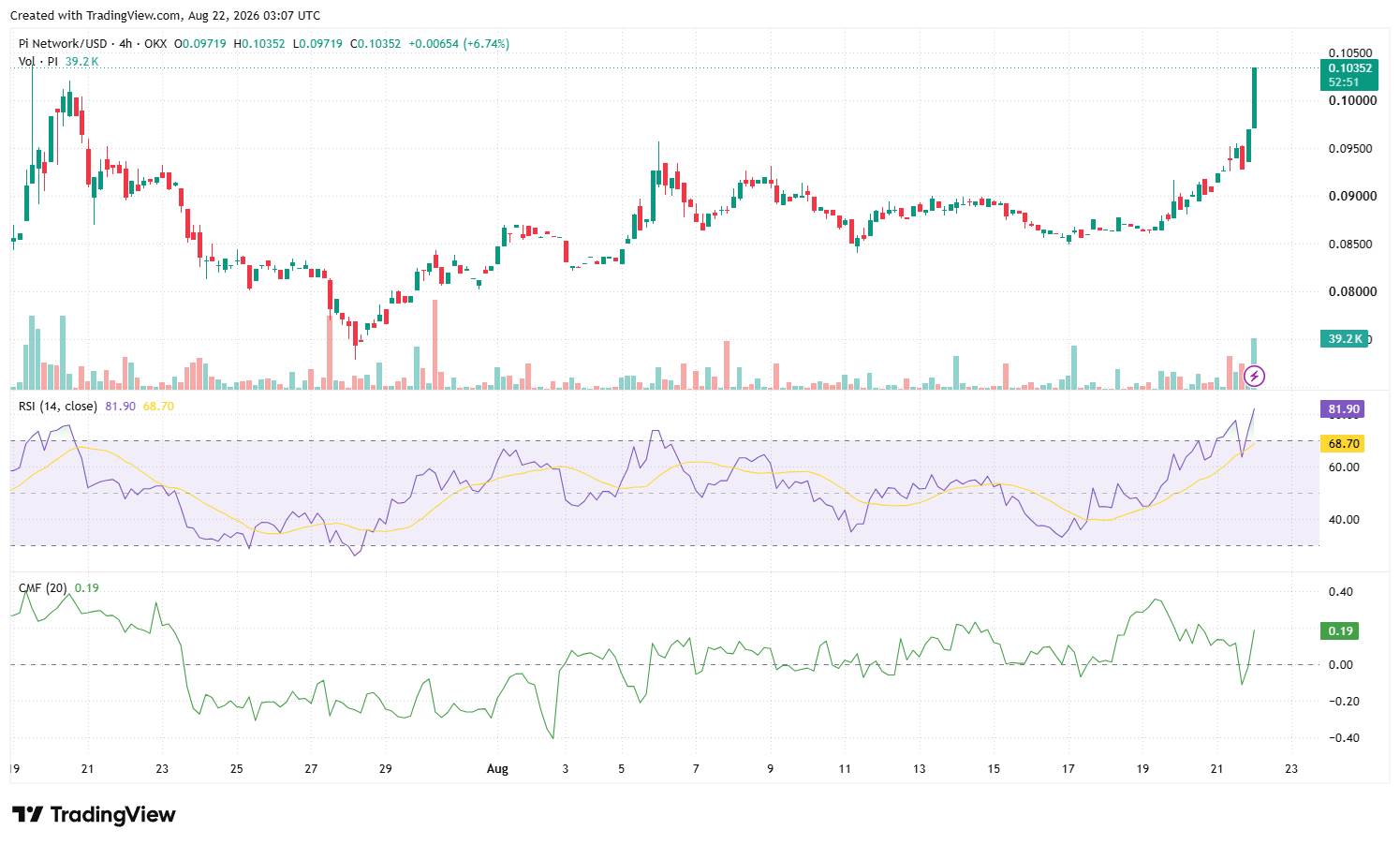
Pi Network prices are trading around US$0.094 after a daily rise of 4%, bringing PI close to the much-watched US$0.10 resistance level. Protocol 27 has entered testnet testing, adding more flexible and secure smart contract authentication capabilities to accounts and applications. The four-hour RSI reached 77.67, while the Chaikin Money Flow remained at 0.16, showing strong momentum while also accompanied by rising risk of a correction. Pi has set the main network upgrade target for September 15, but test results and node readiness may still change the timetable. The price of Pi Network is closer to the US$0.10 threshold after Protocol 27 began testing on the Network Test Network. PI was trading around $0.094 during Friday's market rally and was up about 4% in 24 hours. Bitcoin is close to US$79,500, and the total market value of cryptocurrencies is close to US$2.6 trillion. Protocol 27 will improve smart contract authentication capabilities. Pi plans to upgrade the main network on September 15, and the specific time depends on testing. Traders are currently focusing on the $0.10 mark and the upgrade schedule during the September test period.
Pi Network price tests US$0.10, increasing momentum in the crypto market
Pi Network prices have benefited from a rebound in overall demand for large and small cryptocurrencies. Bitcoin hit a 14-week high, and XRP and other altcoins also rose. Short clearing accelerates market volatility and traders liquidate short positions.
After the Pi main network successfully completed the Protocol 26 upgrade, the Pi test network is upgrading to Protocol 27! Protocol 27 introduces more flexible and secure smart contract authentication capabilities, providing more advanced authorization methods for accounts and applications...
-- Pi Network (@PiCoreTeam) August 21, 2026
After the PI rose approximately 4% in 24 hours, the transaction price was approximately US$0.0939. Subsequent market data showed that tokens fluctuated between US$0.094 and US$0.096. This range puts the Pi Coin price only about 6% short of the much-watched $0.10 level.
Pi Network prices gain momentum, but PI still needs to confirm a breakthrough. A four-hour close above $0.095 would strengthen the reason to test $0.10 again. Repeated blockages below this zone may keep transactions limited to near-term ranges.
The momentum of Pi Network prices shows short-term buyer dominance. The four-hour Relative Strength Index (RSI) reached 81.50, putting the PI into overbought territory. Such a reading could be accompanied by a strong breakthrough, but it also increases the possibility of profit-taking following a rapid rise.
Chaikin Money Flow was 0.16, and capital inflows remained positive. This reading indicates net buying pressure during the measurement period. If the indicator falls below zero and prices fall below nearby support, momentum will weaken.
The first support level is around US$0.09, which has previously limited the rise of tokens. If it continues to fall below this level, US$0.085 may be exposed. The lower boundary of the upward channel sets US$0.08 as the next downward area.
Protocol 27 sets a September 15 target after the test network is launched
Pi Network starts upgrading the test network after the main network completes Protocol 26. The project describes Protocol 27 as the last planned upgrade in the current sequence. Its official announcement sets the main network transition target for September 15.
Protocol 27 introduces a more flexible and secure smart contract authentication feature. This change expands the way accounts and apps approve transactions. Developers can leverage these options to build more advanced authorization rules and transaction flows.
This upgrade follows Protocol 26, which improves contract security, state management, interoperability, and encryption. Together, they aim to keep Pi mainnets in line with the latest protocol features of the network.
Upgrade uses phased testing and then actual deployment. Testnets provide a low-risk environment for identifying compatibility issues, authentication failures, and node issues. Further testing must be carried out before the main network adopts the same code.
Community reports also link Protocol 27 to RPC servers, decentralized exchange capabilities, and automated market maker liquidity pools. Pi's official announcement focuses on certification and does not specify specific applications. Adoption will depend on how developers use the extended control features.
September 15 remains a target date rather than a guaranteed completion date. Test results, node readiness, or technical failures can change the schedule. Pi Network's node page now instructs main network operators to prepare for version 27.
For Pi Network prices, this upgrade creates a clear event that traders can monitor. A breakthrough of US$0.10 would move the PI out of the current range. If we fail to hold US$0.09, the focus will shift to US$0.085 and the channel structure.
The progress of the agreement alone does not determine the price of Pi Coin. Network usage, application activity, exchange liquidity, token supply and broader market direction will also affect demand. The next phase of the testnet will demonstrate whether the new certification system can operate stably before the mainnet is deployed.
























